

How we update posts when Louisiana law changes
Why this policy exists
This website publishes general information about Louisiana personal injury law, insurance claims, and injury-related issues.
Louisiana laws and procedures can change through legislation, court decisions, and rule updates.
Because legal information is a “Your Money or Your Life” (YMYL) category, we maintain editorial standards designed to keep our
content accurate, clear, and trustworthy.
Important disclaimer
The content on this website is provided for general informational purposes only and is not legal advice.
Reading this site does not create an attorney-client relationship.
Deadlines and legal rights depend on the facts of each case, the date of the incident, and which laws apply.
If you need advice about your situation, contact a lawyer directly.
What you’ll see on our posts
Our content cards identify who is credited and when an article was published. A personal attorney-review card also shows the last recorded legal-review date. A firm-prepared card credits Babcock Injury Lawyers without claiming that an individual attorney wrote or legally reviewed that article. An article’s “Sources checked” date records when its cited sources were checked; it is not an attorney-review date.
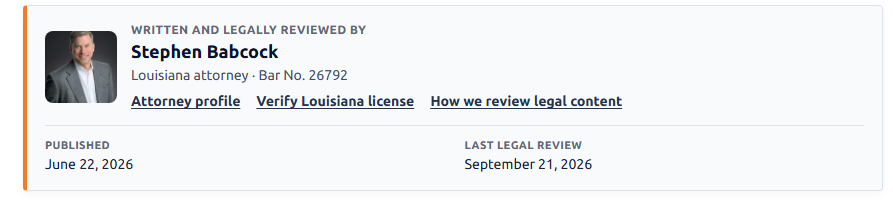
How to read the card
- Written and legally reviewed by: On articles with a documented personal review, names the attorney credited with the article and its legal review. The example card displays Stephen Babcock’s Louisiana Bar No. 26792 so readers can identify him.
- Prepared by Babcock Injury Lawyers: On firm-prepared articles, identifies the firm as the content source without claiming Stephen personally wrote or reviewed that article. The article’s notice gives the actual source-check date.
- Attorney profile: Links to Stephen Babcock’s biography, including his background and practice.
- Verify Louisiana license: Links to the Louisiana State Bar Association membership directory, where readers can look up the attorney. The directory may ask for a word verification before opening.
- How we review legal content: Links to this policy, which explains our sources, legal review, and correction practices.
- Published: The date the article first appeared. It does not, by itself, tell you when its law was last checked.
- Last legal review: On attorney-review cards, the date recorded for the article’s most recent legal review. If it says “Not recorded,” the card has no review date on file. Firm-prepared cards do not display a personal legal-review field; neither publication nor source-check dates substitute for one.
A review date tells you when that review was recorded. It is not a guarantee that the law has not changed since then or that the article answers the facts of your case.
What legal review involves
Depending on the article, we check the legal rules and effective dates that matter to its subject. This may include:
- Checking relevant Louisiana statutes and, when applicable, court decisions against primary sources.
- Checking date-dependent rules such as prescription, comparative fault, wrongful death and survival actions, and insurance issues when the article discusses them.
- Correcting or removing outdated statements and adding citations where they help readers verify a rule.
- Keeping the explanation clear and avoiding promises about case outcomes.
Our editorial standards
Sources we prioritize
When we cite legal authority or key rules, we prefer sources in the following order:
- Primary legal authority
- Louisiana Civil Code, Revised Statutes, Code of Civil Procedure (preferably official Louisiana Legislature pages)
- Published court decisions (Louisiana Supreme Court and Louisiana appellate courts)
- Official government sources (for statistics and public safety data)
- Louisiana agencies and reputable federal sources (e.g., NHTSA, CDC) where relevant
- Reputable professional organizations
- Organizations such as the American Burn Association or IIHS where appropriate to the topic
- Secondary summaries
- Used sparingly and only when consistent with primary authority
Plain-language commitment (without hype)
We aim to explain legal topics clearly without exaggeration. We avoid language that implies:
- a guaranteed result,
- a “typical” settlement value, or
- that hiring a lawyer automatically means a larger recovery.
Every case is fact-specific. Outcomes depend on evidence, fault allocation, damages proof, insurance coverage, and procedure.
Ethics and advertising compliance
We strive to ensure our content and marketing language are consistent with the Louisiana Rules of Professional Conduct,
including the requirement that communications about legal services not be false or misleading or create unjustified expectations.
How we handle changes in Louisiana law
What triggers an update
We may update a post when we identify changes affecting its accuracy, including:
- New or amended Louisiana statutes (including changes with specific effective dates)
- Louisiana Supreme Court or appellate decisions that materially change how a claim is analyzed
- Changes in procedural rules or agency processes that affect claims handling
- Clarifications to commonly misunderstood issues (e.g., prescription transitions, comparative fault thresholds)
Topics we treat as “high update priority”
Some concepts are deadline-driven or frequently misunderstood. We prioritize review of pages discussing:
- Prescription / deadlines (including transition rules and effective dates)
- Comparative fault and how fault impacts recovery
- Wrongful death and survival actions (who can sue, timing, categories of damages)
- Medical malpractice timing and procedural requirements
- Government defendant claims and special rules/notice requirements
- Workers’ compensation vs. third-party claims (especially in industrial/oilfield contexts)
How often we review older posts
Not every post is reviewed on a fixed schedule. We give greater attention to posts that discuss deadlines or fault rules, receive substantial reader traffic, cover changing law, or answer time-sensitive searches.
When a legal review is completed and recorded, the card’s Last legal review date should reflect that review. The Published date remains the original publication date. A formatting change alone does not establish a new legal review.
Correction policy (errors or outdated information)
If we discover that a post contains a material legal inaccuracy or could mislead readers because the law has changed, we may:
- Update language for accuracy and clarity
- Add or refresh a statute/case citation
- Add date-specific qualifiers (for example: “for incidents on/after [date]…”)
- Remove a statement if it cannot be supported
- Add an update note describing the nature of a major legal change (when appropriate)
Reporting a possible issue
If you believe something on our website is outdated or incorrect, please let us know. You can contact us by phone or through our website.
When possible, please include:
- the page URL,
- the sentence you believe is incorrect, and
- (if available) the statute, case, or official source you believe controls.
Medical content and injury information
Some pages discuss injury symptoms, treatment, or recovery timelines. These sections are intended to help readers understand common issues
that arise in injury claims, but they are not medical advice. When we publish medical-related information, we strive to:
- Use careful, non-prescriptive language (“may,” “can,” “often”)
- Cite reputable sources when making factual/statistical claims
- Encourage readers to seek medical evaluation for symptoms and follow their provider’s guidance
Who reviews our content
When an article has a Written and legally reviewed by card, the named attorney is credited with the article’s legal content and an actual personal review. Other articles may be prepared by Babcock Injury Lawyers with research and production assistance, and they carry a firm credit without asserting an individual attorney review. A Last legal review date is shown only where that review was recorded. A source-check date describes a separate editorial check.