

A January 29, 2026 crash at the North Hoover Road and Sisters Road traffic circle killed 30-year-old Maricia Casnave of Lacombe and injured four other passengers, according to the Tangipahoa Parish Sheriff’s Office. The agency’s current release says the Toyota Camry left the roundabout, entered a business yard, and struck a tree.
The same official page now includes a later update. TPSO reported on July 27 that investigators identified Patrick Amos as the driver and arrested him after laboratory testing confirmed impairment. He was booked on several charges, including vehicular homicide and driving while intoxicated. Those are allegations. An arrest and bond do not establish guilt, and the criminal case is separate from any civil claim.
What TPSO currently reports
Tangipahoa Parish deputies were notified shortly after 7 p.m. on Thursday, January 29. TPSO said a 2011 Toyota Camry was traveling south on North Hoover Road and entered the roundabout at Sisters Road at a high rate of speed. The vehicle lost control, left the roadway, entered the yard of a business, and struck a tree.
Scroll horizontally to see all columns. Use the arrow keys when the table is focused.
| Point | Current TPSO account |
|---|---|
| Time and place | Shortly after 7 p.m. on January 29, 2026, at the North Hoover Road and Sisters Road traffic circle in the Hammond area. |
| Vehicle | A 2011 Toyota Camry. |
| Reported movement | The Camry traveled south on North Hoover Road, entered the roundabout at a high rate of speed, lost control, entered a business yard, and hit a tree. |
| Person killed | Front-seat passenger Maricia Casnave, 30, of Lacombe. |
| Other occupants | Four additional people, including a juvenile, were hospitalized with injuries. |
| Restraints | TPSO reported that Casnave and the four other occupants were unrestrained. |
| Driver update | TPSO later reported that Patrick Amos, 26, of Covington was the driver. |
| Criminal update | TPSO reported an arrest after laboratory testing confirmed impairment and listed six booked charges. |
The original February 5 portion of the release said two of the four injured occupants remained hospitalized that day. It did not provide later medical updates. The current page does not give the occupants’ names, describe each injury, or publish the laboratory results.
What changed after the first release
When TPSO first published the case on February 5, the agency said the investigation was continuing and possible criminal charges were pending. The later update says investigators determined Amos was driving, laboratory testing confirmed impairment, and a warrant was issued.
TPSO reported that Amos was booked on one count each of vehicular homicide, first-degree vehicular negligent injuring, reckless operation of a vehicle, driving while intoxicated, driving under suspension, and a child-restraint violation. The agency said he remained in the Tangipahoa Parish Jail on a $211,000 bond when the update was published.
That update is important, but it has limits. Booking language is not a conviction. The prosecution must prove any criminal charge through the criminal process, and the accused retains the presumption of innocence. A civil case uses different claims, burdens, parties, and damages. Evidence may overlap, but a criminal allegation does not by itself decide civil liability or insurance coverage.
Evidence that may explain the crash
The Sheriff’s Office release supplies a basic sequence. A complete reconstruction may require records that are not included on the public page.
Scroll horizontally to see all columns. Use the arrow keys when the table is focused.
| Evidence | Question it may answer | Preservation concern |
|---|---|---|
| Crash report, diagram, and scene measurements | Approach path, lane position, point of departure, and distance to the tree. | Request the investigating agency’s records and any supplements. |
| Business and roadway video | Entry speed, lane use, braking, lighting, and the vehicle’s movement through the traffic circle. | Many systems overwrite recordings quickly. |
| Vehicle inspection and electronic data | Speed, braking, throttle, steering, restraints, and mechanical condition, depending on available systems. | Repair, salvage, or transfer can alter the evidence. |
| Laboratory and medical records | The reported impairment finding and the nature of each occupant’s injuries. | These records are not all public and may require proper authorization or legal process. |
| Witness accounts | How the Camry approached, what happened inside the vehicle, and what responders observed. | Contact information and memory can deteriorate over time. |
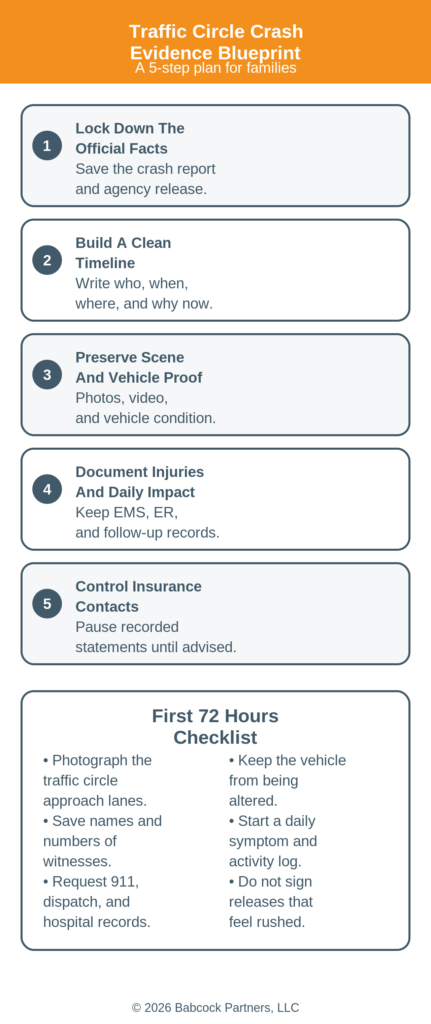
The infographic remains useful as a quick reference, but not every item will exist in every case. The investigation should start with the official file and the condition of the Camry, then identify video and witnesses that can independently test the reported sequence.
Why passenger claims require a separate analysis
A passenger ordinarily is not responsible for steering, speed, or the driver’s path through a roundabout. The civil analysis may instead focus on the driver’s conduct, the vehicle owner, insurance policies, and any other person or condition supported by evidence.
TPSO reported that none of the five passengers was restrained. That fact may lead an insurer to argue that a seat belt affected a particular injury. It does not answer who caused the crash. Any restraint argument should be tied to medical and reconstruction evidence showing whether and how nonuse caused or worsened a specific injury. It should not be treated as a substitute for analyzing why the Camry left the roadway.
Four injured passengers also may be making claims against limited liability coverage. Policy limits, the number of claimants, medical liens, and other coverage can affect how a case is handled. Depending on the policy language and valid selection forms, uninsured or underinsured motorist coverage available to an occupant or resident relative may also require review.
Our Hammond car accident practice page explains the records and insurance issues that matter in local crash claims. The article about Louisiana passenger uninsured-motorist policy priority discusses one part of the coverage sequence, but the actual policy wording controls.
Louisiana claims after a fatal crash
If competent evidence establishes that another person’s fault caused a death, Louisiana may recognize a survival action under Civil Code article 2315.1 and a wrongful death action under article 2315.2. They are related but not interchangeable.
- A survival action concerns damages the person could have pursued between injury and death.
- A wrongful death action concerns losses suffered by the eligible beneficiaries because of the death.
- Both statutes identify an order of people who may bring the claim.
- The current statutes contain timing rules tied to the date of injury and the date of death.
The firm’s Louisiana wrongful death and survival practice page provides a fuller overview. A separate guide explains the difference between survival and wrongful death claims.
Louisiana Civil Code article 3493.1 generally provides a two-year prescriptive period for delictual actions arising from injuries sustained on or after July 1, 2024. Articles 2315.1 and 2315.2 contain their own language for survival and wrongful death claims. Other defendants and claim types can involve shorter notice or filing requirements. A family should confirm the deadline for the actual facts rather than treating a general rule as a universal answer.
Comparative fault can also affect civil recovery. For a crash in 2026, article 2323 generally bars a claimant found 51 percent or more at fault and reduces damages proportionally when the claimant’s share is below 51 percent. Because Casnave was reported as a passenger, any attempt to assign her fault would require evidence supporting a legal and factual basis. Restraint nonuse and crash causation are distinct questions.
What families can preserve now
- Keep the crash-report number, detective contact information, and every later supplement or notice.
- Preserve photographs, messages, location data, and contact information for people who witnessed the crash or stopped to help.
- Do not authorize disposal or material alteration of the Camry before its condition and available electronic data are considered.
- Collect policies for the Camry and every potentially insured injured occupant or household.
- Maintain separate medical, wage, funeral, and out-of-pocket records for each person.
- Do not assume the criminal file will automatically preserve or provide every record needed for a civil claim.
Babcock Injury Lawyers represents Louisiana families in serious and fatal crash matters. A review can focus on the current law-enforcement record, preservation needs, available insurance, family authority, and deadlines. We do not promise a result, and we do not treat an arrest as proof of guilt.
If your family needs help after a Hammond-area crash, call (225) 500-5000 or use the firm’s contact form. The initial consultation is free.
Legal disclaimer: This article provides general information, not legal advice. It does not create an attorney-client relationship. Criminal allegations remain allegations unless proved in court, and every civil claim depends on its evidence, parties, policies, and governing law.
Sources
- Tangipahoa Parish Sheriff’s Office, One Dead, Several Injured in Hammond-Area Crash, original release February 5, 2026, with July 27, 2026 update.
- Louisiana Civil Code article 2315.1, survival action.
- Louisiana Civil Code article 2315.2, wrongful death action.
- Louisiana Civil Code article 3493.1, prescription for delictual actions.
- Louisiana Civil Code article 2323, comparative fault.
Editorial & Legal Accuracy Notice (Louisiana)
This article distinguishes the Sheriff’s Office’s original February release from its later arrest update. The listed criminal charges are accusations, not findings of guilt. Civil liability and insurance coverage require their own analysis.
Sources checked: September 28, 2026.