

Louisiana’s 2026 truck-enforcement audit documents a decline in trucks weighed and violations identified by DOTD’s stationary program. It also explains why a truck passing a weigh station is not necessarily breaking the law, and why an enforcement statistic cannot establish the cause of an individual crash.
This guide brings the audit’s station information, annual figures, and observation limits together with Louisiana’s enforcement statutes. It includes calculations from the published tables so readers can distinguish the number of enforcement encounters from the number of violations identified.
What the audit examined
The Louisiana Legislative Auditor issued Size and Weight Enforcement on State and Federal Highways, audit control 40250016, on August 5, 2026. It examined DOTD’s and Louisiana State Police’s programs for fiscal years 2023 through 2025, with some later observations and information from 2026.
The report separates DOTD’s stationary program from LSP’s mobile program. Their figures should not be combined casually: some LSP activity measures use federal fiscal years, while other measures use state fiscal years. The tables below focus on DOTD’s stationary program and preserve the report’s stated periods.
Fewer trucks weighed and fewer violations identified
Scroll horizontally to see all columns. Use the arrow keys when the table is focused.
| Measure | FY2023 | FY2024 | FY2025 |
|---|---|---|---|
| Trucks weighed | 1,145,868 | 1,149,045 | 995,035 |
| Violations identified | 8,678 | 5,773 | 4,303 |
| Identified violations per 1,000 weighings* | 7.57 | 5.02 | 4.32 |
| Penalties deposited into the Transportation Trust Fund | $853,647 | $685,221 | $527,914 |
*Babcock Injury Lawyers calculation: identified violations divided by trucks weighed, multiplied by 1,000. Rounded to two decimals. These are violations per weighing, not the percentage of unique trucks that were overweight.
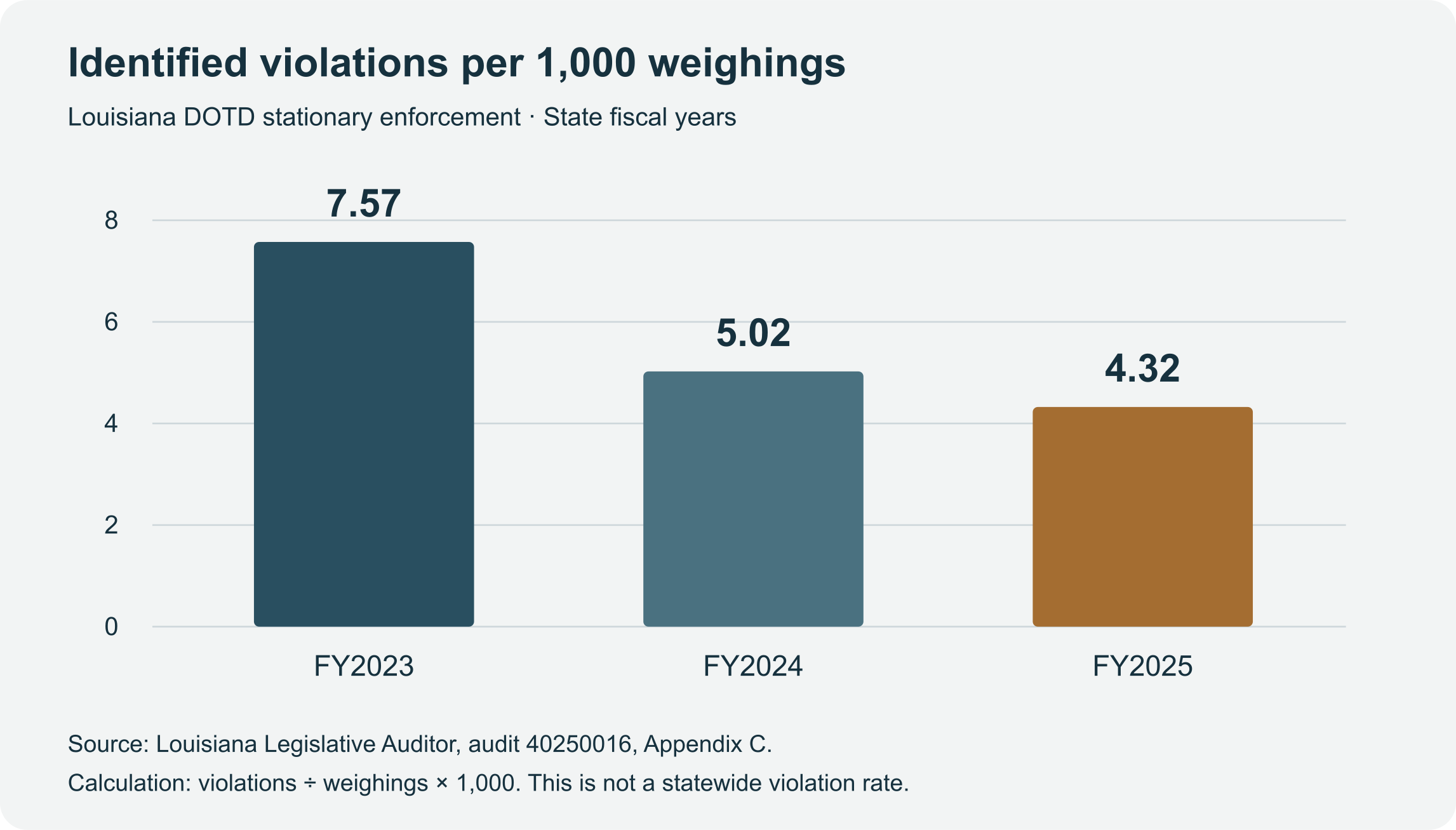
Between FY2023 and FY2025, trucks weighed fell by approximately 13.2%, while identified violations fell by approximately 50.4%. The calculated number of identified violations per 1,000 weighings fell by approximately 42.9%. That last measure accounts for the change in weighing volume, but it does not explain the cause of the decline.
A different mix of trucks, bypass behavior, station availability, enforcement practices, or recording issues can affect the figures. The audit discusses data and operational limitations. A decline in identified violations cannot, on its own, demonstrate that trucks became more compliant.
The monetary measures also need careful labels. Exhibit 3 reports FY2025 penalties issued of $801,974, penalties collected of $492,327, and Transportation Trust Fund deposits of $527,914. Those are distinct measures. Treating the deposit figure as the amount collected on that year’s issued penalties would conflate categories.
Station status reported in the 2026 audit
The audit’s Exhibit 2 maps open and closed stations as of March 2026. Its narrative reports 10 operational stations and seven closed or non-operational stations as of April 2026. The table below transcribes the map’s location groupings; it is not a live operational directory.
Scroll horizontally to see all columns. Use the arrow keys when the table is focused.
| Location shown in the audit | Status shown |
|---|---|
| Baptist | Both directions open. |
| Breaux Bridge | Both directions open. |
| Delta | Both directions open. |
| Greenwood | Eastbound open; westbound closed. |
| Kentwood | Both directions closed. |
| LaPlace, I-10 | Both directions open. |
| LaPlace, Airline Highway | Both directions closed. |
| Starks | Open; the map identifies one station at this location. |
| Toomey | Both directions closed. |
Historical activity and later operational status answer different questions. For example, Appendix C records Kentwood weighings during FY2023–FY2025, while the March 2026 map marks the location closed. That is a reason to preserve dates, not to erase one of the records. The report also distinguishes a station’s operational condition from its daily opening hours.
When bypassing a station is lawful, and when it is not
R.S. 32:388(A) establishes a stopping requirement for covered commercial vehicles and identifies exceptions, including specified passenger and recreational vehicles. It also addresses penalties and the feasibility of stopping in light of traffic and safety conditions.
The audit describes weigh-in-motion screening that can authorize some trucks to continue past a station. It identifies illegal bypassing when a covered truck avoids the required screening lane or disregards an instruction to enter. Consequently, a photograph of a truck continuing along the interstate does not necessarily prove a bypass violation.
The statute provides different bypass penalties according to the vehicle’s gross vehicle weight rating: $100 below 26,000 pounds and $500 at or above that threshold. That rating-based distinction should not be confused with a measurement showing how much cargo the truck carried during a particular trip.
What the auditors actually observed
Exhibit 5 reports 4,703 estimated truck observations and 733 estimated illegal bypasses across six directional stations at Baptist, Breaux Bridge, and Delta. The resulting 15.6% describes those observations.
Scroll horizontally to see all columns. Use the arrow keys when the table is focused.
| Station | Estimated trucks counted | Estimated illegal bypasses | Observation length |
|---|---|---|---|
| Baptist eastbound | 909 | 84 | 2 hours |
| Baptist westbound | 914 | 124 | 2 hours |
| Breaux Bridge eastbound | 823 | 170 | 2 hours |
| Breaux Bridge westbound | 961 | 175 | 2 hours |
| Delta eastbound | 629 | 82 | 1.5 hours |
| Delta westbound | 467 | 98 | 1.5 hours |
| Total | 4,703 | 733 | Selected observation periods |
The report notes limited visibility at Delta eastbound. It also says auditors could not accurately count some trucks that underwent screening but then failed to enter when instructed. LaPlace observations were excluded from this analysis after a crash disrupted traffic. These details limit any attempt to extend the observed rate to all Louisiana truck traffic or a full year.
An illegally bypassing truck is not necessarily overweight. The observation establishes a screening or stopping issue; a weight violation requires additional facts.
Weight limits, permits, and stopping requirements are different inquiries
A truck can raise more than one compliance question. The relevant rules may concern total weight, weight on an axle group, vehicle dimensions, permit conditions, the authorized route, or a stopping instruction. Compliance with one requirement does not establish compliance with all of them.
R.S. 32:389 provides enforcement authority involving inspections, measurements, scales, and permit conditions. The necessary investigation should identify the vehicle, its actual configuration and load, the route, any permit, and the conditions at the relevant time. The fact that a truck is large or has a permit does not by itself establish a violation.
What the agencies said they would change
DOTD’s response described work on enforcement procedures and planned mobile-scale use by October 1, 2026. The report also records a bypass-enforcement pilot: from May 26 through July 16, 2026, DOTD reported 130 violations and $55,500 in assessed penalties over 33 days at four stations. Those are reported pilot results, not a statewide annual total.
LSP disputed the audit’s characterization of agency coordination and explained that it already coordinated when appropriate. It also cautioned against relying solely on traffic volume and pavement condition to direct enforcement. Both the findings and the agencies’ responses belong in a fair account of the report.
The implementation dates described in the response are commitments made during the audit process. The sources reviewed for this article did not independently confirm completion of the October 1 mobile-scale rollout. Readers should not treat the scheduled date as proof that the change occurred.
How this information can inform an individual crash investigation
The audit supplies statewide program context. A particular injury claim still requires evidence about the truck and collision involved. Useful records can include scale tickets, permits, load manifests, bills of lading, dispatch and route records, inspection reports, vehicle-condition evidence, video, and available electronic records.
Those materials can answer whether a relevant requirement was violated and whether that violation contributed to the crash or claimed injury. Statewide enforcement totals cannot answer those questions for an individual carrier or driver.
Sources and calculations
The station and enforcement figures come from Exhibits 2, 3 and 5 and Appendix C of the Louisiana Legislative Auditor’s report. Violations per 1,000 weighings are calculated by dividing violations by weighings and multiplying by 1,000. Percentage changes compare the later figure with the earlier figure; calculations use unrounded values.
Download the supporting data package: station activity, field observations, calculations, and source notes. No activity is estimated for periods when a station was closed. The figures describe the auditor’s findings and the agency records summarized in that report.
Research date: October 16, 2026. Audit issue date: August 5, 2026. Operational-status and observation dates are identified separately above. Babcock Injury Lawyers prepared the explanatory analysis; the Louisiana Legislative Auditor produced the underlying audit.
Related Louisiana guidance. Weight records should be considered alongside the driver and carrier files. Our CDL verification guide identifies those records, and our Louisiana truck-accident guide explains the broader investigation. Browse the full Louisiana Legal Research collection for additional topics.