

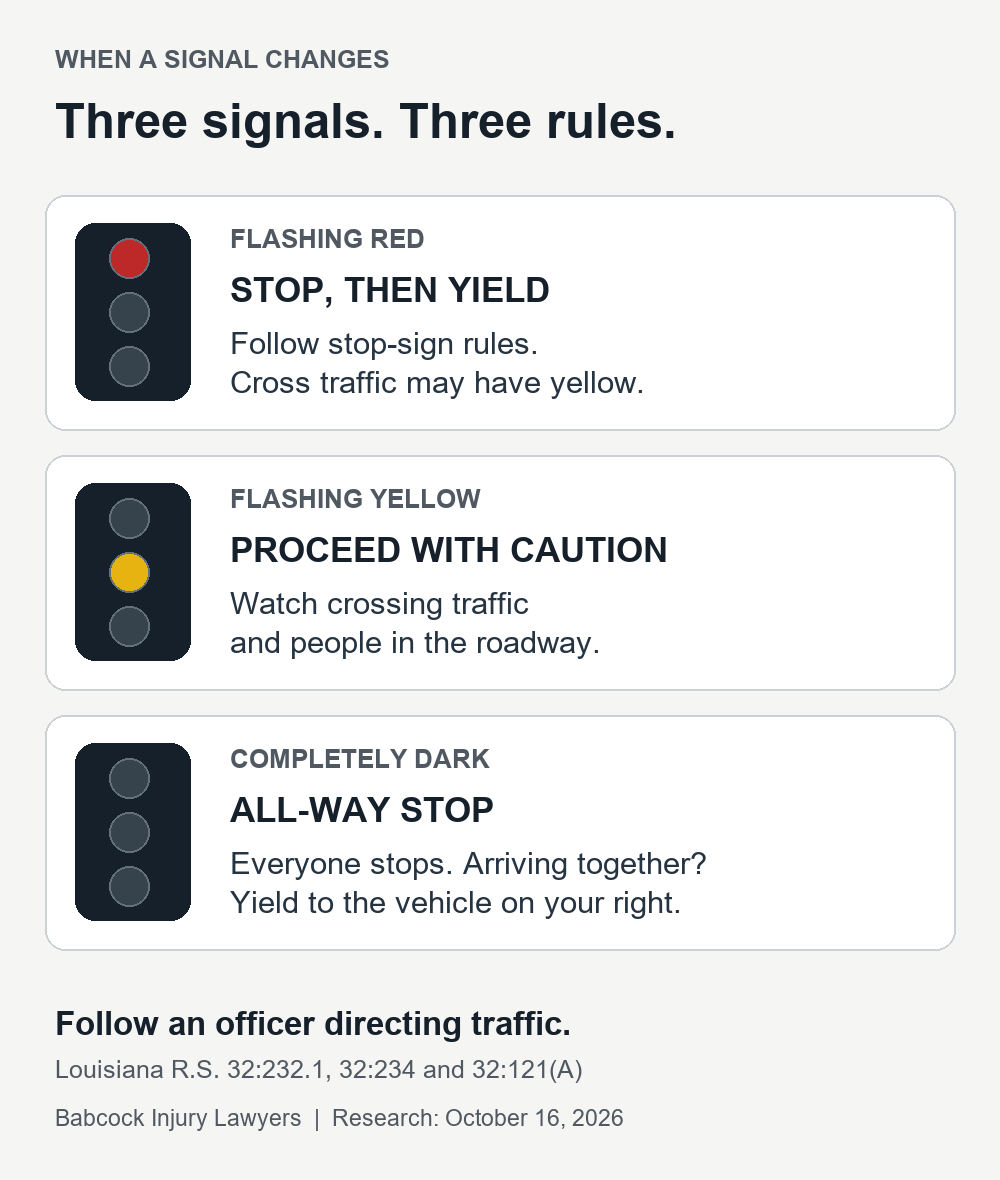
A traffic light that is flashing is not necessarily governed by the same rule as a signal that has gone completely dark. Louisiana distinguishes three situations: flashing red means stop; flashing yellow means proceed only with caution; a completely dark, nonfunctioning signal at an intersection makes the intersection an all-way stop. An officer directing traffic can change what drivers should do.
The distinction matters during rain, power failures, and equipment problems. Look at the indication facing your lane and the intersection around you. Do not assume that cross traffic sees the same signal you do.
The three-signal quick reference
Scroll horizontally to see all columns. Use the arrow keys when the table is focused.
| What you encounter | Louisiana rule | The mistake to avoid |
|---|---|---|
| Flashing circular red | Stop before entering the crosswalk or at the marked limit line; if neither exists, stop before the intersection. Then follow the rules for proceeding from a stop sign. | Stopping does not automatically give you the next turn if cross traffic has a flashing yellow signal. |
| Flashing circular yellow or amber | Proceed through or past the signal only with caution. Slow enough to observe and respond to vehicles and people in the intersection. | Do not assume everyone must stop, or that caution means an unconditional right to enter. |
| The intersection’s traffic-control signal is nonfunctioning and completely dark | Treat the intersection as an all-way stop. The statute incorporates the rule that, when vehicles approach or enter from different highways at approximately the same time, the driver on the left yields to the driver on the right. | A dark signal does not mean the main road has an automatic green light. |
| A law enforcement officer is directing traffic | Follow the officer’s directions rather than substituting the default malfunction rule. | Do not disregard the officer because the signal would otherwise tell you something different. |
The controlling provisions are R.S. 32:232.1, R.S. 32:234 and R.S. 32:121(A). The same legal response can apply whether a signal is deliberately placed in flash mode or flashes because of a malfunction; the displayed indication matters.
Three intersection examples
Example 1: Red for you, yellow for the crossing road. You stop at a flashing red light. A vehicle approaches on the crossing road under a flashing yellow. Your stop does not convert the intersection into an all-way stop. Assess the approaching traffic and proceed only when the stop-sign rules allow it. The other driver still must exercise caution.
Example 2: Every signal is dark after a power failure. You and a driver to your right arrive at approximately the same time from different roads. Both must stop; the incorporated right-of-way rule requires the driver on the left to yield. Do not enter merely because the other driver hesitates or another motorist waves you through. Check for traffic already moving and people crossing.
Example 3: The light changes while traffic is queued. A signal that was dark begins flashing as you approach. Watch the actual indication and any officer’s directions. A photograph taken several minutes later may not establish what either driver saw at the moment of a collision.
A flashing yellow arrow is a separate instruction
A flashing yellow left-turn arrow permits a cautious turn in the indicated direction; it is not a protected green arrow. R.S. 32:232(4) requires a driver turning left or making a left U-turn to yield to approaching vehicles from the opposite direction, pedestrians lawfully in the associated crosswalk, and vehicles lawfully in the intersection.
A steady yellow light is different again: it warns that the green movement is ending or red is about to appear. Do not apply the flashing-yellow rule to a steady yellow signal. Nor should this three-signal guide be used for railroad warning lights; R.S. 32:234 expressly places railroad grade crossings under separate provisions.
How to report a broken signal in New Orleans
The City of New Orleans reporting page directs people to report fallen or malfunctioning signals that threaten health and safety to 911. It also provides 311 and the online NOLA 311 service as reporting routes. A 311 report records the nearest address, receives a ticket number, and is routed to Public Works for assessment.
- Make the report from a safe place. Describe the intersection, direction of travel and whether the indication is dark, flashing red, flashing yellow, or changing unpredictably.
- Identify a fallen signal, exposed equipment, blocked lane, collision, or immediate danger. Use emergency services when emergency assistance is needed.
- Keep the service-request number and reporting time. A submitted or closed service request does not, by itself, establish what was wrong or when a repair was completed.
What to preserve after a collision at a malfunctioning signal
Scroll horizontally to see all columns. Use the arrow keys when the table is focused.
| Record | Why it can help |
|---|---|
| Original video, including the lead-up and aftermath | May show the signal facing each approach, the vehicles’ movements and a change in signal operation. Preserve the original file rather than only a short edited clip. |
| Intersection, lane, travel direction and exact time | Connects the event to the correct signal head and narrows a request for dispatch, maintenance or controller records. |
| Witness names and independent accounts | Helps distinguish what each person actually observed from assumptions about what opposing traffic saw. |
| Police report, incident number and officer information | Identifies the investigation and any traffic direction or temporary controls. |
| 311 records, work orders and relevant maintenance records | May help establish notice, inspections and repairs, but require interpretation alongside the crash evidence. |
A malfunction does not automatically establish that the city, the state, a maintenance contractor, or another driver owes damages. Responsibility depends on the relevant duties, the condition of the signal, notice where required, what each driver did, and causation. Preserve evidence before drawing a conclusion about who was at fault.
Sources and research date
- Inoperative intersection signals — R.S. 32:232.1
- Flashing signals and railroad exception — R.S. 32:234
- Simultaneous arrival — R.S. 32:121(A)
- Steady signals and flashing yellow arrows — R.S. 32:232
- City of New Orleans: Report a Broken Traffic Light
Research current through October 16, 2026. Examples are fictional and illustrate the cited rules. This guide provides general information; a particular collision, policy, or enforcement notice requires review of its own facts and documents.
Related Louisiana guidance. For other rules that can affect an intersection collision, see our guide to Louisiana’s hands-free driving law. Our Louisiana car-accident guide explains the broader questions of fault, evidence, and insurance. Browse the full Louisiana Legal Research collection for additional topics.