


This guide explains how liability is analyzed after a Louisiana school bus accident and what evidence to preserve early.
When a school bus crash happens, our first job is to slow the story down and speed the proof up. We are not built for volume. We are built for leverage. Speed + evidence preservation + insurer-insider knowledge + trial-ready preparation = The Babcock Benefit. That leverage matters in school bus accidents because video, route logs, and witness memories can fade within days.
School bus accidents in Louisiana can involve children, multiple vehicles, and more than one insurance layer. For the broader bus-crash basics, start with our Baton Rouge bus accident page and then use the sections below to spot liability and evidence issues that are unique to school transportation. If the crash happened in Baton Rouge, you can also use the Baton Rouge location hub to find related local resources.
If you are inside the first 72 hours, call (225) 500-5000 or use the free case review form before evidence changes.
Firm links: Client Reviews | Contact | Locations
Who Is Legally Responsible for a School Bus Accident in Louisiana?
In Louisiana, school bus accident liability starts with the general negligence rule in La. Civ. Code art. 2315, which focuses on duty, breach, and causation. When more than one party played a role, La. Civ. Code art. 2323 allows fault to be apportioned among involved people and entities.
- Bus driver: driving decisions, loading practices, and attention
- School board or school system: policies, supervision, training, and maintenance oversight
- Private contractor: dispatch, hiring, training, and insurance coverage
- Another driver: rear-end crashes, illegal passing, or failure to yield
- Product or maintenance chain: defective parts or negligent repairs
Responsibility can also shift depending on where the crash occurred, what the bus was doing, and whether the student was inside the bus or loading nearby. Because school bus accidents often involve children, families should also review how child-specific injuries are handled on our child injury page so expectations about documentation are realistic.
If a driver passed a stopped bus, the statute on overtaking and passing a school bus, La. R.S. 32:80, becomes a key starting point for the liability story. That is also why we look for stop-arm camera video and signal timing early, because those records can pin down what other motorists could see.
What Makes School Bus Crash Liability Different From a Regular Car Wreck?
School bus accident cases often involve more documentation, more potential defendants, and different operational rules than a routine car crash. NHTSA’s school bus safety overview explains that school buses are built around compartmentalization and specialized safety design, which can change how injuries and causation are argued.
- Data sources: bus cameras, GPS, dispatch logs, and route schedules
- Operational context: loading zones, stops, and driver procedures
- Entity questions: public school system versus private contractor
- Multiple victims: one incident may affect several students and families
Even when the crash looks simple at first glance, school bus accidents can turn on small details like signal activation, stop location, and whether a student was entering or exiting the bus. This is why we build an early proof plan that targets the bus-specific records and not just the police report.
Could Another Driver Be at Fault in a School Bus Accident?
Yes, another motorist is often a key liability target, especially in rear-end collisions, illegal passing, or crashes near bus stops. The overtaking rules in La. R.S. 32:80 can matter because they address how drivers must respond to school bus warning signals.
| Common Scenario | Evidence That Usually Matters |
|---|---|
| Rear-end collision with a stopped or slowing bus | Bus video, brake/stop timing, witness statements, and vehicle photos |
| Illegal passing near a stop | Stop-arm camera, signal activation timing, and roadway sight lines |
| Intersection crash while bus turns | Route plan, turn timing, lane position, and scene measurements |
Louisiana comparative fault rules in La. Civ. Code art. 2323 are also the reason insurers often try to push blame onto a bus driver, a parent, or even a student’s actions. That is what we mean by leverage in these cases: we focus on objective records so the fault split is not based on assumptions.
What Duties Do School Bus Drivers and School Systems Owe?
School bus drivers and school systems generally have duties to operate the bus safely, follow loading procedures, and respond reasonably to foreseeable risks. The general negligence framework in La. Civ. Code art. 2315 is the foundation, and school-bus-specific roadway duties can be informed by statutes like La. R.S. 32:80 when warning signals and traffic behavior are in dispute.
- Driving: speed, attention, lane control, and safe stopping distance
- Loading: choosing a safe stop location and using signals consistently
- Supervision: reasonable steps to reduce foreseeable loading-zone hazards
- Maintenance: keeping brakes, lights, and safety systems in working order
In practice, duty questions often turn into documentation questions: what policies existed, what training occurred, and what the driver actually did that day. This is why we try to preserve the driver file, route paperwork, and camera footage quickly, because those documents may not be kept forever.
Can a Private Bus Company or Contractor Be Responsible?
Yes, many Louisiana school transportation systems use contractors, and liability can follow the company that controlled hiring, training, dispatch, and maintenance. The same negligence framework in La. Civ. Code art. 2315 applies, but the evidence focus changes to contracts, insurance policies, and who had operational control.
- Hiring and training: driver screening, route training, and supervision
- Dispatch decisions: scheduling pressure, route changes, and time windows
- Maintenance systems: inspections, repairs, and documented defects
- Insurance layers: commercial auto, excess coverage, and contract requirements
Talk to a lawyer quickly if you hear that video is “routinely overwritten,” if the operator name is unclear, or if multiple vehicles were involved. This is why we identify the operator and insurer early, because the rules and the coverage path can change based on who ran the route.
When Does a Defect in the Bus or Seat Become a Legal Issue?
A defect becomes a legal issue when a product or component fails and that failure contributes to injury, especially when the bus’s crash protection features are at the center of the dispute. Louisiana’s product-liability framework is addressed in La. R.S. 9:2800.51, and safety standards can also inform what a vehicle was designed to do.
- Seat and restraint issues: seat anchoring, padding, and spacing design
- Door or aisle problems: latch failures, pinch points, or exit obstructions
- Maintenance-related failures: brakes, tires, lights, or steering components
FMVSS 222 in the eCFR is one example of the federal standard that addresses school bus seating and crash protection concepts. If the question becomes “what safety design should have prevented this,” NHTSA’s FMVSS guidance for school buses can help frame what rules applied to the bus type involved.
What Should You Do in the First 72 Hours After a School Bus Accident?
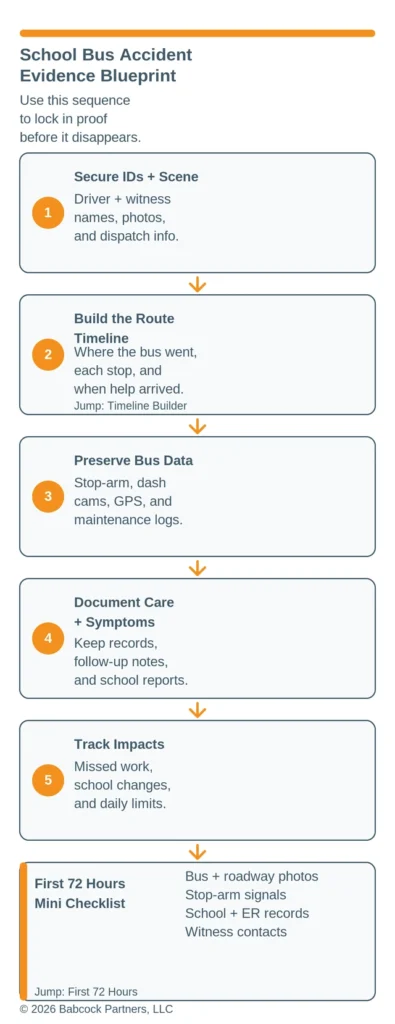
In the first 72 hours, focus on preserving objective proof and creating a clean timeline while memories are still fresh. This is why we push evidence preservation early, because bus video, dispatch logs, and digital records may be overwritten on a retention schedule.
- Write down basics: route number, stop location, time window, and who called 911.
- Collect contacts: driver name, witnesses, and any school staff who responded.
- Preserve visuals: take photos of the stop area, signage, and vehicle damage.
- Track records: keep medical paperwork and any school nurse or absence notes.
- Log impacts: note symptoms, missed work, and school disruptions in plain language.
If a child was involved, keep the documentation child-focused and consistent, and avoid guessing about long-term outcomes. If the incident involved a fatality, families often need to understand the separate concepts in La. Civ. Code art. 2315.2 for wrongful death and La. Civ. Code art. 2315.1 for survival claims.
How Do You Build a Timeline for a School Bus Accident Claim?
A strong school bus accident timeline ties the route sequence to objective records like video, GPS, dispatch logs, and medical check-in times. A simple way to start is to list time windows first and then attach proof sources to each window so missing pieces are obvious.
| Time Window | What To Capture |
|---|---|
| Before the crash | Route plan, prior stops, weather, and any dispatch changes |
| Crash moment | Bus video, GPS location, stop-arm activation, witness names |
| Minutes after | 911 calls, first responder arrival, scene photos, statements |
| Same day | Medical evaluation notes, school nurse notes, missed school or work |
| Next 30 days | Follow-up appointments, symptom tracking, repair and towing documents |
How Do Insurance Companies Defend School Bus Accident Claims?
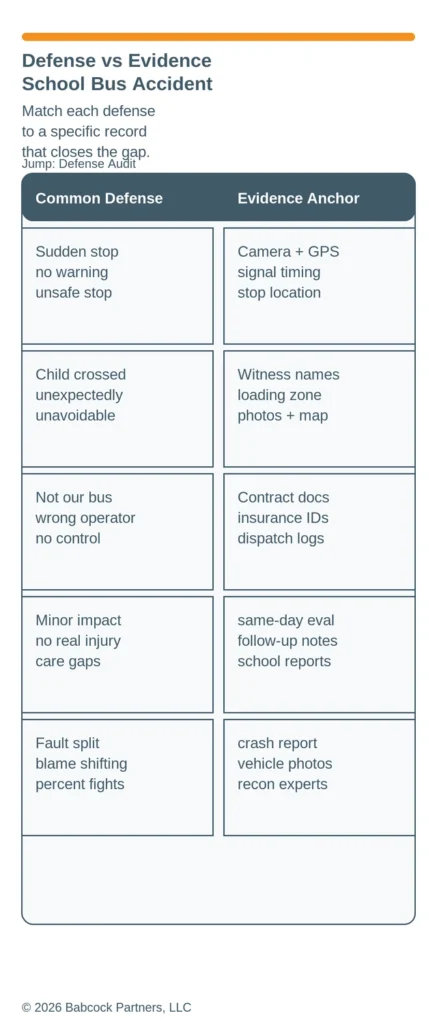
Insurers often defend school bus accident claims by attacking causation, shifting fault, and highlighting documentation gaps. The comparative fault framework in La. Civ. Code art. 2323 is one reason the defense story often focuses on “who contributed” instead of “what happened.”
| Defense Angle We Often See | Evidence Anchor That Helps Answer It |
|---|---|
| “Sudden stop” or “no warning” | Camera footage, GPS timing, stop location, and signal activation data |
| “Child crossed unexpectedly” | Witness list, loading-zone photos, and route/stop documentation |
| “Wrong operator” or “not our bus” | Contract documents, insurance identifiers, dispatch logs, and driver file |
| “Minor impact, no injury” | Consistent medical documentation, school records, and symptom timeline |
| “Fault split among parties” | Crash report, vehicle photos, measurements, and reconstruction analysis |
That is what we mean by leverage against insurer tactics: we match each defense angle to a specific record that can be verified. When the proof is organized early, it is harder for an insurer to turn uncertainty into a denial.
What we see in practice
What we see in practice is that school bus accidents become evidence disputes faster than families expect. The case often turns on whether objective records were preserved before the “official story” hardened.
- Video is fragile: camera systems may overwrite files unless preservation happens early
- Operator identity matters: public system versus contractor changes how coverage and procedures work
- Documentation gaps get weaponized: missing school notes or delayed care becomes a defense theme
- Fault gets spread: insurers may blame the bus, another driver, and the family at the same time
We also see that families often have the proof they need, but it is scattered across phones, school emails, and medical portals. The practical goal is not volume; it is clarity, and clarity comes from building one timeline that everyone can agree on.
What Damages Can Be Claimed After a School Bus Accident?
Damages in a school bus accident case depend on the injuries, the proof, and who is legally responsible. The general damages framework comes from Louisiana tort principles like La. Civ. Code art. 2315, and different rules can apply if the claim involves death.
- Medical and related expenses: bills, therapy, and out-of-pocket costs
- Work and earning impacts: missed work and job limitations for parents or adult victims
- Pain and daily function limits: documented changes in sleep, focus, mobility, or school performance
- Property losses: vehicle damage, car seats, and personal items when relevant
If a fatality occurred, La. Civ. Code art. 2315.2 addresses wrongful death claims and La. Civ. Code art. 2315.1 addresses survival claims. For families looking for a focused overview, our wrongful death page explains adjacent issues so this post can stay narrow on school bus liability.
How Do Claims Involving School Boards or Public Entities Work?
When a school board or other public entity is involved, special statutes can affect procedure and limitations. Louisiana’s Governmental Claims framework begins in La. R.S. 13:5101, and related provisions like La. R.S. 13:5106 show how public-entity litigation can differ from private-party claims.
- Step one: confirm who owned and operated the bus that day
- Step two: identify the correct entity name and insurance layers
- Step three: preserve records and confirm the correct court path
Louisiana Law Snapshot (Updated 2026)
The Louisiana Legislature’s text for La. Civ. Code art. 3493.1 sets a two-year delictual prescription for many personal injury claims, which means deadlines can arrive faster than families expect. Because prescription questions can be fact-specific, it is safer to treat the deadline as an evidence-and-filing clock, not a date to negotiate around.
La. Civ. Code art. 2323 explains Louisiana comparative fault, where responsibility may be divided by percentage. The same statute notes an effective Jan. 1, 2026 update, and under that updated rule a plaintiff who is 51% or more at fault may be barred from recovery.
Talk to a Louisiana Lawyer About a School Bus Accident
If you are dealing with school bus accidents, early facts can get rewritten by paperwork and assumptions. We are not built for volume. We are built for leverage. The Babcock Benefit is our shorthand for moving fast on proof, anticipating insurer angles, and preparing a case like it may be tried.
Call (225) 500-5000 and use the free case review form so we can triage evidence and deadlines while records are still available. If you want a quick overview of our broader approach, review our bus accident practice page as well.
These items are helpful to have with you when you call, but do not delay calling because you do not have them. If you have them handy, keep them nearby for the call.
- Crash report number or the investigating agency
- Photos or videos of the scene and vehicles
- Names of witnesses and any school contacts
- Medical paperwork and school nurse notes
- A short written timeline in your own words
Call Today If…
- The school mentions video retention limits or you suspect camera overwrite
- A child was hit while loading or unloading near a stop
- The operator is unclear or a contractor was involved
- Multiple vehicles or a commercial driver were involved
- You are being pushed to give a recorded statement or sign a release
What Happens Next
- Evidence triage: we identify the key records and send preservation requests for video, GPS, and logs.
- Deadline spotting: we map the timelines that matter and flag early filing risks.
- Insurer contact strategy: we control the narrative with documents, not guesses, and avoid preventable traps.