Editorial & Legal Accuracy Notice (Louisiana)
This blog contains general legal and safety information and is not legal advice. Laws and deadlines can change, and outcomes depend on specific facts.
Last reviewed / updated: March, 2026
Reviewed, updated, and authored by: Stephen Babcock, Louisiana injury lawyer
This guide explains how to avoid distracted driving in Louisiana and what to preserve if a crash happens. It also highlights the proof issues that often shape Baton Rouge claims.
Distracted driving is not just “texting.” It includes anything that steals your eyes, hands, or attention when you should be driving. The CDC’s distracted driving overview breaks distraction into visual, manual, and cognitive types, and that framework helps you spot risk before a crash happens.
If a distracted driver hits you, the hard part is usually proof, not persuasion. Our distracted driving practice page explains how we approach these cases in Baton Rouge with a focus on evidence that survives scrutiny. The National Highway Traffic Safety Administration (NHTSA) reports that distracted driving killed 3,275 people in 2023, so prevention and fast documentation both matter.
Our approach is simple: reduce risk first, then preserve proof fast if a crash occurs. We are not built for volume. We are built for leverage. Speed + evidence preservation + insurer-insider knowledge + trial-ready preparation = The Babcock Benefit. In distracted driving cases, leverage often turns on whether video, phone data, and witness details are secured before they disappear.
If you are inside the first 72 hours, call (225) 500-5000 or use the free case review form before evidence changes.
Firm links: Client Reviews | Contact | Locations
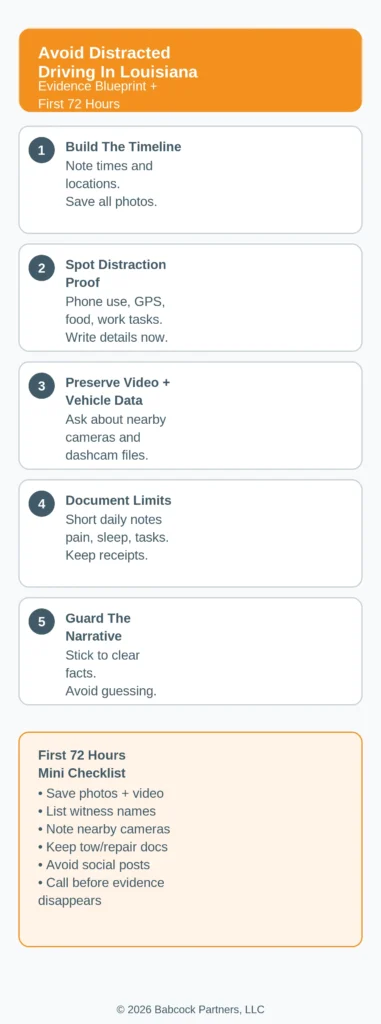
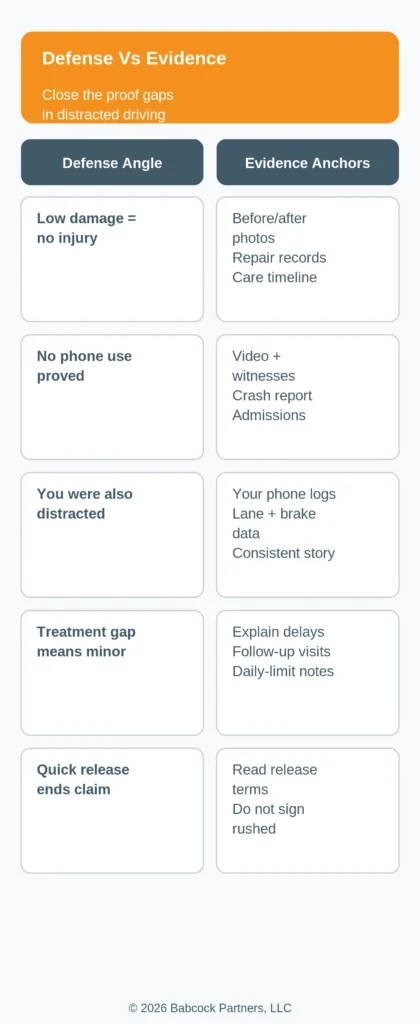
Want a print-friendly version of the checklists and both infographics? Download the printable toolkit (PDF).
How Can I Avoid Distracted Driving in Louisiana?
You avoid distracted driving by making the “right” choice the easy choice before you move the car: silence alerts, set navigation, and keep the phone out of reach. Because distraction is visual, manual, and cognitive, you want habits that protect all three at the same time, not just a hands-free setup.
- Set GPS, music, and calls before you shift into drive.
- Use Do Not Disturb and put the phone away from your hand.
- Leave extra following distance so one glance does not become a crash.
- Pull over and park if you need to read or type anything.
Many crashes happen at Baton Rouge intersections where “one second” becomes a red-light run or a late brake. If you were hurt in a crash, our Baton Rouge car accident page covers the broader steps that protect both safety and your claim. The key is reducing surprises: more space, fewer tasks, and fewer reasons to look down.
Following distance matters because the law expects drivers to avoid tailgating and to adjust for traffic conditions. Louisiana’s following vehicles statute (La. R.S. 32:81) is one reason insurers love to argue “you should have had time to stop” in rear-end situations. That is what we mean by leverage: your habits can reduce both crash risk and fault arguments.
What Counts as Distracted Driving?
Distracted driving includes any activity that pulls your attention away from driving, including phone use, eating, grooming, or dealing with passengers. The CDC describes three main categories—visual, manual, and cognitive—so you can spot the risk even when your hands are on the wheel.
| Type of Distraction | Common Examples | Simple Fix |
|---|---|---|
| Visual (eyes off road) | Reading a text, checking GPS, looking at a notification | Set navigation early; keep screens dark while moving |
| Manual (hands off wheel) | Holding a phone, eating, reaching for items in the car | Put items within reach before driving; pull over to handle tasks |
| Cognitive (mind off driving) | Intense calls, arguing, “zoning out,” mental multitasking | Keep calls short; end the call if traffic gets complex |
Texting is the classic example because it often combines all three types at once. The NHTSA distracted driving page explains that sending or reading a text can take your eyes off the road for about five seconds, which is enough time to cover a football field at highway speed. In other words, a “quick” message is rarely quick.
We also see distraction show up as lane drift, late braking, and drivers who claim they never saw a stopped vehicle. This is why we build the claim around concrete anchors like timeline, scene evidence, and third-party video instead of arguments. When you can show what happened, you do not have to debate what someone “must have been doing.”
What Does Louisiana’s Wireless-Device Law Actually Restrict?
Louisiana limits certain wireless device use while you operate a motor vehicle, and the details matter because they affect both safety and what ends up in the crash report. The current text of La. R.S. 32:59 focuses on operating a wireless telecommunications device unless the vehicle is “lawfully stationary,” with defined terms and exceptions.
- Using a phone while moving can trigger both safety and evidence issues.
- “Lawfully stationary” is a key phrase; parking is safer than stopping in a lane.
- The statute contains enforcement rules that can affect how phone proof is obtained.
- If a violation occurs in a crash context, the officer may note it on the report.
From a claim perspective, the enforcement limits are just as important as the prohibition itself. The same statute, La. R.S. 32:59, includes limits on searches and seizures of a device based solely on that offense, which is one reason phone data often becomes a later, formal evidence step. This is why we move quickly on preservation and documentation rather than assuming the crash report will capture everything for you.
If your crash happened on a busy corridor or intersection, it can also help to review our Baton Rouge location hub and related collision pages for context. Our intersection collision guide explains how right-of-way disputes and red-light timing can shape liability, and the Baton Rouge hub collects local resources. Keep this article focused on distraction, but remember that most crashes involve more than one issue.
What Should You Do After a Distracted Driving Crash?
After a distracted driving crash, your job is to get safe, get help, and freeze the facts before they change. Start with emergency care and the crash report, then move to evidence that can vanish fast, like video, witness memory, and phone-related clues.
- Get to a safe location, call 911 if needed, and ask for a report.
- Photograph the scene wide and close, including lane markings and signals.
- Collect witness names and contact info, including passengers.
- Identify nearby cameras and note exact business names or addresses.
- Avoid guessing about speed or fault when you are shaken.
Even small details can matter later, especially if the other driver denies distraction. If you can safely do it, write a short note on your phone about what you observed and when you observed it, then do not edit it repeatedly. This is why we encourage a simple “one-page timeline” early, because it becomes the backbone for video requests and record pulls.
If you suspect distraction and you are in Baton Rouge, it can help to talk with counsel quickly about how to preserve third-party evidence. Our Baton Rouge distracted driving case page explains the basics, including why early preservation letters matter. That early push is not about drama—it is about stopping the evidence clock.
Timeline Builder: What Should You Do in the First 72 Hours After a Distracted Driving Crash?
The first 72 hours are about preventing avoidable proof gaps: video overwrites, missing witnesses, and inconsistent timelines. A simple schedule also helps you focus on health and logistics, because many people feel worse later, and Cleveland Clinic’s whiplash overview notes symptoms can take time to appear.
| Time Window | Priority Actions | Why It Helps |
|---|---|---|
| 0–6 hours | Photos, witness contacts, crash report request, medical check if needed | Locks down the scene before vehicles move and memories fade |
| 6–24 hours | Write your timeline, list camera locations, save receipts and towing info | Creates a clean record and reduces “changed story” attacks |
| 24–72 hours | Follow up for report number, request video preservation, avoid recorded statements | Stops overwrites and prevents early insurer narrative control |
This is why we treat the first 72 hours like an evidence triage window: you cannot rebuild what you never preserved. If you wait until you “feel better,” the best proof may already be gone.

How Is Distracted Driving Proven in a Louisiana Claim?
Distracted driving is proven through a mix of scene evidence and records that point to attention loss, such as video, witnesses, and device-related details. You rarely need a “smoking gun” text; you need consistent anchors that make distraction the most reasonable explanation for the driving behavior.
- Crash report details, including any observed device use or admissions
- Third-party video from businesses, intersections, and doorbell cameras
- Witness statements about head-down driving, drifting, or late braking
- Vehicle data and scene evidence showing speed, braking, and lane position
- Phone and app records obtained through proper legal channels
Louisiana’s device statute can matter here because it affects what is documented and what can be obtained immediately. For example, La. R.S. 32:59 includes language about how violations relate to crash reporting, while also limiting device searches based solely on the offense. This is why we preserve first and litigate later if needed, instead of assuming the roadside process will capture every detail.
If you want a deeper dive on phone-specific evidence issues, our texting and driving accidents page covers how distraction patterns show up in real claims. Still, the best “evidence” is often mundane: a short timeline, a camera location list, and prompt requests before the footage gets overwritten. That is what we mean by leverage: you create proof that is hard to talk away.
Defense Audit: What Do Insurers Argue, and What Evidence Closes the Gap?
Insurers often do not deny a crash happened; they deny what it means, and they attack distraction proof, injury proof, or both. A good defense audit helps you anticipate those angles early so you can gather the records that answer them, not just argue about them.
| Common Defense Narrative | Evidence Anchors That Help |
|---|---|
| “Low impact, so you were not hurt.” | Before/after photos, repair records, prompt evaluation, and consistent notes about limits |
| “No proof they used a phone.” | Video, witnesses, admissions, and preservation requests for device data |
| “You share fault (tailgating, lane drift, speeding).” | Scene photos, lane markings, braking evidence, and a clean timeline that matches the report |
| “Gaps in treatment mean you were fine.” | Clear explanation of delays, follow-up visits, and consistent symptom/limit documentation |
| “A quick release ends it.” | Slow down, read the release scope, and do not sign until you know what it waives |
That is what we mean by leverage: we do not “win” by sounding confident, we win by closing proof gaps early. This is also why early insurer contact can be risky, because adjusters often ask for broad statements before you have the full record. When in doubt, keep it factual and brief until you have counsel.

What we see in practice
What we see in practice is that “distracted driving” becomes a proof fight because the other driver rarely admits it, and the best evidence can disappear fast. We also see insurers shift the focus to comparative fault, like following distance or “you should have avoided it,” even when the other driver was clearly not paying attention.
- Video overwrites quickly, so a late request can mean no footage exists.
- Witnesses forget details, and contact info gets lost if you do not collect it.
- Crash reports vary, so you need your own timeline and scene documentation.
- Early recorded statements can lock you into details you are not ready to confirm.
Before You Talk to an Insurer: A Simple Checklist
Before you give a recorded statement or sign anything, take ten minutes to organize the facts you already know. This reduces mistakes and helps you avoid “story drift,” which insurers can use to argue you are unreliable even when you are telling the truth.
- Write a one-page timeline with times, locations, and who was there.
- List any cameras you saw, including business names and addresses.
- Gather tow and repair paperwork, photos, and the report number.
- Keep a short daily note about limits, missed work, and appointments.
Need the checklists in print form for a glove box or a family member? Download the printable toolkit (PDF).
Louisiana Law Snapshot (Updated 2026)
Louisiana generally gives you two years to file most injury claims, and La. Civ. Code art. 3493.1 is the starting point for that deadline. Louisiana also applies comparative fault, and the post–Jan. 1, 2026 version of La. Civ. Code art. 2323 includes a 51% bar that can block recovery if you are found 51% or more at fault.
| Rule | Plain-English Meaning | Why It Matters in Distracted Driving Cases |
|---|---|---|
| Two-year prescription | There is a hard filing deadline in most cases. | Waiting can end the case even if distraction proof is strong. |
| Comparative fault + 51% bar | Fault can be split, and you may be barred at 51% or more. | Insurers often argue tailgating or inattention to raise your fault share. |
Missing the deadline can end the case regardless of how clear the distracted driving evidence is, so talk to a lawyer quickly if you are close to that window. Comparative fault fights also reward a clean timeline and scene proof, because “shared fault” arguments often grow when records are thin.
Free Case Review for a Distracted Driving Crash in Louisiana
If you were hit by a distracted driver, we can help you focus on the proof that matters most and avoid early traps that weaken a claim. We are not built for volume. We are built for leverage. The Babcock Benefit is our plain-English approach to fast evidence preservation, smart insurer strategy, and trial-ready preparation when the case requires it.
Call (225) 500-5000 and use the free case review form so we can triage evidence, spot deadlines, and plan next steps. If you want more detail on our process, review how we build leverage in these cases. Evidence changes quickly, and the earlier you act, the more options you keep.
These items are helpful to have with you when you call, but do not delay calling because you do not have them. If you have them handy, keep them nearby for the call.
- Crash report number or exchange-of-info sheet
- Photos or video of the scene and vehicle damage
- Witness names and contact details
- Tow, rental, or repair documents
- A short timeline of what happened
Call Today If…
- You think there is nearby video that could overwrite soon
- The other driver denies distraction or is changing their story
- You are being pushed for a recorded statement or quick release
- You were hurt and symptoms are changing over the first week
What Happens Next
- We identify and preserve time-sensitive evidence (video, witnesses, device-related records).
- We map key deadlines and comparative fault issues early so you do not get boxed in later.
- We handle insurer communications with a plan that protects your record and options.