Editorial & Legal Accuracy Notice (Louisiana)
This blog contains general legal and safety information and is not legal advice. Laws and deadlines can change, and outcomes depend on specific facts.
Last reviewed / updated: March 2, 2026
Reviewed, updated, and authored by: Stephen Babcock, Louisiana injury lawyer
This guide explains cyclists’ rights on Louisiana roads, the key road-sharing rules, and the evidence checklist that protects your claim after a crash.
Our approach is to treat cyclists’ rights like a proof checklist, because road stories change fast. We are not built for volume. We are built for leverage. Speed + evidence preservation + insurer-insider knowledge + trial-ready preparation = The Babcock Benefit. For cyclists’ rights on Louisiana roads, leverage often comes from clear lane-position facts and preserved video.
La. R.S. 32:194 places most roadway cycling under the same basic rules that apply to drivers, with bicycle-specific exceptions. If you were hit while riding in Baton Rouge or nearby, our Baton Rouge bicycle accidents page explains how we preserve proof and deal with insurer tactics. This article stays focused on road-sharing rules and what to document so the story does not get rewritten later.
If you are inside the first 72 hours, call (225) 500-5000 or use the free case review form before evidence changes.
Firm links: Client Reviews | Contact | Locations
Download the printable toolkit (PDF)
What Rights Do Cyclists Have on Louisiana Roads?
La. R.S. 32:194 gives a person on a bicycle the rights and duties of a vehicle driver when riding on a highway, with a few bicycle-specific rules. That baseline is why most disputes come down to lane position, safe passing, and what the evidence shows.
- Right to use the road: La. R.S. 32:194 starts from the premise that bicycles belong in roadway traffic.
- Duty to follow signals: The same framework in La. R.S. 32:194 ties roadway cycling to the usual rules of the road.
- Lane position is fact-driven: La. R.S. 32:197 uses “as far right as practicable,” which depends on hazards and road design.
- Drivers have passing duties: The three-foot passing rule in La. R.S. 32:76.1 often becomes the core proof issue.
- Harassment is prohibited: La. R.S. 32:201 can matter when conduct is intentional or threatening.
La. R.S. 32:193 places bicycle operation in Louisiana’s traffic code so the usual “rules of the road” framework applies. In practice, that helps when a driver argues a cyclist “did not belong there,” because the statute starts from the opposite premise.
Even when everyone is trying to do the right thing, the most dangerous moments are often predictable: right hooks at intersections, passes on narrow lanes, and dooring next to parked cars. NHTSA’s bicycle safety guidance emphasizes driver scanning and giving cyclists room, which also points to the kinds of facts you want captured on video and photos.
What Must Drivers Do When Passing a Cyclist in Louisiana?
La. R.S. 32:76.1 requires a driver who overtakes a bicycle to use due care and leave at least three feet of clearance until safely past. The fastest way a claim loses leverage is when “close pass” facts are not measured, photographed, or backed by video.
- Minimum clearance: Leave at least three feet while passing and until fully clear.
- No-passing zones: Passing a bicycle in a no-passing zone is allowed only when it is safe to do so.
- Speed and patience: Slow down if needed and pass like you would a slow-moving vehicle.
- Right turns: Look right and behind before turning right on red.
If a driver says they “gave plenty of room,” the proof usually lives in road geometry: lane width, shoulder width, and where the bike was riding relative to the fog line. This is why we ask people to capture wide-angle scene photos early, before weather, traffic, or cleanup changes the road picture.
Passing cases also turn on timing, especially when a driver cuts back in too quickly. When you can, mark the exact passing point on a map screenshot and save any dashcam, phone video, or doorbell video from nearby homes.
When Can a Cyclist Use the Full Lane?
La. R.S. 32:197 generally expects cyclists to ride near the right side of the lane when practicable, and it also lists safety exceptions. Those exceptions are the legal backbone for “taking the lane” when the lane is too narrow, hazards exist, or a left turn is coming.
| Common Scenario | What To Document |
|---|---|
| Lane is too narrow to share | Photos showing lane width, parked cars, drainage grates, and the shoulder condition. |
| Road hazards force a safer line | Close-up photos of potholes, gravel, debris, broken pavement, and construction cones. |
| Approaching a left turn | A map screenshot with the route, plus intersection photos showing signal placement and turn lanes. |
| Preparing to avoid dooring | Photos of the parked-car line and the door zone, plus the location of the impact or fall. |
If a driver becomes aggressive, that fact can matter beyond “bad attitude.” La. R.S. 32:201 prohibits harassment of a bicyclist, which can become relevant when someone intentionally crowds, threatens, or throws objects.
Do Cars Have to Stay Out of Bicycle Lanes?
La. R.S. 32:203 limits when a motor vehicle may operate in a marked bicycle lane and requires yielding to bicycle traffic in the lane. Many bike-lane crashes happen during turning, parking, and driveway entries, so the lane markings and sight lines often become the proof battlefield.
- Photograph the markings: Capture the bike-lane line, symbols, and any “bike lane ends” signs.
- Record the conflict point: Mark where the car entered, crossed, or blocked the lane.
- Look for camera angles: Nearby businesses may have footage, but it can be overwritten fast.
- Save vehicle identifiers: Plate, make/model, and insurance card photos matter.
Right-hook crashes are common because drivers look left for cars but forget to check the bike lane on the right. NHTSA highlights the need to look right and behind before turning right on red, and that same habit matters on green lights, yield turns, and driveway exits.
What About Dooring, Harassment, and Night Riding?
La. R.S. 32:283 requires people in vehicles to open doors only when it is reasonably safe and without interfering with moving traffic, which is why dooring cases are not just “unlucky.” La. R.S. 32:201 also makes harassment of a bicyclist illegal, and that can matter when a driver’s conduct is intentional.
| Issue | Why It Matters |
|---|---|
| Dooring | Door position, parked-car line, and bike damage can show why the cyclist’s road position was reasonable. |
| Harassment | Saved texts, witness names, and video can support a report of intentional interference or threats. |
| Night visibility | La. R.S. 32:329.1 sets bicycle lighting requirements that frequently become a defense focus after dark. |
| Helmet questions | La. R.S. 32:199 requires helmets for riders and passengers under 12 and addresses how citations relate to negligence arguments. |
Helmet use is also a safety issue, even when it is not legally required for adults. CDC’s bicycle safety overview notes that bicycle helmets reduce the risk of head and brain injuries in crashes.
What Should You Do After a Bicycle Crash in Louisiana?
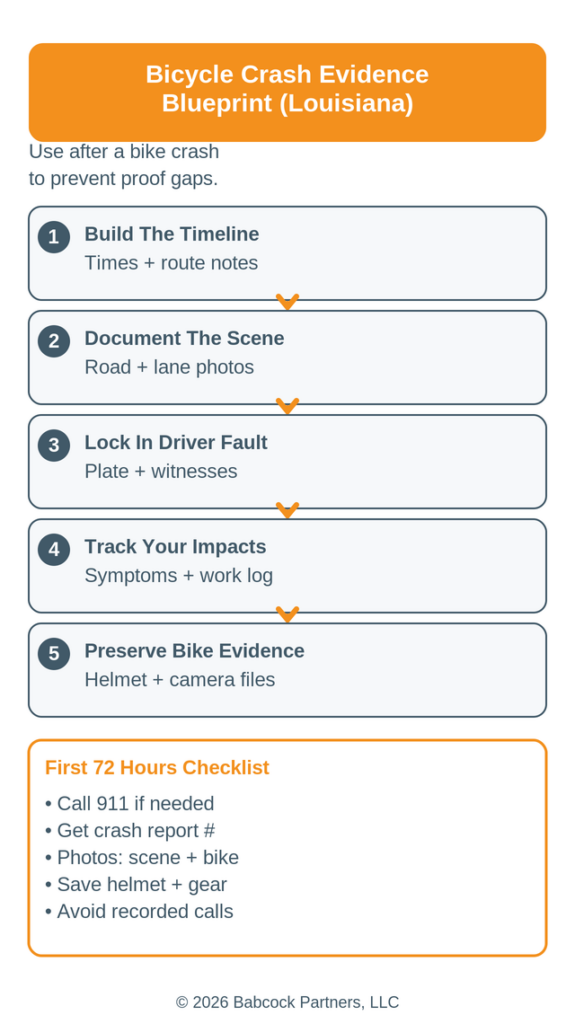
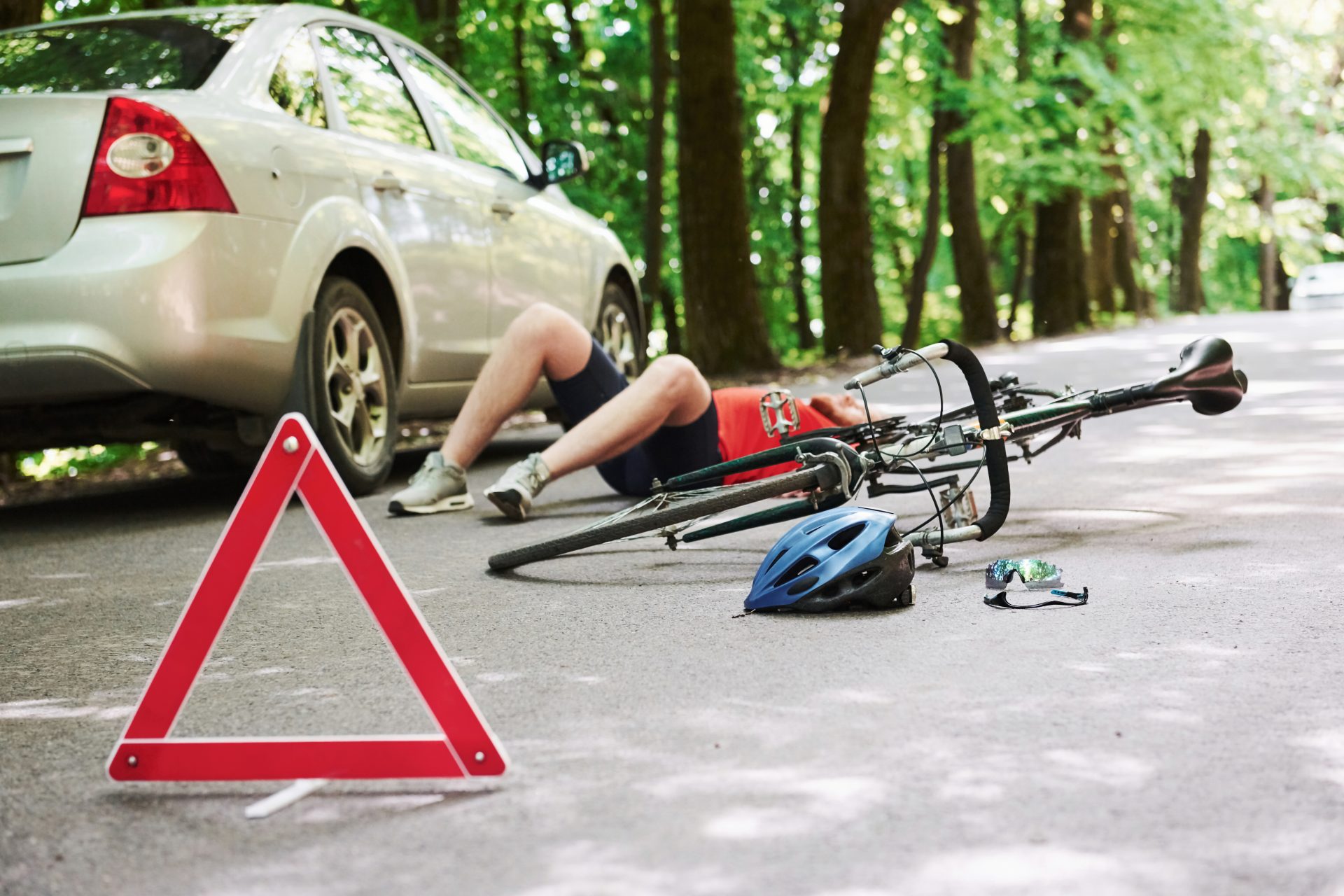
The best first step is to get safe, call 911 if needed, and make sure a report is created while the scene is still intact. Next, focus on preserving proof that will still exist a week from now, because bike repairs, video overwrites, and memory gaps can change the story.
- Get medical help if needed: Do not “tough it out” if you have head, neck, or internal symptoms.
- Request a report: Ask which agency is responding and write down the report number if available.
- Photograph the road: Capture the bike lane, lane width, sight lines, and the exact conflict point.
- Document the bike and gear: Keep the helmet, lights, clothing, and the bike in the same post-crash condition.
- Save names and files: Witness contacts, texts, and any video should be backed up immediately.
If you need help building a proof record that holds up under pressure, see our bicycle crash practice page for how we approach evidence and insurer communications. That is what we mean by leverage: the earlier the record is built, the harder it is to blame the cyclist later.
Talk to a Lawyer Quickly If…
Some situations have a faster “evidence clock” than others, even when you feel okay at first. Talk to a lawyer quickly if there is disputed fault, commercial insurance is involved, or you suspect video exists at a nearby business.
- The driver says you “came out of nowhere” or claims there was no contact.
- The crash involved a right hook, left turn, or driveway entry where markings matter.
- You were riding at night and visibility is being questioned.
- Your bike needs repairs soon and you want to preserve its condition first.
Timeline Builder
A clean timeline is how you turn “I remember it this way” into a record that can be verified. Start simple and build outward with photos, texts, and route data that show exactly where you rode and what the driver did.
| Time Window | Best Actions | What To Save |
|---|---|---|
| 0–2 hours | Safety, 911, photos of lane markings and sight lines. | Wide-angle scene photos, driver info, witness contacts. |
| Same day | Write a short narrative and back up video files. | Texts, call logs, video copies, map screenshot of route. |
| First 72 hours | Get evaluated if symptoms appear and document impacts. | Symptom/activity log, missed work notes, receipts. |
| First 2 weeks | Preserve the bike and gear before repairs. | Bike photos, repair estimates, helmet and light photos. |
| Ongoing | Keep records consistent and organized. | Medical and wage records, follow-up visit notes, mileage logs. |
This is why we encourage riders to photograph the roadway and bike lane immediately, because debris, paint, and skid marks can disappear in days. If you are in the Baton Rouge area, you can also find local guidance and resources through our Baton Rouge city hub.
Defense Audit
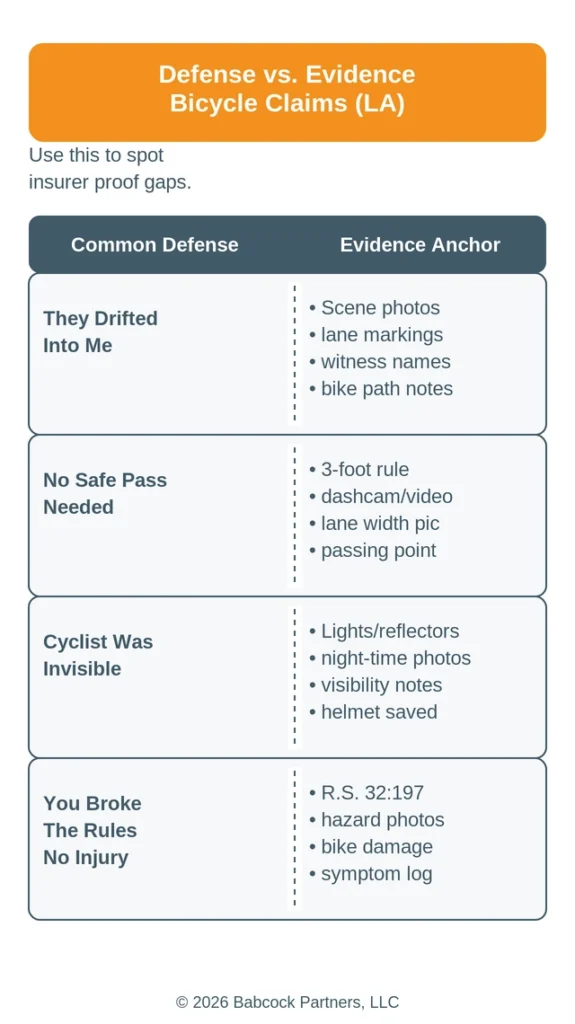
Insurers often decide on a defense theme early and then hunt for gaps that support it. A defense audit helps you collect the proof that answers the theme before it hardens into “the story.”
| Common Defense Narrative | Evidence Anchors That Counter It |
|---|---|
| “The cyclist drifted into the lane.” | Scene photos, lane markings, route map screenshot, and witness names. |
| “It was a safe pass.” | Lane width photo, video if available, and the exact passing point. |
| “The cyclist was invisible.” | Lighting/reflector photos, time-of-day notes, and preserved gear. |
| “Minor contact, no real harm.” | Bike damage photos, early symptom/activity log, and treatment records. |
| “They broke the rules.” | Document the safety reason for lane position and the road hazards in front of you. |
That is what we mean by leverage: insurers lean on uncertainty, and your job is to replace uncertainty with documented facts. The fastest wins in credibility usually come from clean photos, consistent records, and preserved gear.
What we see in practice
We see bicycle cases swing on the smallest details because riders rarely have the same “black box” data that cars do. We also see that early evidence work often matters more than later argument, because once a narrative sets in, it is hard to unwind.
- Video exists, but it is overwritten before anyone requests it.
- Lane markings and road hazards change, then everyone argues about where the cyclist “should have been.”
- The cyclist feels okay at first, then symptoms show up after the adrenaline wears off.
- Insurers push for recorded statements and quick releases before the record is complete.
Insurance and Claim Issues That Can Surprise Cyclists
Most bicycle crash claims turn into an insurance project long before they turn into a lawsuit. If you understand the common pressure points, you can avoid accidental proof gaps and avoid locking into a low-information version of events.
- Recorded statements: You can be asked to “just tell your side,” but details can be used to assign fault.
- Quick repairs: The bike gets fixed, and the best physical proof disappears.
- Selective records: Insurers may focus on old conditions to downplay new symptoms.
- Social media: Innocent posts can be framed as “you’re fine now.”
This is why we recommend controlling what gets recorded and what gets requested early, because insurer tactics usually target uncertainty. If you want a clear explanation of how we build a claim around proof gaps, review our bicycle collision case page.
Download the printable toolkit (PDF)
Louisiana Law Snapshot (Updated 2026)
La. Civ. Code art. 3493.1 sets a two-year delictual prescription period for many Louisiana personal injury claims, but exceptions and special rules can apply. La. Civ. Code art. 2323 applies comparative fault and, effective January 1, 2026, adds a 51% bar when a claimant is 51% or more at fault.
| Rule | What It Means in a Bicycle Crash |
|---|---|
| Two-year deadline | Waiting can risk losing the claim entirely, even if the facts are strong, so confirm deadlines early. |
| Comparative fault + 51% bar | If fault is disputed, evidence that supports lawful lane position and safe passing becomes even more important. |
Free Case Review for Louisiana Bicycle Crashes
We are not built for volume. We are built for leverage. The Babcock Benefit is our plain-English focus on moving fast on evidence and preparing the claim like it may be tested. Call (225) 500-5000 and use the free case review form so we can triage proof, deadlines, and insurer pressure.
Call quickly because video can be overwritten, bikes get repaired, and road conditions change. If your crash happened near an intersection, you may also want to review our intersection collision guide and our distracted driving page for related issues that often drive fault disputes.
These items are helpful to have with you when you call, but do not delay calling because you do not have them. If you have them handy, keep them nearby for the call.
- Crash report number and the responding agency
- Photos of the roadway, bike lane, and your bike/gear
- Driver and witness contact information
- Any video files and the location they came from
- A simple symptom and activity log
Call Today If…
- You believe surveillance video exists at a business or residence
- The driver claims you were not visible or “came out of nowhere”
- The crash involved a right hook, driveway entry, or bike lane conflict
- You have head, neck, back, or internal symptoms that are evolving
- The bike needs repairs soon and you want to preserve its condition first
What Happens Next
- We triage evidence sources and preserve what will disappear first
- We spot deadlines and identify the insurance layers that may apply
- We plan communications so insurer contact does not create proof gaps