Defensive Driving Tips to Avoid Crashes in Louisiana


Editorial & Legal Accuracy Notice (Louisiana)

This blog contains general legal and safety information and is not legal advice. Laws and deadlines can change, and outcomes depend on specific facts.

Last reviewed / updated: March 2, 2026

Reviewed, updated, and authored by: Stephen Babcock, Louisiana injury lawyer

This guide explains practical defensive driving habits and how to preserve proof if a crash still happens.

Defensive driving techniques work best when you treat every mile like a controlled drill: space, sight, and simple decisions. We are not built for volume. We are built for leverage. Speed + evidence preservation + insurer-insider knowledge + trial-ready preparation = The Babcock Benefit. In a Louisiana car wreck case, leverage often turns on whether you can prove what happened before memories fade.

Good defensive driving techniques lower your crash odds, but they also make your story easier to prove if someone hits you anyway. If you are sorting out injuries or insurance after a wreck, our our Baton Rouge car accident page explains how we approach evidence and fault without hype.

Firm links: Client Reviews | Contact | Locations

If you are inside the first 72 hours, call (225) 500-5000 or use the free case review form before evidence changes.

What Are the Best Defensive Driving Techniques for Louisiana Roads?

The best defensive driving techniques are simple habits that buy time: create space, scan early, and avoid surprises before they happen. Start with a “space cushion” mindset, then add routines for intersections, lane changes, and distraction control so you are ready for the next driver mistake.

  • Follow by time, not by car lengths.
  • Scan 12–15 seconds ahead and check mirrors often.
  • Approach intersections as if someone might run the light.
  • Slow down before curves, rain, or congestion tightens your options.
  • Keep your hands and attention on driving, not devices.

Defensive driving techniques are not about being timid. They are about building a buffer so you do not have to brake or swerve at the last second. That buffer also creates cleaner evidence later because your actions look consistent and reasonable in photos, video, and witness accounts.

How Far Back Should You Follow to Avoid Rear-End Crashes?

In clear conditions, AAA’s defensive driving guidance says drivers should follow no closer than three to four seconds behind the vehicle ahead. When weather, darkness, heavy traffic, or large vehicles reduce your margin, adding time is one of the easiest defensive driving techniques to apply.

  1. Pick a fixed object ahead, such as a sign or pole.
  2. When the car ahead passes it, count “one-thousand-one, one-thousand-two, one-thousand-three.”
  3. If you reach the object before you finish counting, back off and rebuild the gap.

Rear-end collisions often become “fault fights” because small details matter: brake lights, traffic flow, and whether you had a safe gap. If you were hit from behind, our rear-end accidents page explains the common proof issues and why early photos and video matter.

How Do You Scan Intersections and Left Turns to Avoid Surprise Hits?

The goal at intersections is to slow your decision-making down before the decision is forced. The best defensive driving techniques here are early scanning, predictable signals, and leaving yourself an “out” if someone runs a red light or cuts a corner.

  • Approach stale green lights ready to brake, not to accelerate.
  • Look left-right-left before you enter, even on green.
  • Pause a half-beat when your light turns green and then go.
  • Avoid entering on yellow if you cannot clear safely.
  • For left turns, wait for a clean gap and watch for a late, fast oncoming car.

Intersections are also where witnesses and cameras are most common. After a crash, note nearby businesses, traffic cameras, and doorbell cameras early because many systems overwrite quickly. This is why we treat evidence preservation like a first-day task, not a later clean-up job.

One defensive driving technique that always pays off is buckling up every trip, every seat. NHTSA’s seat belt overview notes that wearing a seat belt correctly in the front seat of a passenger car can reduce fatal injury risk by 45%, which matters even when you did everything right and still got hit.

How Do You Reduce Distraction, Speeding, and Drowsy Driving Risk?

Because NHTSA’s distracted driving overview defines distraction as any activity that diverts attention from driving, treat your phone like a parked-only tool and set navigation before you move. NHTSA’s speeding guidance warns that higher speed reduces control and increases stopping distance, so defensive driving means slowing early and leaving a bigger time gap.

Risk What to Do Now What to Save If a Crash Happens
Distraction Phone away, eyes up, hands on wheel. Phone logs, dashcam clips, and witness names.
Speeding Brake earlier, follow by time, not distance. Scene photos, skid marks, and repair records.
Drowsy Driving Stop when you are nodding off, not after. Trip timeline, rest stops, and any messages about fatigue.

Texting deserves a special warning because NHTSA’s texting explanation notes that reading or sending a text can take your eyes off the road for five seconds. When you want defensive driving techniques that actually stick, start by removing the one habit that steals the most attention.

Fatigue is easier to prevent than to “fight through” at highway speed. When you are yawning, missing exits, or drifting in your lane, pull over and reset, and NHTSA’s drowsy driving resources explain why sleepiness behind the wheel is a serious crash risk. If drowsy driving may be part of your wreck, our drowsy driving accident page explains the evidence questions we look for.

If distraction or speed is a central issue in your crash, we cover those proof themes on our distracted driving page and our speeding accidents page. Those pages focus on documentation and fault analysis rather than “tips and tricks.”

What Should You Do in the First 72 Hours After a Car Accident?

The first 72 hours are about locking down proof while it still exists: photos, video, witnesses, and a clean timeline. If you need a practical starting point, the car accident case page explains what we look for first and why early statements and releases can be risky.

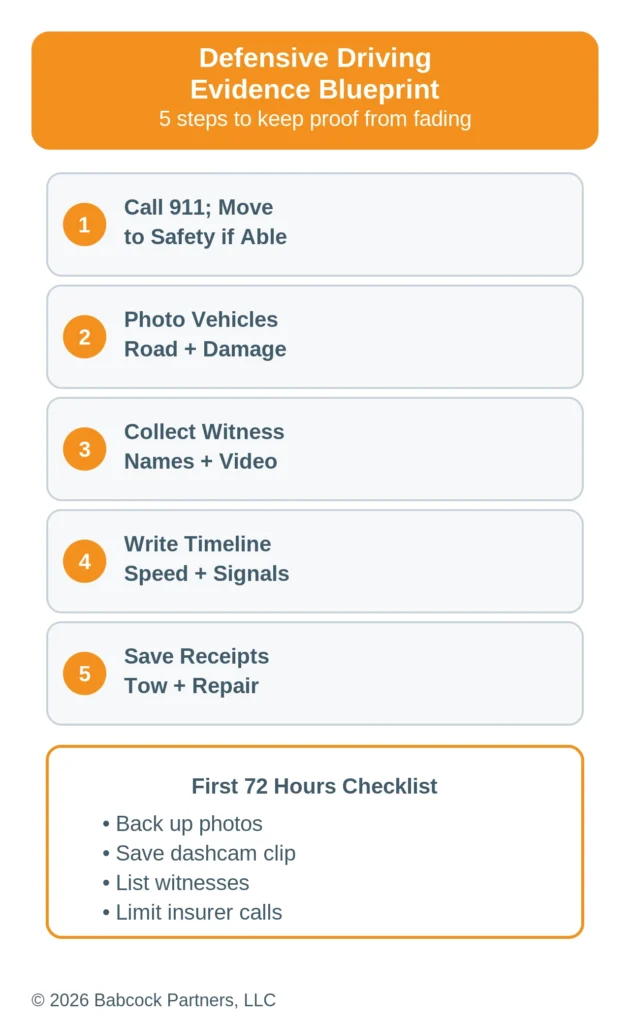
  • Call 911, get care if needed, and move to a safer spot if you can do so without creating more danger.
  • Photograph both vehicles, license plates, the road surface, signs, and any debris or skid marks.
  • Get witness names and numbers, and write down where they were standing.
  • Look for cameras immediately, including stores, traffic cams, and nearby homes.
  • Save tow and repair paperwork, rental receipts, and insurer claim numbers.

This is why we move fast on video and witness information: once it is overwritten or people scatter, you cannot “fix it later” with better wording. That is what we mean by leverage when we say early steps can change the power balance in an insurance claim.

Quick reference: a 5-step crash-proof blueprint + a first-72-hours checklist. (Download the printable PDF below.)

How Do You Build a Crash Timeline That Insurers Cannot Pick Apart?

A strong timeline makes your claim easier to understand and harder to distort, because it anchors opinions to specific moments. The best defensive driving techniques after a crash are documentation techniques: write the “before, during, and after” story while it is still fresh.

Detail to Write Down Why It Matters Where to Pull It From
Where you were going and your lane position Clarifies right-of-way and visibility Phone notes, map route, dashcam
Traffic control and signal timing Supports fault analysis at intersections Photos, crash report, nearby cameras
Weather, lighting, and road condition Explains stopping distance and speed choices Photos, radar apps, witness statements
What you did right after impact Shows reasonableness and safety focus 911 call time, texts, receipts

This is why we encourage clients to write a short timeline the same day: it reduces “memory drift,” and it helps us spot missing evidence before it disappears. Even if you do not remember every detail, a basic sequence is better than a blank space an insurer can fill for you.

How Do Insurers Try to Shift Blame, and What Evidence Counters It?

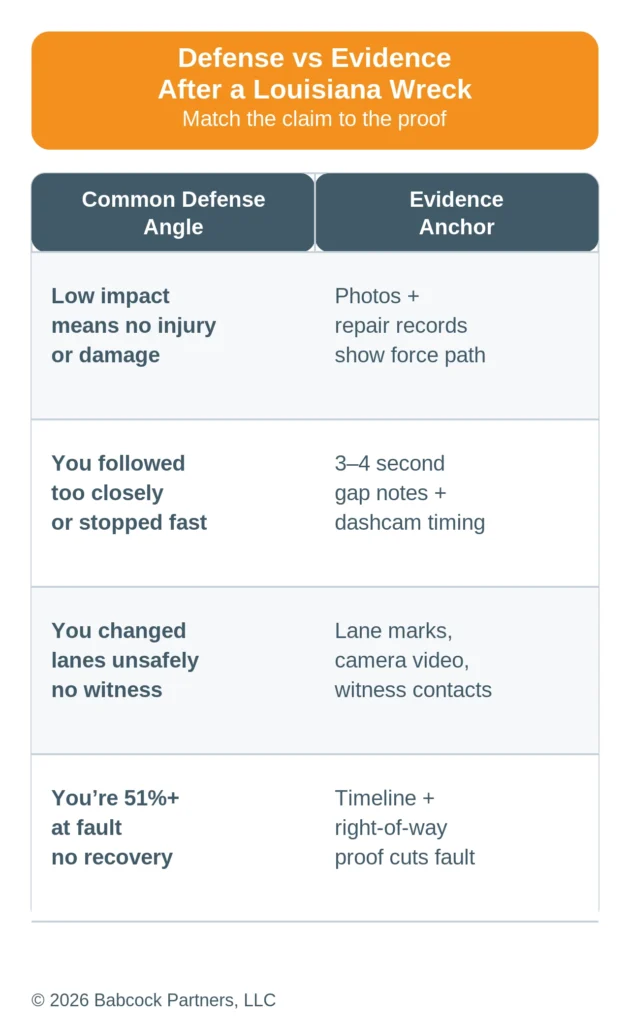
Insurance companies often defend a claim by arguing you could have avoided the crash with different defensive driving techniques, even when the other driver caused the danger. The best counter is not arguing louder; it is matching each defense story to a concrete evidence anchor that answers it.

Common Defense Angle Evidence Anchor That Helps
“Low impact means no injury or damage.” Photos + repair records showing point of force and movement.
“You followed too closely or stopped fast.” Dashcam timing, traffic flow notes, and intersection photos.
“You changed lanes unsafely and nobody saw it.” Witness contacts, camera video, and lane-mark photos.
“You’re 51%+ at fault, so you get nothing.” Timeline plus right-of-way proof that cuts down fault share.

That is what we mean by leverage when we say insurer narratives are predictable: once you know the usual angles, you can gather the record that closes the gaps. This is also why we like to identify cameras and dashcam footage early, because video often answers “who did what” better than opinions do.

Common defense narratives—and the documentation that closes the gaps.

What we see in practice

We see the same pattern over and over: people do the right things at the scene, but the proof trail breaks later when photos are lost, cameras overwrite, or paperwork gets thrown away. We also see how quickly small inconsistencies grow into big credibility problems once an insurer has a recorded statement and a few missing facts.

We see defensive driving techniques become “fault arguments” after the fact, especially when there is no video and both drivers claim they were careful. That is why we focus on specific, neutral evidence: timestamps, locations, photos, and third-party video. We do not need a perfect memory; we need a record that makes sense.

When Should You Talk to a Lawyer After a Louisiana Crash?

You should talk to a lawyer quickly when the evidence clock is faster than your ability to collect it. If fault is disputed, injuries are serious, or a commercial vehicle is involved, early guidance can prevent unforced errors that shrink the claim.

  • You were hit by a company vehicle, truck, or rideshare.
  • There may be a hit-and-run, DUI suspicion, or multiple vehicles.
  • You need help preserving video, witness statements, or vehicle data.
  • An adjuster is pushing for a recorded statement or a release right away.
  • You are being blamed for “not driving defensively enough.”

Louisiana Law Snapshot (Updated 2026)

For most injury claims, Louisiana Civil Code article 3493.1 provides a two-year deadline to file suit, so waiting can erase a claim even when liability seems obvious. Fault is also compared, and Louisiana Civil Code article 2323 applies a 51% bar starting January 1, 2026, which can block recovery if you are mostly at fault.

  • Do not assume an insurer’s “investigation” pauses the filing deadline.
  • Do not sign broad releases until you understand what rights you are giving up.
  • Write your timeline early so fault arguments have fewer openings.

If you are unsure how these rules apply to your facts, get advice quickly, especially when evidence is disappearing. The safer approach is to treat deadlines and fault disputes as early risks, not problems you can solve after a repair or after symptoms settle.

Free Case Review: Keep the Leverage Before It’s Gone

We are not built for volume. We are built for leverage. If a crash changed your week, we focus on fast evidence preservation and trial-ready preparation so the insurer cannot rewrite your story later. Call (225) 500-5000 and use the free case review form, because video can disappear, vehicles get repaired, and statements can lock in a version of events that is hard to unwind.

These items are helpful to have with you when you call, but do not delay calling because you do not have them. If you have them handy, keep them nearby for the call.

  • Crash report number (if you have it) and the intersection or roadway location.
  • Photos and video from the scene, including damage close-ups.
  • Witness names and any camera locations you noticed.
  • Insurance information and any claim number already assigned.
  • Repair or tow paperwork and rental car receipts.

Call Today If…

  • You are being blamed and you need help preserving proof.
  • A trucking or company vehicle is involved and you want to secure data fast.
  • You are pressured to give a recorded statement or sign a release.
  • You cannot locate the video or witnesses on your own.
  • Your injuries or symptoms are changing, and you need a clean documentation plan.

What Happens Next

  1. We triage evidence quickly, including video, photos, records, and witness contacts.
  2. We spot deadlines and fault issues early, so you are not surprised later.
  3. We plan insurer communications to reduce unforced errors and preserve leverage.

If you want to see our approach in one place, start with our Baton Rouge car accident practice and then call so we can apply it to your facts. We can also tell you quickly what to stop doing so you do not create avoidable gaps in the record.

×