Everything You Need to Know About Louisiana’s New Car Seat Laws


Editorial & Legal Accuracy Notice (Louisiana)

This blog contains general legal and safety information and is not legal advice. Laws and deadlines can change, and outcomes depend on specific facts.

Last reviewed / updated: March, 2026

Reviewed, updated, and authored by: Stephen Babcock, Louisiana injury lawyer

This guide explains Louisiana car seat laws in plain English and shows what to document if a ticket or injury claim turns on restraint use.

Louisiana car seat laws can feel simple until you have to prove what happened. Police reports, insurance files, and photos often disagree about which seat was used and whether it was installed correctly. This page focuses on the current statute and the proof steps that keep a safety issue from turning into a blame issue.

At Babcock Injury Lawyers, we treat safety-law questions as evidence questions because details get lost fast after a crash. We are not built for volume. We are built for leverage. Speed + evidence preservation + insurer-insider knowledge + trial-ready preparation = The Babcock Benefit. When a car seat issue shows up in a police report or insurance file, leverage comes from proving what was used and how.

If you want a printable version, this page includes a toolkit and two infographics. The toolkit is designed for parents, caregivers, and anyone gathering documents after a crash.

If you are inside the first 72 hours, call (225) 500-5000 or use the free case review form before evidence changes.

Firm links: Client Reviews | Contact | Locations

Prefer a quick handout? Download the printable toolkit (PDF) and keep it with your records. The toolkit includes both infographics from this page.

What Are Louisiana’s Car Seat Laws in 2026?

Louisiana car seat laws in 2026 require a step-by-step progression based on age and the seat’s height and weight limits. Louisiana’s child passenger restraint statute in La. R.S. 32:295 spells out the minimum restraint type and adds a “more protective category” rule when a child fits more than one stage.

Child’s Stage Minimum Restraint Under Louisiana Law
Under age 2 Rear-facing child restraint until the seat’s height/weight limit
Age 2+ and outgrown rear-facing limits Forward-facing seat with an internal harness until limits
Age 4+ and outgrown harness limits Belt-positioning booster with a lap-shoulder belt
Age 9+ or outgrown booster/seat limits Adult safety belt that fits correctly
Under age 13 Ride in the back seat when available

The law ties “properly restrained” to following both the vehicle and child seat manufacturer instructions, which is why documentation matters. For the safety best-practice view, NHTSA’s car seat and booster seat guidance explains how stages line up with size and how to use key features like tethers.

When Can a Child Use Only a Seat Belt in Louisiana?

A child can use only a seat belt when the child is at least 9 years old or has outgrown the limits of a child restraint system or booster seat. The belt must also fit correctly under La. R.S. 32:295, and “fit” means more than just buckling it.

  • The child sits all the way back and knees bend at the seat edge.
  • The lap belt sits snug across thighs and low hips, not the abdomen.
  • The shoulder belt crosses the center of the chest, not the neck or face.
  • If the belt does not fit, use the more protective restraint stage.

That belt-fit test appears directly in the statute, so photos that show belt placement can matter when someone disputes compliance. For a plain-language booster and belt-fit checklist, CDC’s child passenger safety resources explain that children often need a booster until the belt fits properly.

Do Louisiana’s Rules Require the Back Seat?

Louisiana generally requires children under 13 to ride in the rear seat when it is available. The requirement appears in La. R.S. 32:295 and works alongside the restraint-stage rules.

  • Children under 13 should ride in back when a rear seat exists.
  • If a front airbag is active, the statute directs certain younger and smaller children to the rear seat when available.
  • Some vehicle types are excluded from the statute’s definition of “motor vehicle,” so check the actual text when the situation involves unusual vehicles.

If a ticket or claim turns on seating position, write down the vehicle make/model and seating layout early so the file does not rely on assumptions. The general seat belt requirement for drivers and most occupants appears in La. R.S. 32:295.1, and it defers to the child restraint statute for children under 13.

Are Car Seat Violations a Primary Offense in Louisiana?

Yes, failing to secure a child in any type of child restraint system is a primary offense in Louisiana. The enforcement rules and fines are described in La. R.S. 32:295, including a separate “secondary offense” rule when a child is restrained but not in the most age- and size-appropriate stage.

Issue How Louisiana Treats It
No restraint used at all Primary offense under the statute
Wrong stage (example: booster too early) Secondary offense that generally requires a stop for a moving violation
Fines Graduated fines are listed for first, second, and later offenses

If you received a citation, keep the ticket, note the time and exact location, and take clear photos of the child seat as it was installed before anything changes. If the citation is tied to a collision, our Baton Rouge car accident page and Baton Rouge child injury page explain how we preserve evidence without inflating the facts.

Timeline Builder: Proving Proper Restraint Use After a Crash

The fastest way to protect a child restraint issue is to build a simple timeline that connects what was used, who installed it, and what changed after the crash. Because La. R.S. 32:295 ties “properly restrained” to manufacturer instructions, your timeline should point to labels, manuals, and photos that show the seat’s limits and belt path.

  1. Before the crash: Note the seat model, where it was installed, and who last adjusted the harness.
  2. At the scene: Photograph the seat in place, the child’s seating position, and any airbag deployment.
  3. Within 24 hours: Photograph labels, belt paths, tether routing, and harness/chest clip position.
  4. Within 72 hours: Save manuals, receipts, and any seat-check paperwork, then request the crash report number.
  5. Ongoing: Keep a short log of symptoms and function changes if an injury concern exists.

This is why we treat the first 72 hours like an evidence sprint, not a paperwork chore. When you document the seat details early, you shrink the space for later “we can’t tell” arguments.

Quick reference: a five-step plan to document proper restraint use and preserve key proof after a crash.

Defense Audit: What Insurers Look For in Car Seat Cases

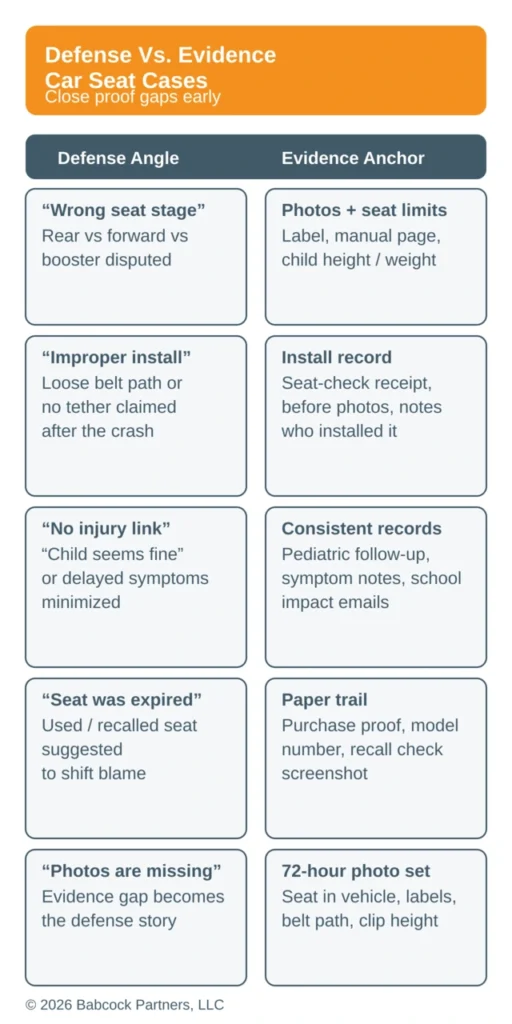
Insurers often treat car seat questions as leverage points, especially when medical bills rise or injuries take time to show up. A simple defense audit helps you gather the records that answer common narratives before the file hardens.

Common Defense Angle Evidence That Helps
“Wrong seat stage for age/size” Label photos, manual page for limits, and current height/weight notes
“Improper installation” Before-photos, tether/belt-path photos, and any certified seat-check record
“Seat belt didn’t fit” Belt-fit photos showing lap belt on thighs and shoulder belt across chest
“Seat was expired or recalled” Purchase proof, model number, and a saved recall-check result
“No injury link” Consistent medical follow-up and a short symptom/function log

That is what we mean by leverage when we say you should control the paper trail, not the other side’s assumptions. When the insurer has fewer proof gaps to exploit, discussions stay closer to the facts.

Common car seat defense narratives—and the documentation that helps close the gaps.

What we see in practice

We often see car seat facts reported differently by different people, even when everyone is trying to be honest. One caregiver may remember “booster,” another may remember “harness,” and a later photo may show a different setup. That is why we push families to document the seat as close to the incident as possible.

We also see defense teams try to turn a safety rule into a blame rule, even when the injury mechanism does not match the story they want to tell. While La. R.S. 32:295 includes language that limits how restraint nonuse can be used in a civil negligence trial, adjusters still argue “noncompliance” to reduce value during negotiations.

This is why we build a proof bundle that is easy to understand: seat label photos, install photos, witness notes, and a clean timeline. If the case involves Baton Rouge roads, our local hub at Baton Rouge explains how we approach evidence quickly and carefully.

What Should You Do in the First 72 Hours After a Crash Involving a Child?

Start by protecting your child’s health and then protect the details that prove how the child was restrained. The goal is not to “build a case,” but to keep the record accurate when memories fade and vehicles get repaired.

  • Get medical evaluation if anything feels off, even if symptoms look minor at first.
  • Take a full photo set: seat in vehicle, labels, belt path, harness routing, and tether use.
  • Write down who installed the seat and whether anything changed after the incident.
  • Request the crash report number and save any exchange of information.
  • Do not discard the seat until you know whether it will matter later.

Need a ready-to-print checklist for your folder? Download the printable toolkit (PDF) and use it as a one-stop reference. It includes the evidence blueprint and the defense-audit comparison.

Where Can You Get a Car Seat Checked in Louisiana?

A certified seat check can help you confirm installation and create a simple record that shows you took safety seriously. In Louisiana, you can often find inspection events and resources through local safety programs.

Talk to a lawyer quickly if a child was hospitalized, if a citation is issued, or if the insurer asks for a recorded statement about “restraint use.” Those are high-pressure moments where a small detail can steer the claim.

Louisiana Law Snapshot (Updated 2026)

Most Louisiana injury claims have a two-year deadline, and missing it can end the case no matter how strong the facts are. Louisiana sets that two-year prescriptive period in La. Civ. Code art. 3493.1, which makes early deadline spotting part of the evidence plan.

  • Two-year prescription: The clock generally starts on the day the injury or damage is sustained.
  • Comparative fault: Under La. Civ. Code art. 2323, a person who is 51% or more at fault cannot recover damages for injury claims, and the statute shows an effective date of January 1, 2026 for that change.
  • Why it matters here: Car seat disputes often become “percentage fault” arguments, so accurate documentation helps protect the fact story.

Next Step: Build Leverage Before The File Hardens

We are not built for volume. We are built for leverage. If your child was hurt or a car seat issue is being used against you, the best time to act is before the insurer treats a guess as a fact.

Our approach uses the Babcock Benefit mindset: preserve the right proof, spot deadlines, and prepare the claim as if it could be tried. Call (225) 500-5000 and use the free case review form so we can triage evidence and protect your statements. Act quickly because vehicles get repaired, seats get replaced, and memories drift.

These items are helpful to have with you when you call, but do not delay calling because you do not have them. If you have them handy, keep them nearby for the call.

  • Crash report number or incident number
  • Photos of the child seat label and installation
  • Child’s approximate height and weight at the time
  • Names of anyone who installed or adjusted the seat
  • Medical visit notes or discharge papers if applicable

Call Today If…

  • The insurer is asking for a recorded statement about restraint use
  • A ticket was issued or the report mentions “improper restraint”
  • Your child has delayed symptoms, missed school, or new behavior changes
  • The vehicle or car seat is about to be repaired, returned, or discarded

What Happens Next

  • We triage evidence: photos, seat details, witnesses, and report sources.
  • We spot deadlines and notice issues early, then build a clean timeline.
  • We set an insurer contact strategy to protect your words and your proof.
×