


Editorial & Legal Accuracy Notice (Louisiana)
This blog contains general legal and safety information and is not legal advice. Laws and deadlines can change, and outcomes depend on specific facts.
Last reviewed / updated: March, 2026
Reviewed, updated, and authored by: Stephen Babcock, Louisiana injury lawyer
This guide explains how class action lawsuits work in Louisiana, what proof usually matters early, and how to read a class notice without losing options.
Our approach is to turn confusing legal procedures into a simple action plan you can follow. We are not built for volume. We are built for leverage. Speed + evidence preservation + insurer-insider knowledge + trial-ready preparation = The Babcock Benefit. In a class action, leverage comes from locking down the common proof and the deadlines before the defense narrows your choices.
Class actions can involve unsafe products, hidden fees, misleading notices, or a standard contract term that hits many people the same way. The hard part is that the case rises or falls on what is common across the group, not on what is unique to one person. That is why the first week is often about document preservation, not courtroom drama.
If you are inside the first 72 hours, call (225) 500-5000 or use the free case review form before evidence changes.
Firm links: Client Reviews | Contact | Locations
Download the printable toolkit (PDF) to keep the timeline builder and defense audit on one page while you gather records. It is designed for printing and quick note-taking.
What Is a Class Action Lawsuit in Louisiana?
A Louisiana class action is a court-approved way for a few people to sue as representatives for a larger group when common issues predominate under La. Code Civ. Proc. art. 591. If the case is in federal court, the similar certification framework comes from Federal Rule of Civil Procedure 23. The judge still decides whether it can proceed as a class.
- One set of claims: the court treats the dispute as one case instead of thousands of separate lawsuits.
- Common proof: the focus is what is shared across the group, such as the same fee, policy, product, or notice.
- Defined group: the judge must define who is in the class and what issues are in the case under La. Code Civ. Proc. art. 592.
- Notice and deadlines: class notices can create short windows to opt out or submit a claim.
Some large-scale cases are not true class actions. For example, many injury-heavy product cases are handled as individual suits coordinated in a federal multidistrict litigation process described in 28 U.S.C. § 1407, because each person’s medical proof is different. A real class action lawsuit usually depends on common proof that can be shown with the same documents for everyone.
What Must Be Proven for a Louisiana Class Action to Be Certified?
To certify a class action in Louisiana, the court looks for a class large enough to make individual suits impractical. The judge also checks that common questions predominate and that the representatives’ claims and interests line up with the group under La. Code Civ. Proc. art. 591. The fastest way to help a real case is to organize “common proof” early. That helps the judge see why the dispute can be resolved for the whole group in one proceeding.
| Certification Focus | Plain-English Meaning | Evidence That Usually Helps |
|---|---|---|
| Size of the class | The group is big enough that separate lawsuits are not realistic. |
|
| Common issues predominate | The key questions can be answered with the same proof for everyone. |
|
| Representative claims fit | The named plaintiffs’ issues match what the class is facing. |
|
| Adequate representation | The representatives and lawyers can fairly protect the class’s interests. |
|
Louisiana also has early procedure deadlines once a class petition is served. The timing rule in La. Code Civ. Proc. art. 592 generally requires a motion to certify the class within 90 days after service of the petition, unless the court sets a different deadline. Talk to a lawyer quickly if you were served with a class petition or you received a notice with an opt-out date. Missed deadlines can close off options.
Can a Louisiana Class Action End Up in Federal Court?
Yes, many Louisiana class actions end up in federal court because the jurisdiction rules in 28 U.S.C. § 1332 include special provisions for certain class actions, and removal rules can apply under 28 U.S.C. § 1453. Once in federal court, certification and settlement procedures run through Federal Rule of Civil Procedure 23, which can change the schedule and the proof focus.
- Removal happens fast: the defense may move the case from state court to federal court early.
- The court tests “common proof”: judges often focus on whether one answer can resolve a central issue for the class.
- Notices matter: opt-out and claim deadlines often run from the notice date, not from when you first heard about the case.
Federal courts often treat commonality as a shared answer that can resolve a central issue for the class. The Supreme Court discussed this idea in Wal-Mart Stores, Inc. v. Dukes. In plain terms, you want common documents and timelines organized early. Otherwise the defense may try to turn the case into thousands of individualized stories.
Timeline Builder: What to Save in the First 30 Days
If you think you may be part of a class action lawsuit, the safest move is to preserve the “before and after” record while you still can. A clean timeline paired with screenshots and account records helps show the common issue and limits later disputes about what terms you saw and when.
| Time Window | What to Do | Why It Matters |
|---|---|---|
| First 72 hours |
|
Records change quickly, and later versions may not show what you actually saw. |
| First 2 weeks |
|
This helps connect the common policy or practice to your specific experience. |
| First 30 days |
|
This creates a “common proof” backbone and protects against memory drift. |
This is why we focus on evidence preservation before arguments. If the defense can claim the terms changed or the notice was different, the case can bog down in avoidable side fights.
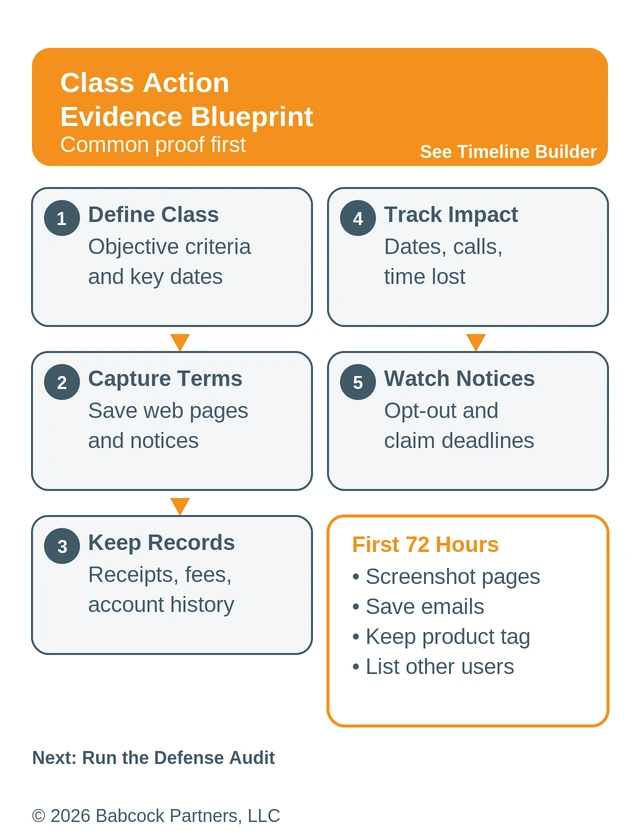
Download the printable toolkit (PDF) if you want this timeline and the defense audit as a quick handout. The toolkit also includes a short contact page for follow-up.
Defense Audit: What Defendants Argue and How You Answer
Most class action fights are really “proof structure” fights: the defense tries to show the case cannot be proven with shared evidence. The quickest way to respond is to match the common arguments to the specific records that answer them, using the certification ideas in La. Code Civ. Proc. art. 591 and the similar framework in Federal Rule of Civil Procedure 23.
| Defense Angle | Evidence Anchor You Can Start Preserving |
|---|---|
| “There is no common issue.” | One contract version, one policy, one fee schedule, or one standardized notice that applied across the group. |
| “It is too individualized.” | Uniform account exports, receipts, and the same charge codes repeated across people. |
| “The class is unclear.” | Objective criteria: date range, product version, location, or customer category that can be verified. |
| “Arbitration or a waiver blocks court.” | Saved terms, proof of what you agreed to, and any opt-out proof or notice history you have. |
That is what we mean by leverage: when the record answers the defense playbook before it is filed, insurers and corporate risk teams have less room to stall. This is also why we push to capture contract versions and notices early, because those documents are often the first battleground.

What we see in practice
We see class actions move faster when the “common proof file” is built early and kept organized. We also see cases stall when the record is scattered, because the defense can turn simple issues into dozens of side disputes.
- Certification is the gate: most energy goes into whether the case can proceed as a class, not into dramatic trial moments.
- Notices create pressure: many people lose options by missing opt-out or claim deadlines.
- Contract versions matter: a small change in terms can become a major fight about who is in the class.
- Settlement releases are dense: you may be asked to give up more than you think if you do not read the scope carefully.
This is why we treat time as evidence. Even when the underlying issue is straightforward, the paper trail can fade quickly if you do not preserve it.
Should You Join a Class Action or Opt Out?
Whether you should stay in a class action depends on your personal harm, your deadlines, and the scope of the release. Class notices and settlement terms often include opt-out timing and court-approval steps described in Federal Rule of Civil Procedure 23. Louisiana procedure also addresses certification and notice mechanics in La. Code Civ. Proc. art. 592.
| Option | When It Can Make Sense | What to Watch |
|---|---|---|
| Stay in the class | You have the same core issue as everyone else and your damages are modest or hard to pursue alone. | Broad releases, short claim deadlines, and proof requirements for claims administrators. |
| Opt out | Your harm is different, larger, or needs individualized proof that does not fit the class. | Strict opt-out deadlines and the need to preserve your own evidence and filing timeline. |
| Do nothing | You are still gathering information or you are unsure whether you qualify. | You may lose the chance to opt out or submit a claim if you miss the notice window. |
Talk to a lawyer quickly if you received a class notice with an opt-out date or a claim submission deadline. If you are on the fence, take screenshots and save the notice first. Then get advice about the release language and whether your situation truly matches the class definition.
What to Gather Before You Talk to a Lawyer
You do not need a perfect file to get meaningful guidance, but a few documents can speed up the analysis. If you can, bring the records that show what terms applied to you, when the issue happened, and how it affected you.
- The class notice (email, postcard, or website link) and the date you received it
- Screenshots of the terms, pricing, policies, or error messages you saw
- Receipts, invoices, billing statements, or account exports
- Customer service tickets, complaint numbers, or chat logs
- A short timeline: “what happened, when, and what changed”
Download the printable toolkit (PDF) to use the checklist while you collect these records. It can also help you track dates from a class notice.
Louisiana Law Snapshot (Updated 2026)
Most Louisiana injury and damage claims are subject to a two-year delictual prescription period, and the starting point and exceptions can be fact-specific. Comparative fault can also reduce or block recovery, and the updated language in La. Civ. Code art. 2323 includes a post–Jan. 1, 2026 51% bar for certain recoveries.
| Rule | Plain-English Meaning | Why It Matters for Class Members |
|---|---|---|
| Two-year prescription | The general deadline for many claims can be two years from the date of injury or damage, as described in La. Civ. Code art. 3493.1. | Even if a class case exists, your individual deadline questions can matter, especially if you opt out. |
| Comparative fault | Fault can be allocated among parties, and recovery can be reduced based on your share of fault under La. Civ. Code art. 2323. | Defense teams may look for ways to argue you caused part of the loss to weaken the class narrative. |
Talk With Us About Your Options
We are not built for volume. We are built for leverage. If you need help understanding a class notice, an opt-out deadline, or whether you fit the class definition, we can help you think it through. We bring the Babcock Benefit mindset: move fast, preserve proof, and prepare the case like it may have to be tried. Call (225) 500-5000 and use the free case review form below so we can help you protect options before deadlines and evidence change.
These items are helpful to have with you when you call, but do not delay calling because you do not have them. If you have them handy, keep them nearby for the call.
- Any class notice and the deadline dates listed on it
- Screenshots of the terms, policies, or charges you saw
- Receipts, billing statements, or account exports
- A short timeline of what happened
- Names of other people you know were affected
Call Today If…
- You received a notice with an opt-out or claim deadline
- You cannot access your account history or the terms you saw
- A company is offering a refund or credit tied to a release
- You think your situation is different than the “average” class member
What Happens Next
- We triage evidence fast and build a common-proof timeline.
- We spot deadlines and notice issues that can affect your options.
- We plan an insurer and defense contact strategy that protects your position and avoids avoidable statements.