

There is no reliable “typical” Louisiana car accident settlement. Two crashes that look similar in photographs can produce very different results because the injuries, proof, fault, available insurance, and future needs are different. A useful evaluation starts with those facts, not an online average.
This article explains the parts of a settlement that can be documented and tested. It does not promise a number or treat a settlement calculator as evidence.
Why one average does not answer the question
A settlement is an agreement to resolve a claim. Its value depends on what the claimant could prove if the dispute continued, what defenses the insurer could support, and what sources of recovery are actually available. The seriousness of the injury matters, but so do the details connecting that injury to the crash.
Five questions usually frame the discussion:
- Who was at fault? Photographs, witness accounts, the crash report, vehicle damage, video, and other records may help answer that question.
- Did the crash cause the claimed injuries? Medical history, the timing of symptoms, examinations, diagnostic testing, and treatment records can matter.
- What losses can be documented? Medical expenses, lost earnings, property damage, pain, limitations, and future needs require different proof.
- What insurance or other recovery sources apply? A strong damages case does not create coverage that is not there.
- Is the claim ready to be resolved? An early offer may arrive before the medical course, wage loss, liens, or future care are understood.
For a broader overview of the claim process, see the firm’s Baton Rouge car accident practice page and the published guide to the car accident settlement process.
What belongs in a damages file
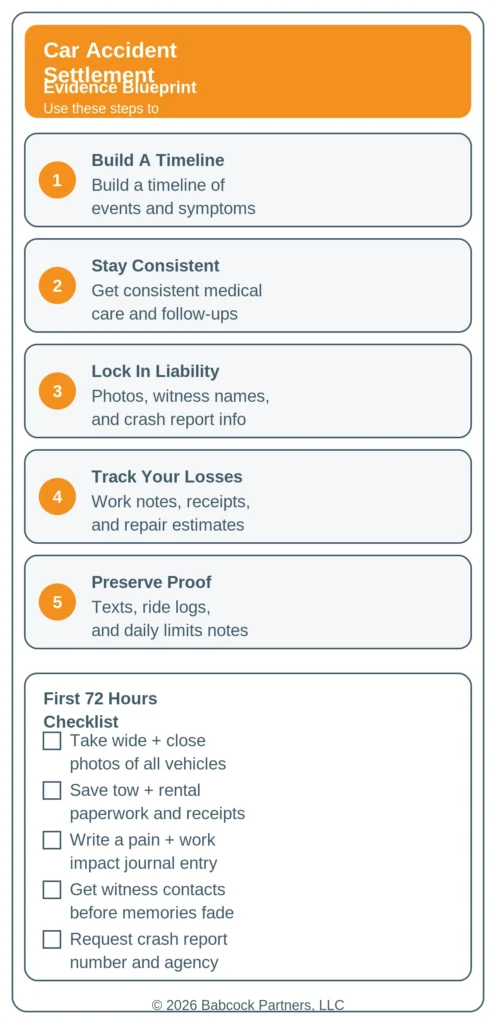
A persuasive claim explains what changed after the crash and supports that account with records. The file should be understandable to someone who was not at the scene and has never met the injured person.
Medical care and future needs
Medical records can establish complaints, findings, diagnoses, treatment, restrictions, and recommendations. Bills show charges, but bills alone do not explain why care was needed or whether additional treatment is likely. When future care is part of the claim, the supporting medical opinion and expected cost need careful attention.
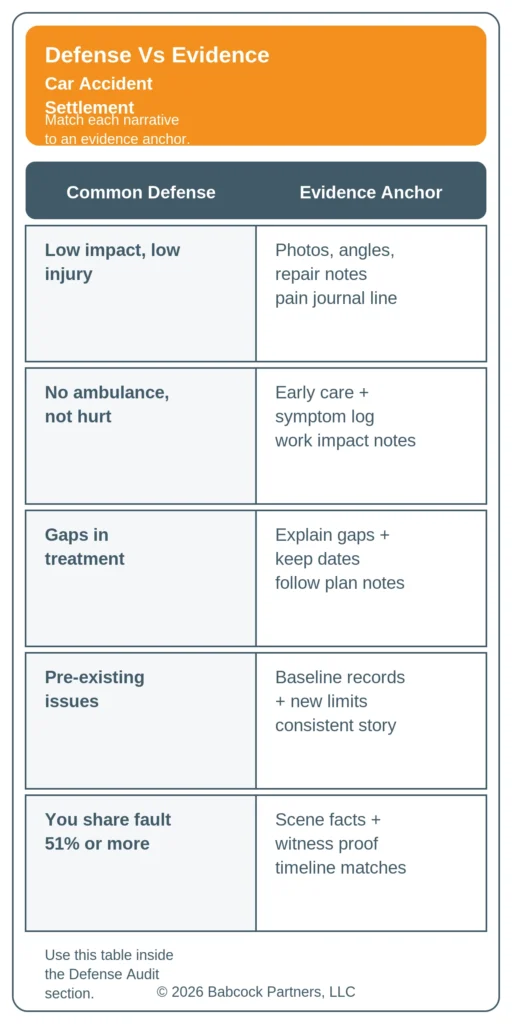
A prior condition does not automatically defeat a claim. It can, however, create a causation dispute. Records describing the person’s condition before the crash and the specific change afterward may be more useful than broad statements that everything became worse.
Lost income and reduced earning ability
Pay records, tax documents, employer confirmation, schedules, and medical restrictions can support time missed from work. A self-employed person may need business records that separate ordinary fluctuations from crash-related losses. A claim for diminished earning ability is different from a simple total of missed paychecks and may require evidence about lasting restrictions and the person’s occupation.
Daily limitations and pain
There is no invoice for disrupted sleep, difficulty caring for a child, or the loss of an ordinary activity. Specific examples are more informative than a long list of adjectives. A brief dated record of symptoms and limitations can help, especially when it remains consistent with medical records and the person’s actual activities.
Property damage and related costs
Vehicle photographs, estimates, repair records, valuation documents, towing charges, and rental expenses belong in the file. The property claim and bodily injury claim may proceed on different tracks. Resolving one does not necessarily resolve the other, but the language of any release should be read before it is signed.
How fault changes settlement value
Louisiana Civil Code article 2323 makes fault part of the damages calculation. The current rule, effective January 1, 2026, bars recovery when the claimant is 51 percent or more at fault and reduces damages when the claimant’s fault is 50 percent or less. Claims governed by the earlier version of the law may use the former pure comparative-fault rule. The crash date and other transition facts therefore matter.
A fault dispute should be approached through evidence rather than labels. Lane markings, traffic controls, points of impact, vehicle positions, video, electronic data, witness information, and the consistency of the drivers’ accounts can all be important. The article on proving fault after a Louisiana car accident discusses that issue in more detail.
Insurance can set a practical limit
A claimant can have well-supported losses that exceed the insurance available from the at-fault driver. The coverage review may include liability insurance, policies covering other responsible parties, and the injured person’s own applicable coverage. Policy language, exclusions, limits, offsets, and the identity of insured persons can affect the analysis.
Coverage should be investigated instead of assumed. A declaration page is useful, but it may not answer every question. Serious-injury cases may also require an inquiry into whether another person or business bears responsibility for the crash.
Why the medical timeline matters
A delay or gap in care is not automatically fatal to a claim. People may lack transportation, wait for an appointment, try to work through symptoms, or face insurance and cost problems. Still, an unexplained gap gives the insurer room to argue that the condition improved or came from something else.
The sound response is an accurate timeline, not an embellished one. Preserve appointment records, referral delays, work demands, transportation problems, and other facts that explain what happened. Do not seek unnecessary treatment merely to create paperwork. The point is to document needed care and the reason for significant interruptions.
What to examine before accepting an offer
An offer is not just a number. It normally comes with a release that can end some or all claims arising from the crash. Before accepting, consider whether:
- the injuries and expected course of treatment are reasonably understood;
- all wage and property losses have been identified;
- health-insurance, Medicare, Medicaid, workers’ compensation, medical-payment, or other reimbursement issues have been investigated where applicable;
- all potentially responsible parties and coverage sources have been considered;
- the release accurately describes the claims and parties being released; and
- the net recovery, after fees, costs, and valid repayment obligations, has been explained.
A settlement can provide certainty and avoid the delay and risk of litigation. It can also be final even if the injury later becomes more serious. The decision should be based on the actual record and the release terms, not pressure to close the file quickly.
Deadlines depend on when the crash occurred
Louisiana Civil Code article 3493.1 generally provides a two-year period for covered delictual actions arising on or after July 1, 2024. Earlier crashes may remain subject to the former one-year period, and other claims or defendants can involve different notice requirements or deadlines. Settlement discussions do not necessarily suspend prescription.
Anyone unsure about a deadline should have the specific dates and parties reviewed promptly. The published article on evidence for a Louisiana car accident case also identifies records that can disappear long before a filing deadline arrives.
A better way to think about settlement value
The most useful question is not, “What is the average settlement?” It is, “What do the evidence, law, available coverage, and unresolved risks show in this claim?” That question leads to a documented evaluation instead of a number borrowed from an unrelated case.