

The police account of this Bossier City crash was brief but consequential: a motorcyclist died after a multi-vehicle collision at Airline Drive and Old Minden Road, and an involved driver was cited for failing to yield. A citation is important evidence, but it does not by itself answer every civil-liability question. The underlying report, witness accounts, roadway evidence, and vehicle damage still matter.
The Bossier City Police alert previously linked from this article is no longer available at its former public URL as of September 27, 2026. The historical summary below reflects that archived alert. Anyone evaluating a claim should obtain the crash report and related records directly from the agency rather than relying on this article.
What the Archived Police Alert Reported
The alert identifies the intersection, reports that the rider died at the scene, and states that a driver received a failure-to-yield citation. Those facts point to a right-of-way issue. They do not establish the precise movement of every vehicle, the timing of the signal, each driver’s view, or whether another vehicle contributed to the sequence.
That distinction matters in a multi-vehicle crash. One driver may have made the first unsafe movement while another driver’s speed, lane change, or following distance affected the result. A civil investigation therefore asks more than whether a ticket was issued. It asks what each person did, when the danger became visible, and whether the collision could have been avoided.
The Records That Can Reconstruct the Crash
The most useful evidence is usually the evidence created closest to the collision. The police report and diagram provide a starting point. Dispatch records can fix the time of the first call and identify responding units. Photographs can show debris, impact points, traffic controls, sight lines, and where the vehicles came to rest. Nearby business video may show the approach to the intersection even when the impact itself is outside the camera’s frame.
The motorcycle and the other vehicles can also preserve information that is lost once repairs or salvage begin. Damage patterns, paint transfer, broken components, tire marks, and electronic data, when a vehicle actually records relevant data, may help test competing accounts. The helmet and riding gear should be kept in their post-crash condition as well.
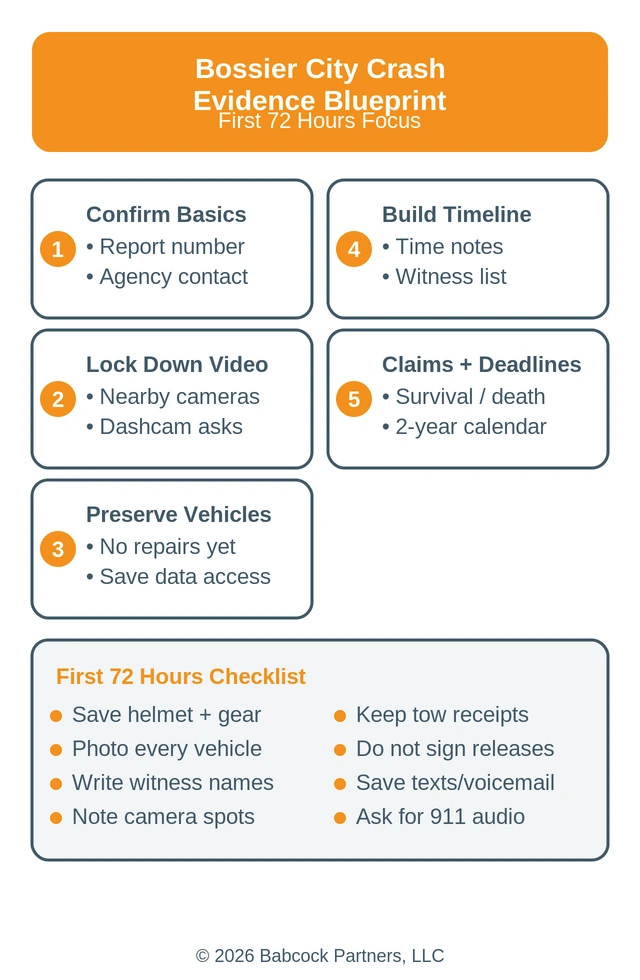
A family does not need to know which item will prove decisive before asking that it be preserved. The practical task is to identify the investigating agency, report number, tow locations, witnesses, and likely cameras, then keep the original files and documents. Our guide to how fault is determined in Louisiana motorcycle crashes explains how those pieces are tested against each other.
A Traffic Citation Is Evidence, Not the Whole Case
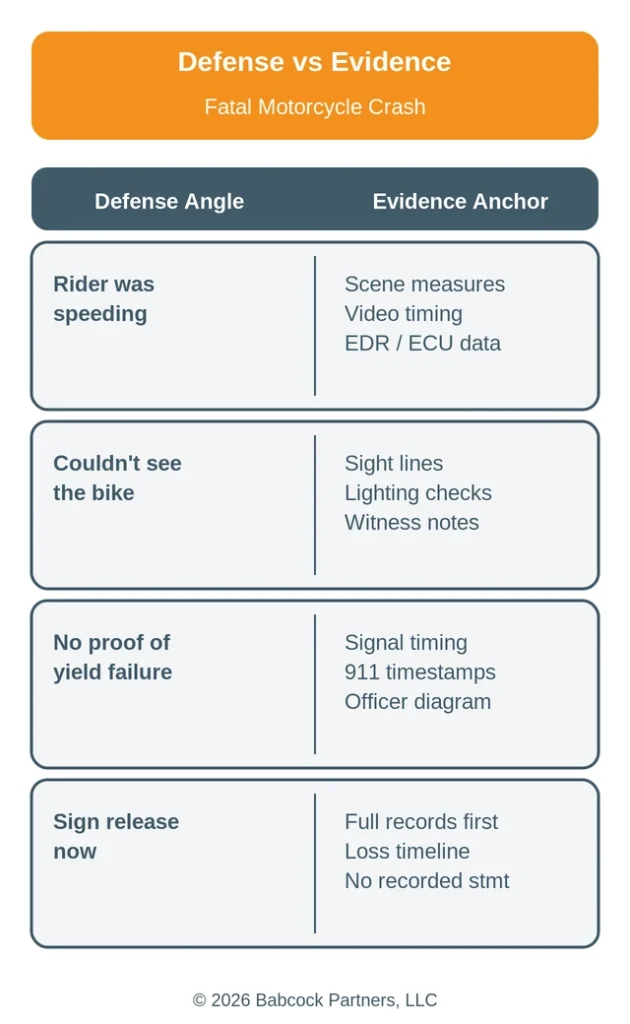
A failure-to-yield citation may support a negligence claim, especially when the physical evidence matches the officer’s conclusion. Still, a citation does not automatically set the percentages of civil fault or prove every claimed loss. The cited driver or insurer may dispute the officer’s reconstruction, argue that another vehicle obstructed the view, or contend that the rider’s conduct contributed to the collision.
Those arguments should be answered with the record, not assumptions about motorcycles. Signal timing, visibility, lane geometry, video, witness locations, and impact evidence can show whether a driver had enough time and distance to see the rider and yield. If the vehicles gave different accounts, the physical evidence may be more reliable than a statement made after the fact.
Survival and Wrongful Death Claims Are Different
Louisiana law separates the claim that belonged to the injured person from the losses suffered by qualifying relatives. A survival action under Civil Code article 2315.1 preserves certain damages the deceased could have pursued. A wrongful death action under Civil Code article 2315.2 addresses damages sustained by the family members the statute places in priority order.
The two claims may arise from the same crash, but they do not cover the same period or necessarily belong to the same person acting in the same capacity. Medical records, evidence of conscious pain, funeral expenses, financial support records, and proof of the family relationship may become relevant for different reasons. The firm’s Louisiana wrongful death overview discusses that distinction in more detail.
Deadlines also require date-specific analysis. The current text of articles 2315.1 and 2315.2 provides a period tied to the later of one year from death or two years from injury, but the rule in effect when a claim accrued may control. This crash was reported in 2018, long before the current language took effect. A family should not assume that a later amendment revived an old claim. Interruption, suspension, and other exceptions depend on facts and procedural history.
Fault Rules Depend on the Crash Date
Civil Code article 2323 now uses a 51 percent bar for claims governed by the amendment effective January 1, 2026: a person assigned 51 percent or more of the negligence cannot recover, while a lower percentage reduces damages proportionally. That amendment does not turn this 2018 collision into a 2026 claim. The law applicable to the date and posture of a particular case must be checked before drawing conclusions.
The same caution applies when reading modern legal summaries about an older crash. Current law is useful for current incidents, but a historical article should not imply that today’s rule necessarily governed an event eight years earlier. For a newer motorcycle collision, the date of loss, the identity of each responsible person, and the evidence supporting each fault allocation should be analyzed together.
Practical Steps for a Family Dealing With a Recent Fatal Crash
For a recent collision, start with a narrow set of tasks rather than trying to investigate the entire case at once:
- Obtain the report number and the name of the investigating agency.
- Locate every vehicle and ask that it not be repaired, altered, or salvaged before documentation.
- Save original photographs, videos, messages, and call records without editing the files.
- Identify nearby cameras and witnesses while those sources can still be found.
- Keep funeral, medical, employment, and financial-support records together.
- Do not sign a release until you understand which claims and parties it covers.
When several insurers are involved, it helps to keep a written log of who called, the claim number, and what was requested. There is no need to guess about speed, distance, or signal timing. Those questions should be answered, if possible, from evidence. For a broader discussion of scene and vehicle preservation, see what to do after a Louisiana motorcycle accident.
Talk With a Louisiana Motorcycle Accident Lawyer
A fatal crash can involve several vehicles, several policies, and two different types of death claim. If your family needs help identifying the evidence, determining who may bring a claim, or understanding which deadline applies, review the firm’s motorcycle accident practice or call (225) 500-5000. One focused conversation is enough to identify what must be preserved now and what can wait for the full investigative record.
Last reviewed: September 26, 2026. Sources checked: September 27, 2026.