Louisiana DUI Evidence to Prove Fault in Injury Case


Editorial & Legal Accuracy Notice (Louisiana)

This blog contains general legal and safety information and is not legal advice. Laws and deadlines can change, and outcomes depend on specific facts.

Last reviewed / updated: March 3, 2026

Reviewed, updated, and authored by: Stephen Babcock, Louisiana injury lawyer

This guide explains how DUI evidence can help prove fault in a Louisiana injury claim and what to preserve in the first 72 hours.

DUI evidence can feel like a “slam dunk,” but insurers often treat it like a debate. The difference is usually documentation: what exists, what is preserved, and what can be tied to the crash timeline.

In DUI crash cases, leverage starts with fast evidence preservation so the paper trail proves fault, not assumptions. We are not built for volume. We are built for leverage. Speed + evidence preservation + insurer-insider knowledge + trial-ready preparation = The Babcock Benefit.

If you were hit by an impaired driver, start by focusing on records that can disappear quickly, such as video, test paperwork, and vehicle data. For the broader steps we use in these cases, see our Baton Rouge impaired-driving crash page and then come back to the evidence checklist below.

If you are inside the first 72 hours, call (225) 500-5000 or use the free case review form before evidence changes.

Firm links: Client Reviews | Contact | Locations

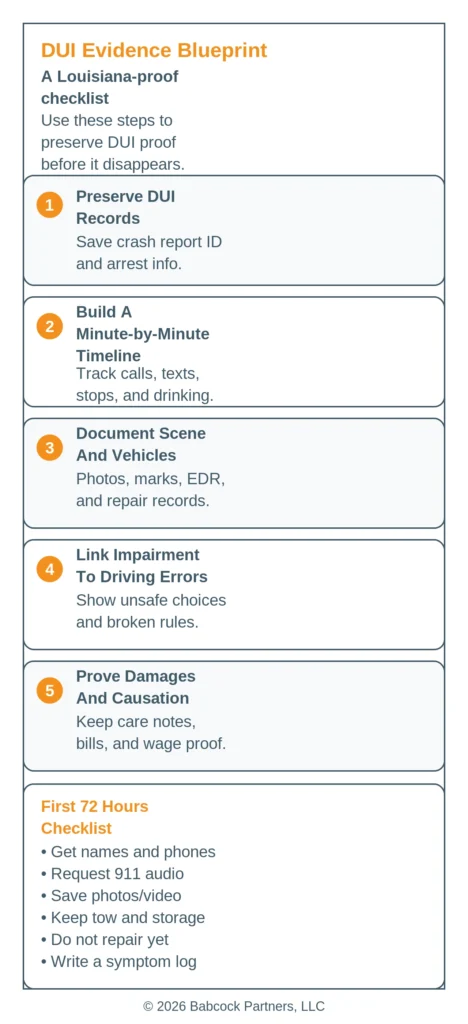
Download the printable toolkit (PDF) if you want the two infographics and a print-friendly checklist in one place. The toolkit is designed to be shared with family members who are helping you track records.

Can DUI Evidence Prove Fault In A Louisiana Injury Case?

Yes, DUI evidence can help prove fault because Louisiana allows recovery when someone’s fault causes damage under La. Civ. Code art. 2315. The key is showing how impairment led to the driving mistake, and Louisiana’s operating-while-impaired statute is often the starting point for what alcohol impairment means.

  • DUI evidence helps with: proving careless driving and rebutting “it was an accident” narratives.
  • You still must prove: how the driver’s conduct caused the crash and your injuries.
  • Best early focus: preserve video, testing paperwork, and the crash timeline.
  • Practical goal: turn DUI facts into civil-proof documents and timestamps.

A criminal DUI case and a civil injury case move on different tracks, and they do not always end the same way. Even if the driver is never convicted, a civil claim can still be supported by officer observations, testing records, and the physical evidence from the crash.

In other words, “DUI evidence to prove fault” usually means building a record that shows impairment plus a concrete driving error, such as speeding, lane drift, or failure to yield. This is why we treat the police file as only one piece of a larger timeline that includes vehicle data, video, and witness accounts.

What DUI Records Matter Most In The First 72 Hours?

The first 72 hours are about preservation, not perfection: you want to secure the records that get overwritten, lost, or repaired away. Focus on video, testing paperwork, and vehicle condition, because those items often decide whether DUI evidence stays usable in a civil claim.

Record To Preserve Why It Matters What You Can Do Now
Bodycam and dashcam video Shows impairment signs, statements, and the scene before it changes. Write down the agency, report number, and date/time; ask that video be preserved.
Breath/blood test paperwork Timing and chain-of-custody are common dispute points. Keep any paperwork you receive; save screenshots of jail booking or court info if visible.
911 audio and CAD logs Captures early observations and timestamps that support the timeline. Note who called 911 and when; save any texts or call logs related to the emergency.
Vehicle condition and data Damage patterns and EDR data can confirm speed and braking. Do not rush repairs; keep tow/storage paperwork and take detailed photos first.
Witness names and short notes Memory fades, and witnesses can be hard to locate later. Get names/numbers and ask for a brief text summary while the details are fresh.

This is why we move fast on preservation letters: video systems and storage policies can erase key minutes without warning. That is what we mean by leverage in DUI cases—protecting proof before the defense has a chance to argue it never existed.

Talk To A Lawyer Quickly If…

Some situations have an extra-fast evidence clock, even when the injury seems “minor” at first. If any of the issues below are present, treat it as a preservation problem and get help before records go stale.

  • The other driver was taken for blood testing or you heard there was a breath test.
  • Your vehicle is at a tow yard and repairs or salvage decisions are coming soon.
  • You are being pushed for a recorded statement or a quick release.
  • A business camera, bar camera, or neighborhood system may have captured the lead-up.

If the crash happened in Baton Rouge, local road layouts and camera coverage can matter, so it helps to document the exact location and direction of travel. You can also start with our Baton Rouge hub to see related crash resources, then keep this page focused on DUI evidence.

How Do You Build A DUI Timeline That Holds Up?

A strong timeline turns “the driver was drunk” into a set of timestamps that match the crash, the testing, and the observed driving behavior. Build it from independent sources—dispatch logs, receipts, phone data, and video—so it does not rely on any single document.

  1. Start with fixed times: crash time, 911 call time, officer arrival, and EMS transport.
  2. Add the DUI events: field sobriety tests, breath/blood draw time, and booking.
  3. Layer in movement proof: receipts, location history, ride or bar timestamps, and witnesses.
  4. Match actions to driving errors: speeding, lane drift, failure to yield, or delayed braking.
  5. Close the gaps: note anything unknown and identify what record could answer it.

When we build a DUI timeline, we write it so a reader can follow it without knowing the people involved. That is what we mean by leverage: a clean record can make it harder for an insurer to reframe the crash as “bad luck” instead of impaired driving.

Quick reference: the 5-step DUI evidence blueprint + the first-72-hours checklist. (Download the printable PDF below.)

What Evidence Connects Impairment To The Crash?

You connect impairment to the crash by pairing DUI evidence with a specific driving mistake and the physical proof that the mistake happened. Because NHTSA’s drunk driving resources tie alcohol impairment to crash risk, insurers often attack timing and testing, which makes your supporting evidence and timestamps important.

Driving Error Proof That Helps
Rear-end impact with late braking EDR data, skid marks, witness accounts, and dashcam video.
Lane departure or sideswipe Scene photos, debris patterns, lane markings, and vehicle scrape evidence.
Failure to yield at an intersection Signal timing, witness statements, camera footage, and point-of-impact mapping.
Speeding or loss of control Yaw marks, event data, roadway conditions, and repair estimates that show crush.

Even in a DUI case, insurers may argue that the crash was unavoidable or that your actions contributed. For a broader overview of how crash evidence is evaluated in negligence cases, our car accident case page explains common proof categories without turning this post into a generic guide.

If the crash caused a death, the evidence clock can be even faster because multiple agencies and insurers may get involved early. In that situation, our fatal car accident resource explains next steps for families, while this page stays focused on DUI evidence preservation.

What Defenses Do Insurers Raise In DUI Crash Claims?

Insurers often try to separate “drinking” from “causing the crash,” which is why documentation has to connect impairment to the mistake. Since CDC’s impaired driving facts emphasize how serious impaired driving remains, adjusters also know juries pay attention to credibility, and they look for gaps they can exploit.

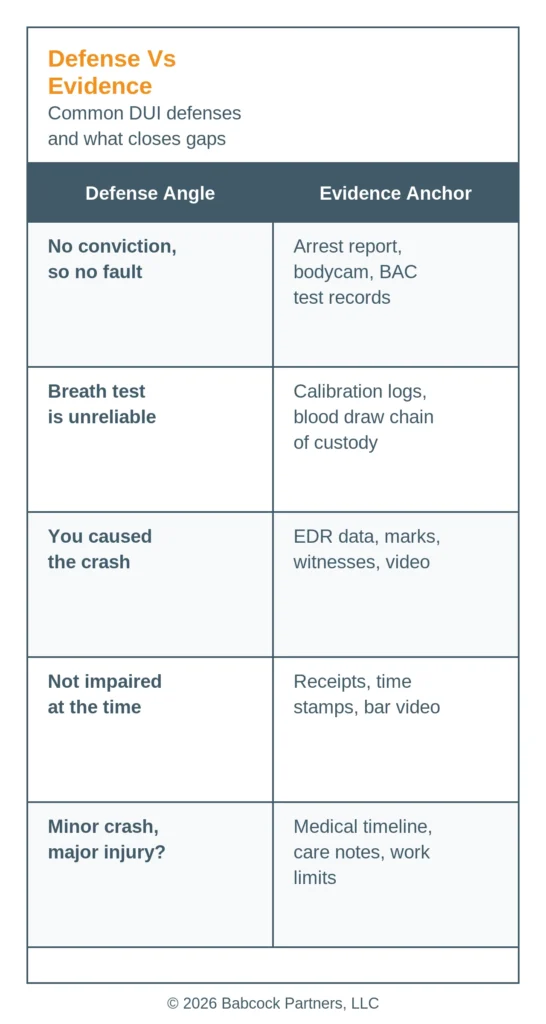
Defense Angle Evidence That Helps
“No conviction, so it doesn’t count.” Arrest report, bodycam, officer observations, and test paperwork with timestamps.
“The test is unreliable.” Calibration and maintenance logs, chain-of-custody, and lab documentation.
“You share fault.” Scene evidence, EDR data, witness statements, and consistent injury documentation.
“They weren’t impaired at the time.” Receipts, time-stamped video, phone location history, and dispatch logs.
“Minor crash, major injury?” Medical timeline, symptom logs, work limits, and notes that track functional change.

That is what we mean by leverage in the defense audit: we build the record that makes the insurer’s favorite story harder to sell. If you want a deeper overview of the strategy in these cases, we also cover it on our drunk driving accident claims page.

Common DUI defense narratives—and the documentation that closes the gaps.

What we see in practice

In real cases, DUI evidence is rarely “one document” that ends the dispute; it is usually a chain of records that has to be requested, preserved, and organized. We also see insurers test whether the claimant’s medical and work records line up with the crash timeline, because gaps make it easier to argue the injury is unrelated.

  • Video comes first: bodycam, dashcam, and nearby business cameras often decide credibility.
  • Testing gets challenged: timing, paperwork, and chain-of-custody questions are common.
  • Vehicle evidence disappears: repairs, salvage, and storage releases can erase proof.
  • Gaps get amplified: missed appointments or inconsistent statements become talking points.

What If The Driver Is Not Convicted Or The DUI Charge Is Reduced?

A civil claim can still move forward when the available records show impaired driving and a crash-causing mistake, even if the criminal case changes course. The practical question is whether you can prove what happened through documents and timestamps that hold up outside the criminal courtroom.

  • Focus on observable facts: officer notes, video, driving behavior, and the scene evidence.
  • Preserve testing context: timing, paperwork, and who handled samples can matter as much as a number.
  • Expect credibility attacks: insurers look for inconsistencies they can frame as “reasonable doubt.”

If you are asked to sign a release “just to get the DUI file,” slow down and get advice first, because releases can cover far more than records. This is why we try to separate preservation steps from settlement steps, so you do not trade away leverage for paperwork.

Download the printable toolkit (PDF) if you want a printer-friendly version of the evidence blueprint and the defense-audit table. It is designed to help you keep names, dates, and record sources consistent.

Louisiana Law Snapshot (Updated 2026)

Most Louisiana injury claims have a two-year delictual prescription period, and La. Civ. Code art. 3493.1 is the statute many crash cases start with when counting the deadline. Louisiana also uses comparative fault, and La. Civ. Code art. 2323 includes a post–Jan. 1, 2026 bar that can block recovery if a claimant is 51% or more at fault.

Rule Plain-English Meaning Why It Matters In DUI Evidence Cases
Two-year prescription The filing deadline can arrive faster than people expect. Preserving DUI records early helps you evaluate the claim before time runs out.
Comparative fault + 51% bar Fault can reduce recovery, and majority fault can block it. Insurers may push “shared fault,” so you want strong scene and timeline proof.


Talk With Babcock Injury Lawyers

We are not built for volume. We are built for leverage.

If you suspect impaired driving, the Babcock Benefit is about moving early, preserving proof, and preparing the case as if it could be tried. Call (225) 500-5000 and use the free case review form so we can triage the evidence clock, spot deadlines, and plan insurer communications.

These items are helpful to have with you when you call, but do not delay calling because you do not have them. If you have them handy, keep them nearby for the call.

  • Crash report number and investigating agency
  • Photos or video you already have
  • Tow yard, storage, and repair estimate paperwork
  • Names and contact info for witnesses and passengers
  • Medical visit dates and current symptoms

Call Today If…

  • The insurer is pushing a recorded statement or a quick settlement release
  • Your vehicle may be repaired, totaled, or released from storage soon
  • You believe bodycam, dashcam, or nearby video exists
  • The other driver’s testing timeline is unclear

What Happens Next

  • Evidence triage: we identify what can disappear first and issue targeted preservation steps.
  • Deadline spotting: we map prescription and notice issues based on your specific facts.
  • Insurer contact strategy: we control statements and submissions to avoid accidental proof gaps.

If you want a simple overview of how we approach these cases, see our help after a DUI crash page and then use the form below to send the basics.

×