

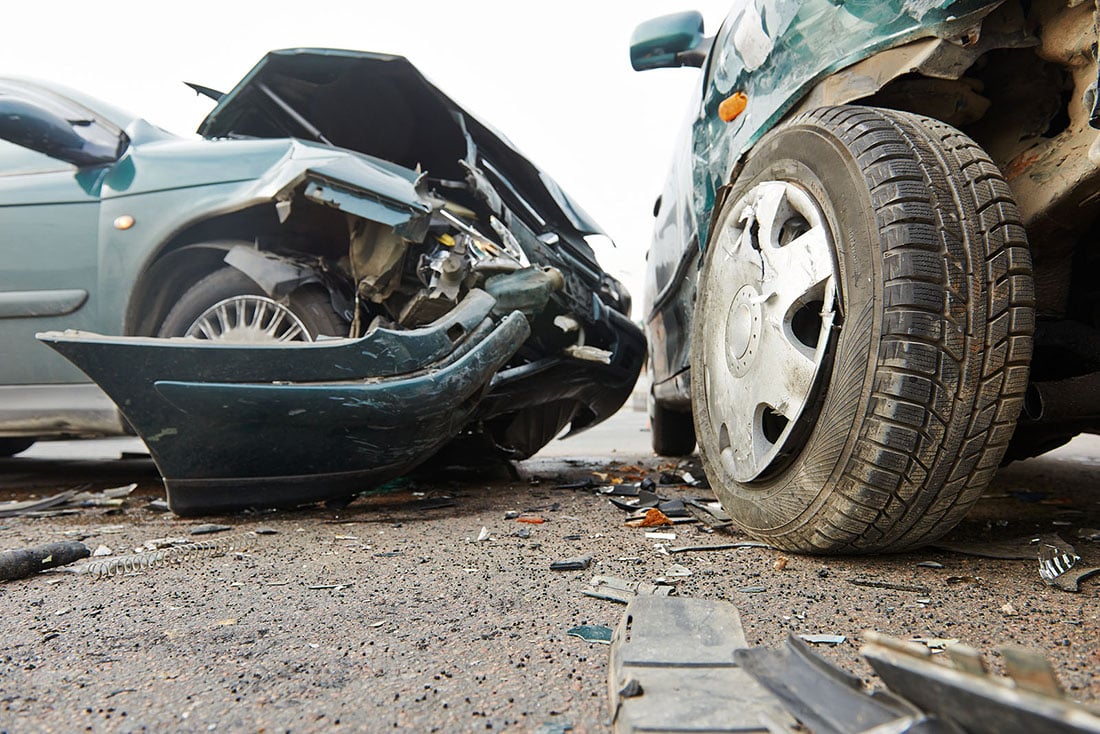
If a police vehicle hits you, begin as you would after any serious collision: get to a safe place, call for medical and law-enforcement help, identify witnesses, and photograph the scene. Then identify the agency and preserve records that may exist only because a government vehicle was involved.
An officer’s employment does not automatically decide fault. The legal analysis can depend on whether the officer was responding to an emergency, whether warning signals were in use, how the vehicles approached the collision, and whether either driver acted unreasonably.
Ask another agency to document the collision
Call 911 and explain that a law-enforcement vehicle is involved. If possible, ask which agency will investigate. An outside agency or different unit may respond, depending on the location and departments involved.
Record the police vehicle’s agency, unit number, license plate, and driver’s name. Obtain the investigating officer’s name and report number. If several agencies respond, note each one because they may hold different records.
Do not argue at the scene about who was at fault. Give accurate facts, avoid estimates you cannot support, and ask that your account and any witnesses be identified in the report.
Lights and siren matter, but they are not the whole inquiry
La. R.S. 32:24 allows specified privileges when an authorized emergency vehicle is responding to an emergency call, pursuing an actual or suspected violator, or responding to a fire alarm. The statute addresses conduct such as proceeding past a red signal after slowing as necessary for safe operation and exceeding a speed limit without endangering life or property.
The statutory exceptions apply only under the warning-signal conditions stated in the law. The statute also says those provisions do not relieve the driver from the duty to drive with due regard for the safety of all persons or protect the driver from the consequences of reckless disregard for safety.
The important facts may include when lights became visible, when a siren became audible, the officer’s route and purpose, traffic conditions, sight lines, speed, signal phase, and the opportunity each driver had to react. Do not assume that the presence or absence of one fact automatically decides the case.
Photograph the roadway as well as the vehicles
When it can be done safely, take wide photographs showing the intersection or road, traffic controls, lane markings, obstructions, lighting, weather, skid or tire marks, debris, and final vehicle positions. Then photograph every side of each vehicle and the interior features that changed during impact.
Photographs taken after vehicles are moved may not show their resting positions. If movement is necessary for safety, note the original locations in a simple diagram. Do not stand in traffic or interfere with emergency operations to take pictures.
Independent witnesses can clarify warning signals and timing
A witness may have heard a siren, seen lights, observed the signal color, or watched the officer’s path before impact. Obtain the person’s name and reliable contact information. Note where the witness was and what the person actually saw or heard.
Nearby businesses, homes, buses, and private vehicles may have cameras. Identify possible sources and the exact time promptly. Video can be overwritten even when a government agency follows its own retention schedule.
Government systems may hold several kinds of records
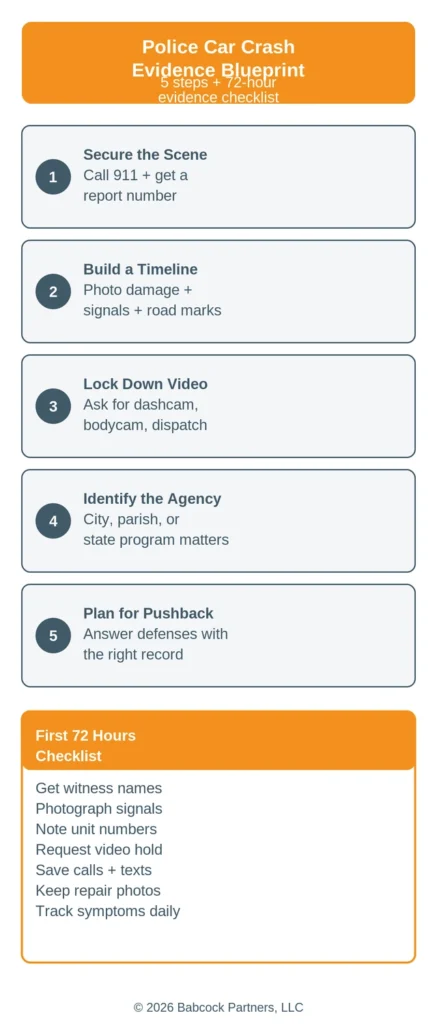
Depending on the agency and event, relevant material may include in-car video, body-worn camera video, dispatch or computer-aided dispatch entries, radio traffic, GPS or vehicle-location data, photographs, crash diagrams, incident reports, pursuit records, and vehicle inspection or repair records.
A precise preservation request should identify the date, time range, location, agency, unit number, report number, and categories of material. Send it to the correct records custodian and retain proof of delivery. A preservation request asks the agency to keep material; it is not the same as a request for immediate public release.
Public-record access has rules and exceptions
La. R.S. 44:31 states Louisiana’s general right to inspect, copy, or reproduce public records, subject to the Public Records Law and other specific law. La. R.S. 44:32 addresses requests and the custodian’s duties.
Not every law-enforcement record must be released immediately or in full. La. R.S. 44:3 contains exceptions and procedures for certain prosecutive, investigative, law-enforcement, and communications-district records. Other privacy, safety, evidentiary, and retention rules may also apply.
If an agency denies or limits a request, preserve the written response and the legal basis it cites. A disputed public-record request can raise issues separate from the injury claim.
Do not wait for the final report to preserve evidence
Louisiana State Police advises allowing time before requesting its completed crash reports and photographs. The agency’s Traffic Records Unit provides current request information.
A report delay is not a reason to wait on photographs, private-camera inquiries, witness contacts, or preservation requests. The final report may organize facts and identify statements, but it cannot restore material that disappeared while the report was pending.
The responsible public entity must be identified correctly
A police unit may belong to a city, parish sheriff, state agency, university, transit authority, or another public entity. The officer may have been working jointly with another department or driving a vehicle owned by a different entity.
Vehicle markings are a useful starting point, but confirm ownership and employment through reliable records. The correct entity affects where a claim is directed, which records custodian holds evidence, how service is made if litigation becomes necessary, and which statutory rules apply.
Special procedural rules may apply to a government defendant
Louisiana law contains rules specific to claims and suits involving the state, state agencies, and political subdivisions. Those rules can address issues such as service, payment, interest, trial procedure, and limits on certain damages. The correct rule depends on the identity of the defendant and the nature of the claim.
Do not assume that a phone call, crash report, public-record request, or ordinary insurance notice satisfies every procedural requirement. It may be useful to obtain legal review early when the responsible entity is uncertain or a deadline is approaching.
Comparative fault can still be disputed
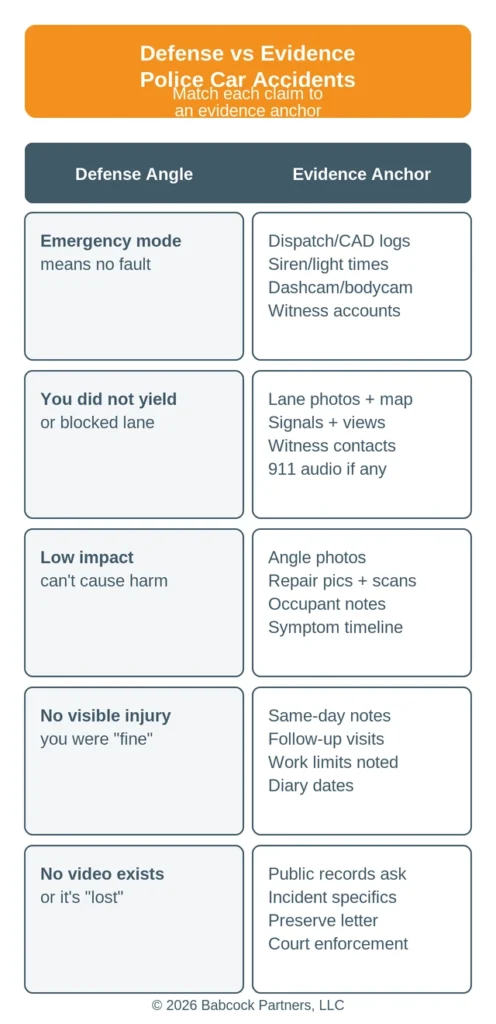
The public entity may argue that the civilian driver failed to yield, entered the intersection after warning signals were active, followed too closely, or otherwise contributed to the collision. The claimant may dispute whether the officer met the conditions for emergency privileges or exercised due regard.
For causes of action governed by the version effective January 1, 2026, Civil Code article 2323 bars recovery when the injured person’s negligence is 51 percent or more and reduces recovery proportionally when it is less than 51 percent. Earlier collisions may be governed by the prior version, so the collision date matters.
Objective timing evidence can be especially important. Dispatch entries, signal video, private surveillance, vehicle data, and witness locations may show whether a driver had enough warning and time to respond.
Medical and property documentation remain important
Seek medical care based on symptoms and professional advice. Describe how the collision occurred, when symptoms began, and whether the body struck anything inside the vehicle. Keep treatment records, work restrictions, wage information, mileage, and out-of-pocket expenses.
Before the vehicle is repaired, totaled, or salvaged, photograph all damage and ask whether the vehicle can be inspected if the impact mechanism is disputed. Save estimates, supplements, tow and storage receipts, rental records, and total-loss communications.
Build one chronology from all available sources
Write a factual timeline while memory is fresh. Include the route, lane, signal, first sight of the police unit, first sound of a siren, first visible warning lights, braking or evasive action, impact, and events after the crash. Identify the source for each time rather than forcing every source to agree.
Save claim numbers and communications from any insurer or risk manager. Do not guess about speed, distance, or emergency status. If information later corrects an earlier account, document the correction and why it was made.
When legal review may help
Focused review may be useful when several agencies were present, video or dispatch records may exist, the officer claims emergency privileges, the civilian driver was cited, fault is disputed, the vehicle will soon be disposed of, injuries are serious, or the correct public entity is unclear.
The firm’s car accident practice page explains the general claim process. Related guides address intersection evidence and vehicle damage documentation.