

The first sign of an injury may come after the tow truck has left and you are home trying to resume your day. Perhaps your neck becomes stiff that evening, or a headache and trouble concentrating appear the next morning. The sensible next step is a medical assessment, not an assumption that the symptom is either harmless or necessarily caused by the crash.
Urgent symptoms come first
After a possible head injury, call 911 or seek emergency care for danger signs such as a worsening headache that does not go away, repeated vomiting, seizures, weakness, slurred speech, increasing confusion or an inability to wake up. CDC lists these among concussion danger signs. Medical care should not wait while you collect photographs, contact an insurer or arrange a legal consultation.
If you have already been examined, follow the return precautions in your discharge instructions. New symptoms or a significant change may require another assessment. For concerns that are not emergencies, contact your treating clinician promptly and explain what has changed.
A symptom can develop later without changing what you felt earlier
CDC explains that mild traumatic brain injury symptoms can appear hours or days after an injury. Whiplash symptoms can also be delayed. Timing varies, and these general patterns cannot diagnose an individual injury.
If you said you were fine at the scene, be candid about it. Explain that you did not notice symptoms then, followed by what you noticed later. Do not change an earlier account to make the timeline look simpler. A clinician needs the actual sequence, including any prior condition or other event that may help explain the symptoms.
Make the record specific and balanced
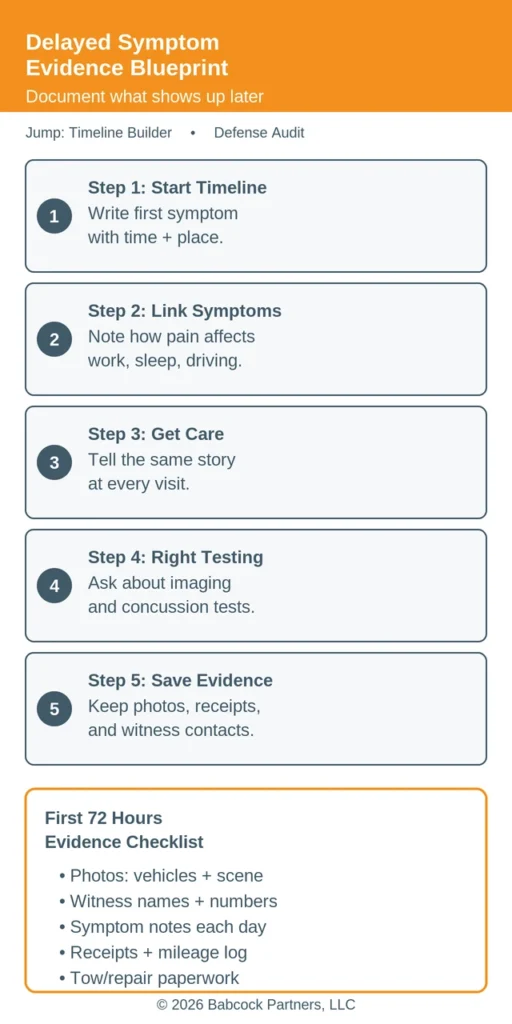
A brief note made when something changes can help you give an accurate history. Useful details include where the pain occurs, what you were doing when you noticed it and how it affects ordinary tasks. “I could not turn far enough to check my blind spot this morning” conveys more than a general statement that everything hurts.
Include improvements, days without a symptom and activities you can still do. Do not force a precise onset time if you only remember that it began sometime that evening. The point is an honest record for your care and recollection, not a script for an insurance claim.
Follow through on medical advice and explain obstacles
Keep discharge instructions, referral information, test reports and the names of treating providers. Tell the clinician about previous injuries, medications and similar symptoms before the collision. Ask questions if you do not understand a restriction or follow-up recommendation.
If cost, transportation or work prevents a visit, contact the provider to discuss options. Record what happened rather than leaving a gap that you may struggle to explain months later. Treatment decisions should be based on medical needs and professional advice. There is no reason to obtain unnecessary treatment merely to make a claim look stronger.
What delayed symptoms mean for an injury claim
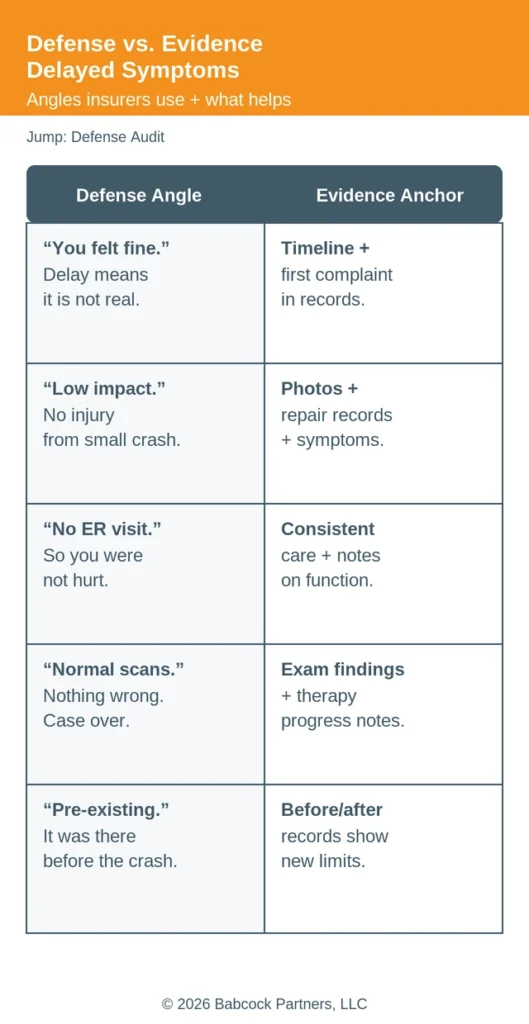
The legal question is not simply whether symptoms appeared after the collision. The claim must establish the required connection between the crash and the injury. Medical history, examination findings, the collision circumstances and other evidence may all bear on that question. A later diagnosis does not automatically prove causation, and an initially quiet symptom history does not automatically disprove it.
Preserve the crash photographs, witness contacts and report information you already have. Save correspondence with insurers and give truthful information. If an adjuster asks why you initially declined treatment, describe what you knew and felt at that time. Do not invent a medical explanation or guess about something you do not remember.
Check a release and the deadline before making decisions
A settlement release may end the claim even if you later need more care. Before signing, understand what claims it covers and how much remains uncertain about your condition. Waiting a set number of days does not by itself resolve that uncertainty.
Louisiana’s general two-year tort period under Civil Code article 3493.1 applies to claims arising on or after July 1, 2024, subject to applicable exceptions. Do not assume that discovering a symptom later automatically restarts the clock. Older collisions and claims governed by special procedures require separate analysis.
Fault also requires attention to the applicable law. The change to article 2323 effective January 1, 2026 reduces recovery for a claimant’s share of fault below 51 percent and bars recovery at 51 percent or more when that rule applies. A medical timeline and an assessment of responsibility for the crash serve different purposes; both may need investigation.
Our car accident practice can help evaluate the claim and the records needed. Call (225) 500-5000 with the collision date, the symptoms being evaluated and any insurance correspondence. You can ask for legal guidance while medical evaluation continues, but urgent symptoms belong with a medical professional first.