Editorial & Legal Accuracy Notice (Louisiana)
This blog contains general legal and safety information and is not legal advice. Laws and deadlines can change, and outcomes depend on specific facts.
Last reviewed / updated: March, 2026
Reviewed, updated, and authored by: Stephen Babcock, Louisiana injury lawyer
This guide explains why crash injuries can show up later, which symptoms deserve fast medical attention, and how to document a clean timeline for an insurance claim. It is written for Louisiana drivers who want practical, evidence-first steps after a wreck.
Delayed pain after a crash can feel like a bad surprise, but it is a common pattern in neck, back, and concussion-type injuries. The key is to treat the delay as an evidence problem, not just a comfort problem. If you want a primer on Louisiana claim steps, start with our Baton Rouge car accident page and then use the timeline tools below.
Our job is to turn a confusing symptom timeline into clear, provable facts. We are not built for volume. We are built for leverage. Speed + evidence preservation + insurer-insider knowledge + trial-ready preparation = The Babcock Benefit. In delayed-symptom car crash cases, leverage usually means getting the record right before an insurer locks in its story.
If you are inside the first 72 hours, call (225) 500-5000 or use the free case review form before evidence changes.
Firm links: Client Reviews | Contact | Locations
Want a print-friendly version you can share with family? Download the printable toolkit (PDF).
Why Do Symptoms Appear Days After A Car Accident?
Neck and soft-tissue injuries can have delayed pain, and MedlinePlus’s whiplash overview explains it may take hours to weeks to develop. A second reason is timing, and Cleveland Clinic’s whiplash guide notes some symptoms take at least 12 hours or even days to show up.
- Inflammation builds: swelling and muscle tightness can peak the next day.
- Movement reveals limits: driving, lifting, and sleep can expose pain you did not notice at the scene.
- Brain symptoms can evolve: headache, fogginess, or light sensitivity may worsen after you go home.
- Documentation lags: if your first written note is days later, the insurer may treat the delay as a gap.
What Delayed Symptoms Should You Take Seriously?
When symptoms involve your brain, vision, strength, or coordination, treat them as urgent, and CDC’s HEADS UP concussion signs and danger warnings outlines red-flag patterns that call for emergency evaluation. For more typical concussion symptoms, Johns Hopkins Medicine’s concussion overview notes headaches, dizziness, nausea, and thinking problems can occur right away or worsen over time.
| Symptom Pattern | Why It Matters | What To Do Next |
|---|---|---|
| Worsening headache, repeated vomiting, confusion, or seizure-like activity | These can signal a serious brain problem that needs fast evaluation. | Seek emergency care and bring the crash details with you. |
| Neck pain with numbness, tingling, or weakness into an arm | Symptoms can overlap with nerve irritation that needs clinical assessment. | Get checked and describe the exact onset and spread of symptoms. |
| Back pain with new leg numbness, weakness, or bowel/bladder changes | Neurologic symptoms can signal a higher-stakes spine issue. | Seek urgent evaluation and do not self-diagnose. |
| Chest pain or shortness of breath | Some conditions are time-sensitive and should not be “waited out.” | Seek urgent evaluation and tell clinicians you were in a crash. |
Talk To A Lawyer Quickly If Your Symptoms Change Fast
If your symptom picture is changing day to day, the claim can turn on what was documented first and what was missed. Quick legal help can also reduce the risk of an early recorded statement framing your delay as “not real.”
- Symptoms worsen after you told an adjuster you were “okay.”
- You are asked to sign a broad medical release before you have a diagnosis.
- Your vehicle is scheduled for repair, teardown, or salvage within days.
How Do You Prove Delayed Symptoms Came From The Crash?
In Louisiana, a delayed-symptom claim is stronger when the record shows a clear before-and-after change tied to the crash, which matches the fault-and-damages framework in La. Civ. Code art. 2315. That is what we mean by leverage: you make the timeline, medical notes, and real-life limits match before the insurer writes its own version.
- Crash mechanics: photos, impact points, and repair records that explain force and motion.
- Symptom timeline: first complaint, follow-ups, and day-to-day changes.
- Consistent care: the same story in every visit note, without major gaps.
- Testing and exams: imaging and clinical findings that fit the complaint.
- Non-medical proof: work limits, sleep disruption, and family observations.
If you are dealing with head symptoms, our brain injury practice page explains how documentation gaps become defense themes in real cases.
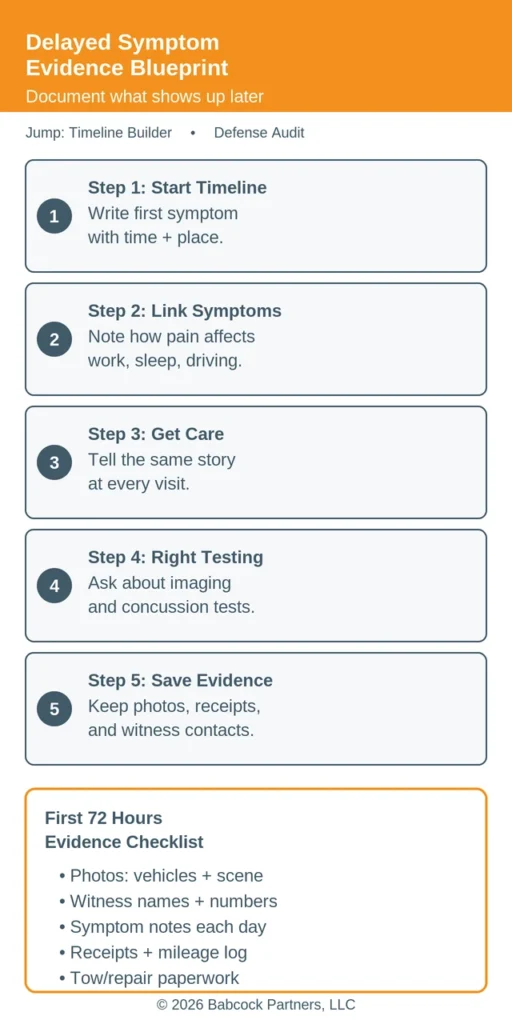
Timeline Builder: A 14-Day Symptom Log You Can Use
Use a simple 14-day log so your first visit, follow-ups, and daily function limits stay consistent. Because Mayo Clinic’s whiplash overview says symptoms often start within days, daily notes help show when problems began and how they changed.
| Date/Time | Symptom | Trigger | What You Could Not Do | Care/Meds |
|---|---|---|---|---|
| Day 1 | ________ | ________ | ________ | ________ |
| Day 2 | ________ | ________ | ________ | ________ |
| Day 3 | ________ | ________ | ________ | ________ |
| Days 4–14 | Repeat daily in one short entry: symptom level, activity limits, and what changed. | |||
Mini checklist for each entry:
- Where is the pain, and what number is it today?
- What activity made it worse?
- What did you stop doing because of it?
- What did you take or try for relief?
Soft-tissue injuries are often documented through pain, swelling, and function limits, and Cleveland Clinic’s soft tissue injury guide describes those common symptoms. If your complaint is headache, dizziness, or “brain fog,” CDC’s mild TBI symptom list can help you describe the pattern clearly to a clinician.
This is why we build the first 72-hour file early—photos and notes get harder to recreate later.

Defense Audit: What Insurers Usually Argue About Delayed Symptoms
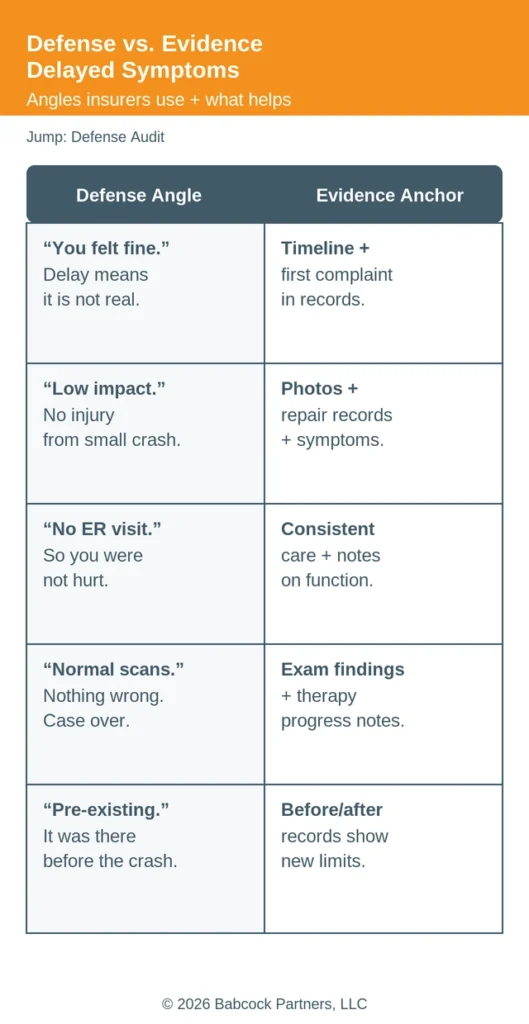
Insurance adjusters rarely argue that you have zero pain; they argue that the pain is unrelated, minor, or already there. The fix is to build evidence that answers each narrative with one specific record item.
| Defense Narrative | Evidence That Helps |
|---|---|
| “You felt fine, so the injury is unrelated.” | Timeline entry + first complaint date in medical notes + a consistent story. |
| “Low impact means no injury.” | Photos, repair records, and symptom notes that match the body mechanics. |
| “No ER visit means you were not hurt.” | Prompt evaluation when symptoms started + follow-up care without big gaps. |
| “Normal imaging means nothing is wrong.” | Exam findings, therapy notes, and function limits that track the complaint. |
| “It was pre-existing.” | Before/after records showing what changed after the crash. |
This is why we audit the defense themes up front; once an insurer labels a crash “minor,” every later record is read through that lens. You can see how we build that record on our car accident practice page without turning your claim into a paperwork maze.

What we see in practice
Delayed symptom cases are won or lost on documentation, not drama. We see the strongest files when the medical notes, daily function limits, and crash evidence tell the same story.
- People often downplay symptoms at the scene and then struggle to explain the change later.
- Gaps in care become “gap in injury” arguments, even when the person was trying to work through pain.
- Photos and repair records disappear fast, especially when the vehicle is repaired or totaled.
- A clean timeline makes settlement talks more honest because it removes easy disputes.
What To Avoid In The First Two Weeks
The most common claim mistake is letting the paperwork get ahead of the symptoms. A clean timeline is easier to defend than a story that changes because it was never written down.
- Do not guess: if you are unsure about onset time, say “approximate” and update later.
- Do not minimize: tell clinicians what you cannot do, not just what hurts.
- Do not sign broad releases fast: ask what time period and providers the insurer wants.
- Do not “tough it out” in silence: gaps in care are often framed as gaps in injury.
If you want a one-page checklist you can hand to a spouse or friend, Download the printable toolkit (PDF).
Louisiana Law Snapshot (Updated 2026)
Louisiana’s two-year delictual prescription generally applies to injury claims, and La. Civ. Code art. 3493.1 explains when that two-year period starts. Fault also matters, and La. Civ. Code art. 2323 includes a post–Jan. 1, 2026 rule that bars recovery if your fault is 51% or more.
- Do not wait for “day 14”: delayed symptoms can still be real, but late documentation creates avoidable disputes.
- Be careful with statements: comparative fault fights often start with a single recorded quote.
- Rear-end basics still matter: following too closely is addressed in La. R.S. 32:81 and shows up in many crash fact patterns.
Talk With A Lawyer About Delayed Symptoms
We are not built for volume. We are built for leverage. If your symptoms showed up later, the Babcock Benefit means moving fast on evidence and building a record that is ready for negotiation or trial, without hype or promises.
Call (225) 500-5000 and use the free case review form so we can triage the evidence clock, spot deadlines, and reduce insurer pressure. For more on the claim process, you can also start with help with a delayed-injury crash claim and then gather what you have.
These items are helpful to have with you when you call, but do not delay calling because you do not have them. If you have them handy, keep them nearby for the call.
- Crash report number (if you have it) and the other driver’s insurance details
- Photos of vehicles, scene, and visible injuries
- Your first symptom notes and the 14-day timeline entries
- Provider names, visit dates, and any work notes
- Repair estimates, tow invoice, and rental paperwork
Call Today If…
- Your symptoms are worsening or you have new neurologic signs
- An adjuster wants a recorded statement or a broad medical release
- Your vehicle is being repaired, totaled, or moved from a tow yard
- You are missing work and need clean documentation fast
What Happens Next
- We triage evidence: photos, witnesses, records, and timeline gaps that can be fixed now.
- We spot deadlines and fault issues early so the case does not get boxed in by paperwork.
- We manage insurer contact strategy so your story stays consistent across the claim.