

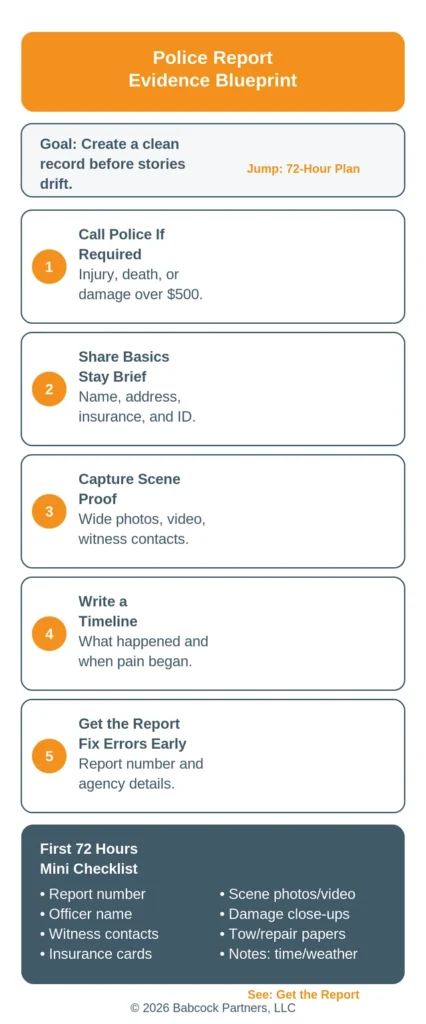
Louisiana requires drivers to notify law enforcement after a crash involving injury, death, or property damage over $500. The report is also a useful starting record of the people, vehicles, location, and accounts of what happened. It does not replace medical care or the other evidence needed to understand an accident.
Which agency should you call?
R.S. 32:398 directs drivers to notify local police when the crash occurs within an incorporated city or town. Outside those limits, notice goes to the nearest sheriff’s office or state police station. Notice is generally required immediately.
The statute contains a specific exception for crashes in an area under an evacuation order or declared state of emergency: the notice and information-exchange requirements in paragraphs A(1) and A(2) must be completed within 72 hours of the crash. That is a statutory exception, not a general three-day reporting allowance. If someone is hurt or there is an immediate danger, call 911 and explain the situation.
Give the facts you know
Provide your name, address, vehicle registration information, and requested license information. Have insurance details available as well. Describe what you actually saw: the direction of travel, lane, signal, impact, and where the vehicles stopped. If you did not see something or cannot estimate a distance, say so.
R.S. 32:1023 addresses false information in crash reports. Accuracy matters more than a polished account. If you later remember a detail or locate a witness, ask the investigating agency how to provide supplemental information.
Tell the officer about symptoms you are experiencing without trying to diagnose them. A statement that you do not yet know whether you are injured is different from a medical finding that there is no injury.
If an officer does not come to the scene
Ask the dispatcher how to complete the report and whether there is an incident number. Record the agency contacted and the time of the call. Follow instructions, and do not assume that an agreement between drivers to handle the damage privately eliminates a reporting obligation.
From a safe location, exchange identifying and insurance information and obtain witnesses’ contact details. Preserve photographs of vehicle damage, the roadway, traffic controls, and the vehicles’ positions if that can be done without entering traffic or delaying emergency assistance. Do not chase a driver who leaves.
Write a short account while the events are fresh. Include what you know and identify what remains uncertain. Keep the original photos and videos, tow paperwork, repair estimates, and messages with the other driver or insurer.
Request the report from the investigating agency
If Louisiana State Police investigated, begin with the LSP Traffic Records Unit and its official crash-report portal. For a city police or sheriff’s report, contact that agency’s records office. Have the date, location, driver names, and report number available.
A report may not be available immediately. Under R.S. 32:398, eligible requesters may obtain it within seven working days following completion of the investigation. The completion date matters; that language does not promise a finished report seven days after every crash.
Read the details before relying on the report
Check the names, vehicles, location, diagram, witness information, and description of the collision. If a factual detail is wrong, contact the agency, identify the specific entry, and provide supporting material. Keep a copy of the correction request. The agency may have a supplement procedure; a request does not guarantee that the officer will change a disputed conclusion.
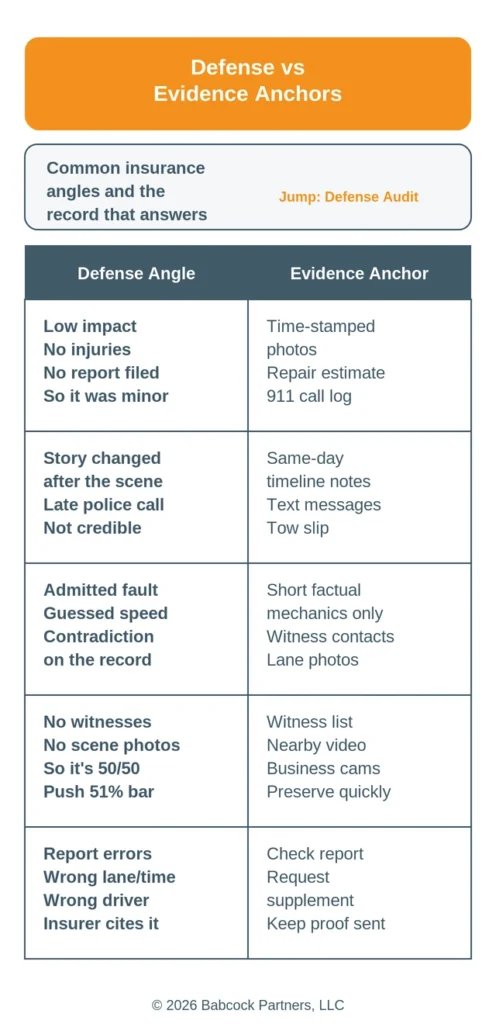
A missing witness or incomplete diagram is a reason to look for additional evidence. It should not be filled in with an assumption. For example, save available dashcam footage and identify nearby businesses with cameras before their recordings are routinely overwritten.
The police report does not determine every claim issue
Reporting the collision, notifying an insurer, and filing a lawsuit are separate steps. Do not wait for a final report without checking the filing deadline. Civil Code article 3493.1 supplies a general two-year period for delictual actions arising from incidents on or after July 1, 2024. Earlier incidents and particular claim types require separate analysis.
Civil Code article 2323 governs comparative fault. Under the rule effective January 1, 2026, a claimant’s negligence of 51 percent or more bars recovery, while a lower percentage reduces damages proportionally. The law applicable to the accident date and all available evidence must be considered, rather than treating a report as the entire case.
If an insurer has rejected the claim, our article on responding to an accident-claim denial explains how to separate coverage, fault, and medical disputes. Our Baton Rouge car-accident practice can review a missing or disputed report with the other records. Call (225) 500-5000 or use the form below.