Baton Rouge Car Accident Prevention Tips for Teens and Young Drivers (Updated 2026)


Editorial & Legal Accuracy Notice (Louisiana)

This blog contains general legal and safety information and is not legal advice. Laws and deadlines can change, and outcomes depend on specific facts.

Last reviewed / updated: March, 2026

Reviewed, updated, and authored by: Stephen Babcock, Louisiana injury lawyer

This guide focuses on Baton Rouge car accident prevention steps you can use immediately and a simple documentation plan if a crash still happens. It also explains how early choices can affect both safety and any later claim process.

Baton Rouge car accident prevention is not about perfect driving; it is about lowering the odds of surprise. When you keep space, manage speed, and reduce distraction, you buy time to brake or steer. This post gives practical habits you can repeat on local streets and highways, plus a proof checklist if a collision still happens.Our approach is to combine road-safety habits with evidence habits so you can protect yourself now and protect the record later: We are not built for volume. We are built for leverage. Speed + evidence preservation + insurer-insider knowledge + trial-ready preparation = The Babcock Benefit. That is what we mean by leverage for car accident prevention in Baton Rouge: fewer crashes, and cleaner proof when one is unavoidable.If you want a one-page version of the checklists, this post includes two infographics and a printable toolkit. You can scan the page now, then save the PDF for later so your plan is in one place.

Firm links: Client Reviews | Contact | Locations

Want a print-friendly version of the checklists and both infographics? Download the printable toolkit (PDF) and keep it on your phone or in your glove box.

If you are inside the first 72 hours, call (225) 500-5000 or use the free case review form before evidence changes.

How Can You Prevent Car Accidents in Baton Rouge?

You prevent most crashes by controlling speed, leaving space, and eliminating distraction, especially at intersections and in rain. The goal is simple: reduce surprise moments and keep enough time to brake or steer while you drive.

  • Set a speed that matches rain, darkness, and traffic flow.
  • Keep a 3+ second following gap, and add time when roads are wet.
  • Scan intersections early, and assume someone may run late.
  • Silence the phone, set navigation, and keep your eyes up.
  • Use signals early and avoid last-second lane changes.

If a crash still happens, the next steps can affect both safety and the paper trail. Our Baton Rouge car accident practice page explains the kinds of evidence and documentation that often matter in Louisiana claims.

NHTSA’s distracted driving guidance describes how visual, manual, and cognitive distraction can raise crash risk even when you feel in control. NHTSA’s speeding overview notes that higher speed increases both crash risk and injury severity.

Top Prevention Moves on Baton Rouge Roads

The highest-value prevention moves are the ones that give you more time: more time to see, decide, and brake. In Baton Rouge, that usually means slowing down for rain, backing off when traffic compresses, and treating intersections as hazard zones.

Situation Common Risk Safer Move
Stoplights and left turns Late red-light entries and failure to yield Cover the brake, scan cross-traffic, and enter on green with a pause
Stop-and-go traffic Chain-reaction rear-end collisions Leave a longer gap and watch two cars ahead
Rain and glare Hydroplaning and delayed stopping distance Slow down early, increase following distance, and avoid sudden steering
Highway merging Last-second lane changes and blind spots Signal early, match speed, and keep an escape route

Space and Following Distance

Following distance is the simplest way to prevent a crash you did not “see coming.” Louisiana’s following-too-closely rule in La. R.S. 32:81 uses a reasonableness standard, and the safe driving version is to leave a time gap you can actually keep. When the car ahead brakes hard, that gap is your airbag before the airbag.

Intersections and Turns

Intersections create conflict points: turning traffic, oncoming traffic, and pedestrians all converge. FHWA’s proven safety countermeasures on turn lanes show how design can reduce crashes, but as a driver you still have to slow down and scan early. If your collision involved a failure-to-yield or red-light issue, our intersection collision page covers common fact patterns and proof points.

Distraction and Speed

Distraction and speed work together to erase reaction time. If you want a focused breakdown on what counts as distraction and how it shows up in claims, read our distracted driving resource. If speed was involved, our speeding accident guidance explains why investigators and insurers often scrutinize speed, braking, and following distance.

First 72 Hours: What to Do After a Crash

The first 72 hours are about safety first and documentation second, because the scene changes fast. If everyone is safe, you want to capture the facts while they are still fresh and before vehicles are repaired or towed.

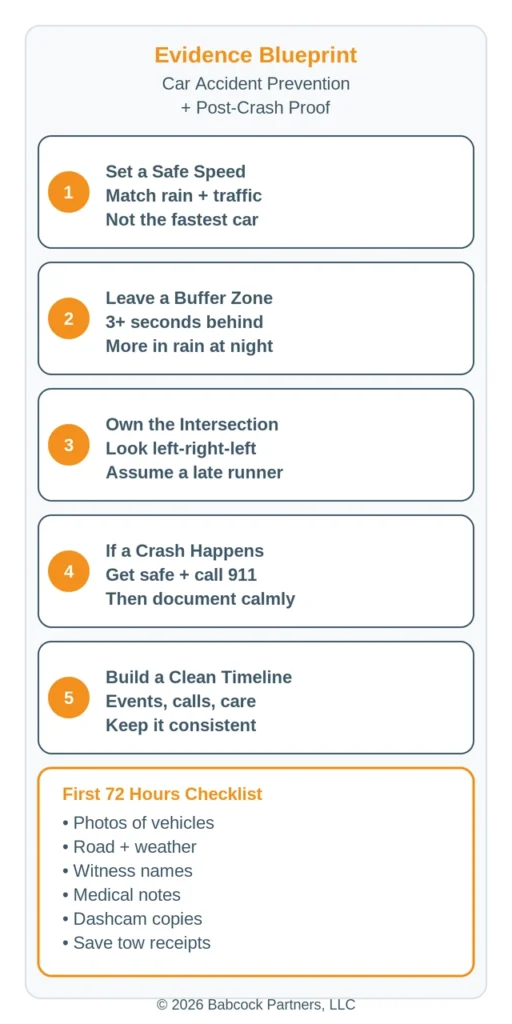
  1. Get to a safe spot if you can, call 911, and accept medical help if needed.
  2. Photograph the whole scene: lanes, signals, skid marks, debris, and weather.
  3. Get names, phone numbers, and insurance details, and note witnesses.
  4. Save dashcam video and phone navigation history, and back it up.
  5. Write a short timeline the same day: pain, symptoms, and missed activities.

This is why we encourage people to take wide photos before zooming in: wide shots anchor where everything was, and they are hard to recreate later. This is also why we tell families not to delay on dashcam requests, because overwrite loops can erase key minutes.

NHTSA’s seat belt information explains how belts help prevent ejection and reduce serious injury, which is one reason crash dynamics can change outcomes quickly. Even when your crash looks “minor,” keep notes on pain and function, because discomfort often shows up after the adrenaline fades.

Timeline Builder: Build a Clean Record From Day One

A simple, consistent timeline can help you stay organized and can prevent confusion later. The goal is not to write a novel; it is to capture dates, symptoms, and practical impacts in plain language.

Time Window What to Capture
Same day Scene photos, witness info, vehicle details, and a short “what happened” note
24–72 hours Symptom and sleep notes, missed work or family tasks, and medical visit summaries
First 2 weeks Follow-up appointments, medication changes, work restrictions, and pain triggers
Ongoing Receipts, mileage to appointments, repair updates, and communication logs
Quick reference: the five-step prevention-and-proof blueprint plus a first-72-hours checklist. Use the PDF toolkit if you want a printable copy.

Defense Audit: How Insurers Try to Shift Fault

After a crash, insurers often test stories that reduce what they have to pay, especially around speed, distraction, and shared fault. You cannot control what an adjuster argues, but you can control what the record shows through photos, timelines, and consistent documentation.

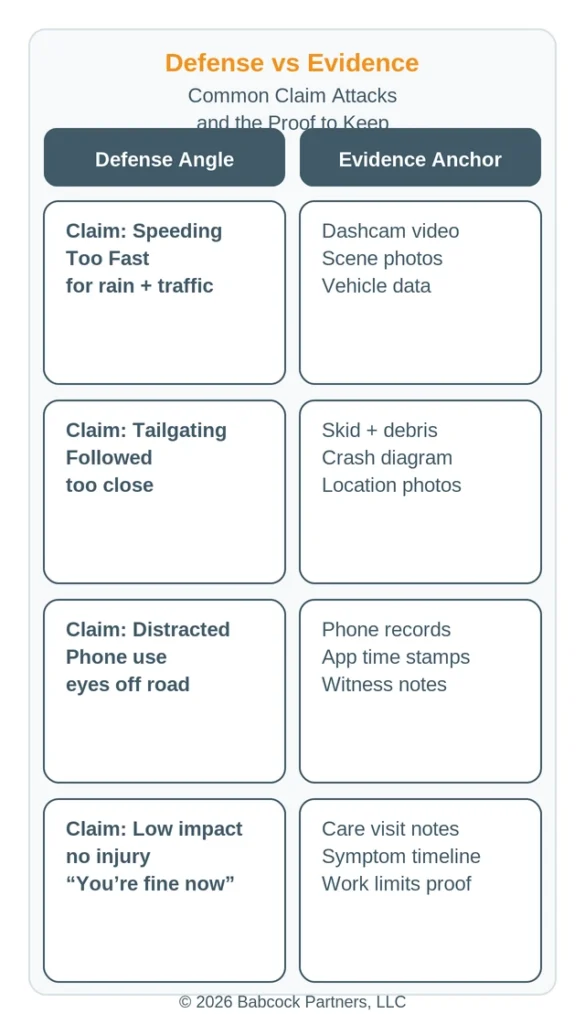
Common Defense Angle Evidence That Helps
“You were speeding” or “too fast for conditions” Dashcam footage, scene photos, weather notes, and a clear time-stamped timeline
“You followed too close” Wide scene photos, skid marks, witness information, and crash report details
“You were distracted” Phone records, app time stamps, dashcam audio, and witness observations
“Low impact means no injury” Prompt medical notes, a symptom timeline, and documentation of work and daily limits

That is what we mean by leverage: when the documentation is steady, there is less room for a defense narrative to grow. The earlier you preserve the facts, the less you have to argue about them later.

Common defense narratives—and the documentation that keeps the record clear.

What we see in practice

In real cases, the biggest problems usually come from missing proof, not from a lack of pain or inconvenience. We often see preventable gaps happen in the first week, when vehicles are repaired, witness memories fade, and timelines become fuzzy.

  • Photos are close-up only, with no wide shots to show lane positions or signals.
  • Dashcam video is overwritten or never copied off the device.
  • People try to “tough it out,” then the timeline looks inconsistent later.
  • Adjusters push for a quick recorded statement before facts are gathered.
  • Repair and rental records are scattered instead of saved in one folder.

We do not need you to be perfect; we need the story to be clear. When you can show what happened, what changed in your life, and what you did to respond responsibly, you create leverage through clarity.

When Should You Talk to a Lawyer After a Baton Rouge Car Crash?

You should talk to a lawyer quickly when injuries are involved, fault is disputed, or the evidence is likely to disappear. Early help is also important when the insurer is pushing for a recorded statement or a fast release before you understand the full picture.

  • You were taken to the ER, missed work, or symptoms are getting worse.
  • There is a dispute about who caused the crash or who had the right of way.
  • A commercial vehicle, rideshare, or delivery driver is involved.
  • You suspect video exists, but it may be deleted or overwritten soon.
  • The adjuster is pushing for a quick settlement or broad medical release.

If you want a focused overview of how these cases are evaluated, start with our car crash claim help page, then keep this prevention-and-proof checklist handy. If you are looking for local resources, the Baton Rouge hub lists core practice areas and links.

For a print-friendly version of the checklist, Download the printable toolkit (PDF) and save it where a family member can find it. The toolkit is designed to help you document what matters without adding stress.

Louisiana Law Snapshot (Updated 2026)

Louisiana’s two-year delictual prescription rule in La. Civ. Code art. 3493.1 is a key reason to act early, because waiting can threaten your ability to bring a claim. Louisiana’s comparative fault rule in La. Civ. Code art. 2323 also matters because fault percentages can reduce recovery, and the statute reflects a post–Jan. 1, 2026 51% bar in many cases.

Rule Plain-English Meaning
Two-year deadline Most injury claims must be filed within two years, and missing the deadline can end the case
Comparative fault Fault can reduce damages, and being more than 50% at fault can bar recovery in many situations

Free Case Review: Build Leverage Before Evidence Disappears

If a Baton Rouge crash has already happened, use this page as a checklist for what to do next and what not to lose. We are not built for volume. We are built for leverage.

  • Video gets overwritten, vehicles get repaired, and scenes change quickly.
  • Insurance narratives start early, and silence can be filled with assumptions.
  • Deadlines and fault rules can apply even while you are trying to recover.

Our Babcock Benefit approach is simple: move fast on evidence, keep the story consistent, and prepare the file as if it may be tried. Call (225) 500-5000 and use the free case review form to start an evidence triage. If you want the big-picture overview first, review basics on our car accident case page.

These items are helpful to have with you when you call, but do not delay calling because you do not have them. If you have them handy, keep them nearby for the call.

  • Crash location, date/time, and the other driver’s insurance information
  • Photos/videos, witness contact info, and any dashcam files
  • Crash report number or the agency that responded
  • Medical visit names and dates, plus any work notes
  • Tow, rental, and repair paperwork

Call Today If…

  • You have head, neck, back, or shoulder symptoms that are changing day to day.
  • The insurer is pushing for a recorded statement or a quick release.
  • Fault is disputed, or you are being blamed for speed or following distance.
  • A company vehicle or commercial driver is involved.
  • You believe surveillance or traffic video exists but may be deleted soon.

What Happens Next

  • We triage evidence first: video, photos, vehicle data, witnesses, and the timeline.
  • We spot deadlines and liability issues early so nothing is missed.
  • We manage insurer communications so the claim record stays consistent and clean.
×