Editorial & Legal Accuracy Notice (Louisiana)
This blog contains general legal and safety information and is not legal advice. Laws and deadlines can change, and outcomes depend on specific facts.
Last reviewed / updated: March, 2026
Reviewed, updated, and authored by: Stephen Babcock, Louisiana injury lawyer
This guide explains when a “no injury” crash can still justify a claim in Louisiana, what evidence matters, and how to avoid paperwork that quietly closes your options.
A car wreck can be expensive even when everyone walks away feeling fine. The hard part is that “not hurt” gets treated like “no loss,” and that is not how real-world claims work. Below is a practical framework for preserving proof and keeping the claim focused on what you can actually document.
Our approach is to treat even a “minor” crash like an evidence problem, not a paperwork problem, so the file has leverage even when you are not hurt. We are not built for volume. We are built for leverage. Speed + evidence preservation + insurer-insider knowledge + trial-ready preparation = The Babcock Benefit.
If you are asking whether you can sue for a car accident if you are not hurt, start by separating two questions: what you can claim, and what you can prove. Once you build a clean paper trail, most disputes become about numbers and fairness instead of confusion.
If you are inside the first 72 hours, call (225) 500-5000 or use the free case review form before evidence changes.
Firm links: Client Reviews | Contact | Locations
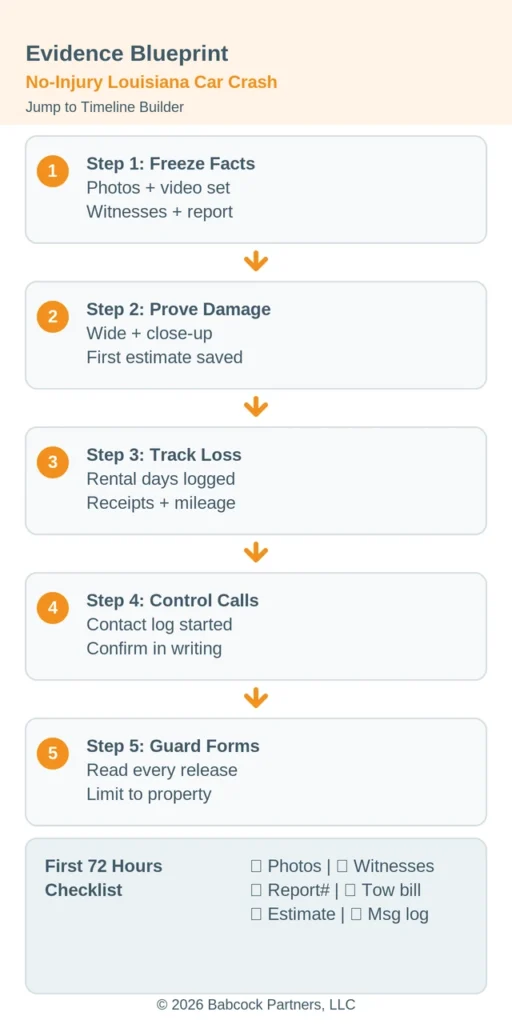
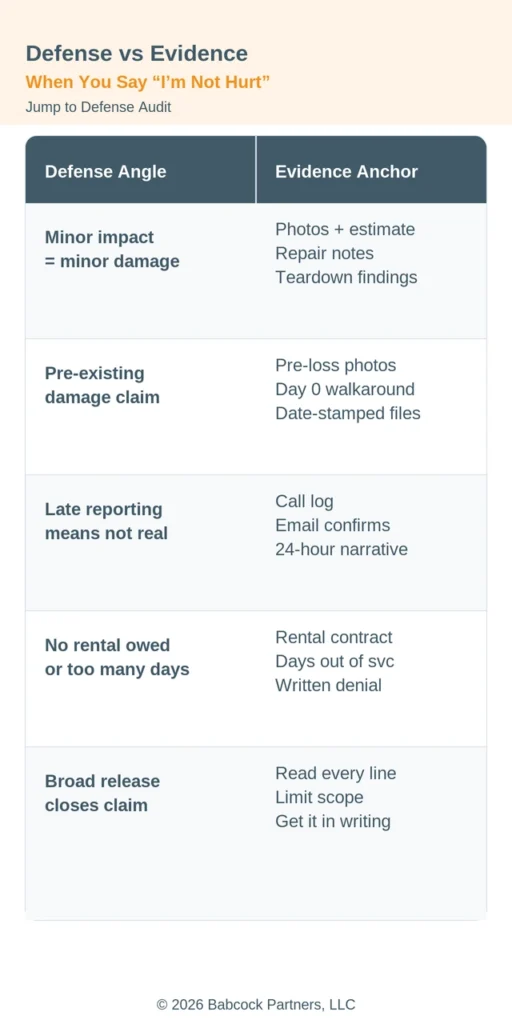
Prefer a print checklist? Download the printable toolkit (PDF) and use it to track photos, repairs, rental days, and every insurer contact. The toolkit also includes the two infographics shown in this article.
Can You Sue After a Car Accident in Louisiana If You Aren’t Hurt?
Yes. Louisiana’s general fault rule in La. Civ. Code art. 2315 allows a person to seek damages caused by another’s fault, and that can include vehicle damage and related losses even when you feel fine.
- Property damage: repair costs or total-loss valuation disputes
- Loss of use: rental days or alternative transportation documentation
- Out-of-pocket costs: towing, storage, and incident-related receipts
- Paperwork problems: delays, denials, and releases that close the file
If the other driver’s insurer is already minimizing the wreck because “no one is hurt,” that is a sign to get organized fast and keep your communications clean. For readers who want a deeper look at how we handle these disputes, see our Baton Rouge crash lawyer page and focus on evidence preservation before repairs and recordings change the story.
Also, “not hurt” is a snapshot in time, not a permanent fact, so listen to your body and get checked if symptoms show up later. Even if you never develop injuries, the best no-injury claims still start with the same disciplined proof file: photos, documents, and a consistent timeline.
What Can You Recover If You Were Not Hurt?
You can usually pursue the financial losses you can document, even when your only harm is to your vehicle and your schedule. Louisiana Department of Insurance’s guide to auto insurance after an accident explains common issues like total-loss handling and when rental reimbursement may apply under your own policy.
| Loss Category | What To Save Now | What To Ask For |
|---|---|---|
| Repair or Total-Loss Value | Photos of all damage, the first estimate, and the shop’s repair notes | Written valuation, comps used, and a copy of any total-loss worksheet |
| Towing, Storage, and Fees | Invoices, dates charged, and the tow yard’s contact info | Itemized payoff and any storage policy in writing |
| Rental or Loss of Use | Rental agreement, days without the vehicle, and trip logs | Coverage terms and any daily limits if you use your own policy |
| Out-of-Pocket Expenses | Receipts for rides, mileage, parking, and other crash-related costs | Clear written position on what the insurer will reimburse |
That is what we mean by leverage: when the adjuster tries to treat the claim as “quick and small,” your file already has dates, receipts, and written numbers that are hard to argue with. If the dispute is really about vehicle valuation and repair fairness, you may also want to review our property damage claim page and keep your focus on documentation rather than frustration.
Separately, filing under your own collision coverage can be a practical way to get repairs moving, even if fault is disputed, and you can still pursue reimbursement where it applies. Louisiana Department of Insurance’s Consumer’s Guide to Auto Insurance notes that collision coverage can pay for damage from an accident regardless of fault, usually subject to a deductible.
Do You Need a Lawyer for a No-Injury Car Accident Claim?
Not always, but you should treat the decision like a cost-benefit question, not an ego question. If the insurer is cooperative and the numbers are clear, you may be able to resolve it; if the insurer is disputing fault or value, legal help can keep you from signing away options by accident.
- Call quickly if liability is disputed: “he said / she said” claims often harden within days.
- Call quickly if the vehicle is totaled: valuation paperwork and timelines move fast once the car is moved.
- Call quickly if you need a rental right away: loss-of-use disputes often start with poor documentation.
- Call quickly if a release is on the table: broad releases can close more than you intended.
When a claim is being treated like “just property damage,” insurers often push for a fast closeout because it is cheaper and cleaner for them. This is why we keep the case framed around a simple proof story and, when needed, point readers back to our car accident practice page for the bigger picture of how crash claims actually get evaluated.
What Should You Do in the First 72 Hours After a No-Injury Crash?
Your goal in the first 72 hours is to freeze the facts before memories fade and the car gets repaired. Even if you plan to handle the claim yourself, these steps make the file easier to prove and harder to undervalue.
- Photograph everything: wide shots, close-ups, license plates, and the inside of both vehicles.
- Get the report information: the agency, report number, and responding officer name.
- Capture the “why” facts: signals, lane markings, skid marks, debris, and sight lines.
- Identify witnesses: names, phone numbers, and a short note of what they saw.
- Start a communication log: date, time, who called, and what was said.
This is why we tell people to treat the timeline like a living document: the first version is usually the most accurate one. If the crash happened in the Baton Rouge area, our Baton Rouge hub has local resources and links to the practice areas that most often come up after a wreck.
Timeline Builder: Build a Paper Trail That Survives the Adjuster
A clean timeline turns a “minor” wreck into a clear claim file with dates and documents, not opinions. If you do one thing, build a single page that shows what happened, what it cost, and what you did to mitigate the loss.
| Time Window | What To Do | What It Proves |
|---|---|---|
| Day 0 | Scene photos, witness names, and a short written narrative while it is fresh | How the crash happened and what the vehicles looked like before repairs |
| Days 1–3 | First estimate, tow/storage invoices, and the first insurer contact log entry | Baseline numbers and a clear start date for loss-of-use |
| Week 1 | Repair updates in writing, rental records, and any photos taken at the shop | That the delay was real and the costs were tied to the wreck |
| Weeks 2–4 | Final invoice, parts list, and a summary of all out-of-pocket receipts | Final damages supported by documents, not memory |

That is what we mean by leverage: once the insurer sees a complete timeline, the discussion shifts from “prove it” to “let’s value it.” For example, many rear-end crashes look cosmetic at first but later reveal hidden damage, and we see that pattern often enough that we discuss it on our rear-end accident page.
Defense Audit: Defense Angles vs. the Record That Beats Them
In “no injury” cases, the defense theme is often that the loss is too small or too uncertain to pay in full. The way to respond is not argument; it is a better record that answers the exact gap the insurer is pointing at.
| Common Defense Angle | Evidence Anchor |
|---|---|
| “Minor impact, minor damage.” | Wide + close-up photos, a first estimate, and repair notes showing what was found after teardown. |
| “That scratch was already there.” | Pre-loss photos, date-stamped walkaround videos, and a clear post-loss photo set from Day 0. |
| “You waited too long to report.” | Call logs, email confirmations, and a short written narrative created within 24 hours. |
| “Rental isn’t covered.” | Rental receipts, days out of service, and written coverage terms or denial reasons. |
| “Sign this release and we’re done.” | A pause, a careful read, and a written request to limit any release to the specific property issue being paid. |

If the crash was caused by a driver looking at a phone, drifting, or failing to yield, the liability story matters even when nobody is hurt because it drives how hard the insurer pushes back. We cover evidence patterns for those cases on our distracted driving page, and the same “better record beats better arguments” rule applies here.
What we see in practice
We see no-injury claims succeed when the client’s file is simple, consistent, and document-driven from the start. We also see them fail when people rely on memory, lose photos during repairs, or sign broad paperwork because they feel pressure to “wrap it up.”
- Value fights start early: the first estimate becomes the anchor, so preserve it.
- Delay becomes a weapon: the longer the gap, the easier it is to question causation and necessity.
- Releases are often broader than people think: the words matter more than the check amount.
- Communication style changes outcomes: calm, written, and consistent beats emotional and scattered.
This is why we build a “trial-ready” proof file even for claims that may never see a courtroom: insurers evaluate risk, and a clean file is riskier to underpay. That is what we mean by leverage when the only dispute is property damage—your documents reduce the insurer’s room to reinterpret the facts.
Common Mistakes That Shrink a No-Injury Claim
Most “no injury” claim problems are preventable, but only if you slow down long enough to document what happened. A few common mistakes can turn a provable loss into a frustrating back-and-forth that never resolves cleanly.
- Only taking one or two photos: you need wide shots, close-ups, and context.
- Letting the shop start repairs before documenting: keep a Day 0 photo set and the first estimate.
- Talking by phone without notes: confirm key points in writing so the file stays consistent.
- Accepting a valuation without asking for the worksheet: request the written basis for the number.
- Signing a release because it “seems routine”: routine forms can still be broad.
If you want a cleaner way to track the claim, Download the printable toolkit (PDF) and use the built-in checklist to log contacts, dates, and documents. Printing it helps because it keeps the same facts in one place when multiple adjusters touch the file.
Louisiana Law Snapshot (Updated 2026)
For most car crash claims in Louisiana, the baseline deadline is two years from the day the injury or damage is sustained, and the clock can run fast while you are still dealing with repairs. La. Civ. Code art. 3493.1 sets this two-year delictual prescription rule, and missing it can end the case regardless of how strong the facts are.
| Rule | Plain-English Meaning |
|---|---|
| Two-year delictual prescription | Most crash claims must be filed within two years of the day damage occurs under Art. 3493.1, so treat “we are still negotiating” as a risk, not a plan. |
| Comparative fault with a 51% bar | Fault can reduce what you recover, and if you are found 51% or more at fault you may be barred from recovery under La. Civ. Code art. 2323, amended effective January 1, 2026. |
Deadlines and fault rules can interact with insurance tactics, especially when an adjuster says “let’s wait and see” while paperwork keeps moving. If you are unsure whether a document is a routine repair form or a settlement release, it is safer to ask questions before signing than to try to undo it later.
Free Case Review: Next Steps for a No-Injury Crash
We are not built for volume. We are built for leverage. The Babcock Benefit approach is simple in practice: preserve proof early, spot the claim’s pressure points, and stay ready if the insurer forces a formal dispute. Call (225) 500-5000 and use the free case review form so we can help you protect the record while repair and settlement paperwork is still flexible.
These items are helpful to have with you when you call, but do not delay calling because you do not have them. If you have them handy, keep them nearby for the call.
- Photos or video from the scene and of the damage
- The other driver’s information and any witness contacts
- The report number or responding agency name
- Repair estimates, invoices, and rental/tow receipts
- A short timeline of insurer contacts and what was said
Call Today If…
- The insurer is disputing fault or saying the damage does not match the impact
- Your vehicle is being treated as a total loss and the valuation seems off
- You are being asked to sign a release or “final settlement” document
- You need a rental or alternative transportation and the insurer is stalling
What Happens Next
- Evidence triage: we identify the photos, documents, and logs that matter most and fill the gaps.
- Deadline spotting: we flag timing issues and prevent “negotiation drift” from turning into a missed filing deadline.
- Insurer contact strategy: we keep communication focused on the proof and the gaps that drive value, not noise.
If you want to learn more about how we evaluate claims beyond “nobody was hurt,” start with help with a Louisiana wreck claim and then bring your documents to the call. The earlier you preserve the record, the easier it is to keep the claim honest.