Common Car Accident Injuries: What to Do After Your Accident


Editorial & Legal Accuracy Notice (Louisiana)

This blog contains general legal and safety information and is not legal advice. Laws and deadlines can change, and outcomes depend on specific facts.

Last reviewed / updated: March, 2026

Reviewed, updated, and authored by: Stephen Babcock, Louisiana injury lawyer

This guide explains common car accident injuries, how insurers question them, and the evidence that helps protect a Louisiana claim.

After a crash, it is normal to focus on the car first and your body second. The problem is that many common car accident injuries get argued as “minor” unless your timeline and documentation are clear. This page helps you spot the common injury patterns and build a record that makes sense. You can also use it as a checklist for the first few days.

Injury lists are everywhere, but proof is where claims live or die. We are not built for volume. We are built for leverage. Speed + evidence preservation + insurer-insider knowledge + trial-ready preparation = The Babcock Benefit. For common car accident injuries, leverage means building a clean timeline and medical record before an adjuster calls it “just soreness.”

If you are inside the first 72 hours, call (225) 500-5000 or use the free case review form before evidence changes.

Firm links: Client Reviews | Contact | Locations

What Are the Most Common Car Accident Injuries in Louisiana?

The most common car accident injuries are soft-tissue strains, concussions, fractures, cuts, bruises, and sometimes internal injuries. In practice, these injuries can be real even when vehicle damage looks small, which is why early documentation matters on our Baton Rouge car accident page.

  • Neck and back strain (often called “whiplash”)
  • Concussion or other head symptoms
  • Fractures and serious sprains
  • Shoulder, knee, and wrist injuries
  • Cuts, bruises, and facial injuries
  • Internal bleeding or organ injury signs

It is also common for one crash to cause multiple injuries at once, like neck pain plus a wrist sprain from bracing on the steering wheel. If your pain pattern shifts over the first week, do not assume you are “in the clear.” Instead, track the change and tell your provider so it lands in the record.

Which Injuries Show Up Hours or Days Later?

Some common car accident injuries do not fully show up until the adrenaline wears off, so the first day can be misleading. For example, MedlinePlus’s whiplash overview explains that whiplash pain may not appear right away and can develop over time.

Injury Pattern Why It Can Feel Delayed What To Document
Neck strain / whiplash Inflammation builds and stiffness increases after rest. Morning stiffness, range of motion limits, headache start time.
Concussion symptoms CDC concussion instructions note that some symptoms may not show up for hours or days. Headache, light sensitivity, dizziness, focus issues, sleep changes.
Soft-tissue shoulder/knee injury Swelling and guarding can hide the true limit early. What movements hurt, what you cannot lift, and when it worsened.
Internal injury warning signs Bleeding can be slow, especially in the abdomen. Cleveland Clinic’s internal bleeding guidance highlights urgent signs like lightheadedness or shortness of breath.

Be careful with “normal imaging” arguments. Cleveland Clinic’s concussion testing overview explains that conventional CT and MRI scans do not detect concussions, even though they may be used to rule out more dangerous problems.

What Evidence Proves a Common Car Accident Injury?

To prove common car accident injuries, you need a clean story: what happened, what changed in your body, and how the change affected your daily function. A good proof file blends medical records with practical evidence like photos, schedules, and consistent notes, so the claim does not depend on memory alone.

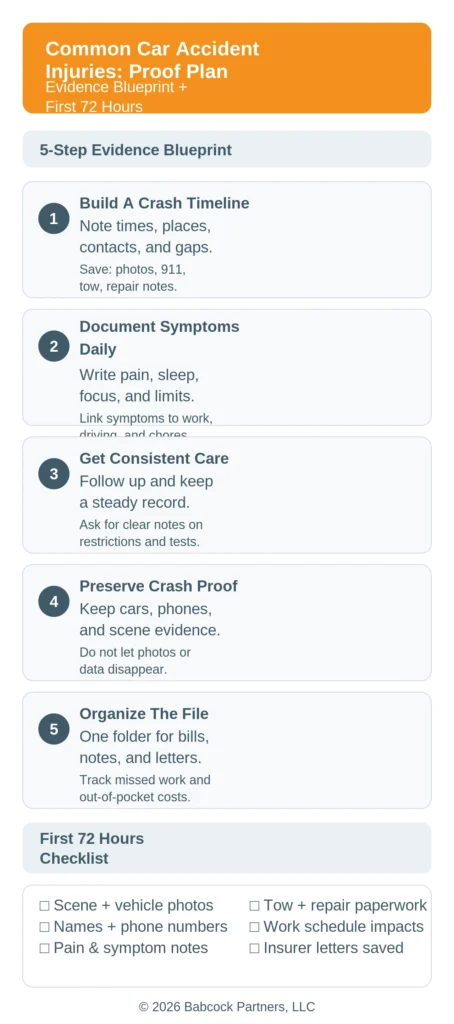
  1. Crash timeline with dates, places, and contacts
  2. Symptom and function log that matches daily life
  3. Consistent medical documentation and follow-up
  4. Non-medical evidence like photos, repair records, and messages
  5. Organized file that prevents missing deadlines

Timeline Builder

Start a timeline the same day, even if it is just bullet points, because later details get fuzzy fast. This is why we build leverage early by capturing what the scene looked like before vehicles are repaired and digital data disappears.

Use this quick timeline template:

  • Before impact: your lane, speed, and what you saw.
  • Impact: points of contact, airbags, and head/arm position.
  • After: who you spoke to, where you went, and when symptoms began.
  • Paper trail: tow, rental, repair estimate, and claim numbers.
Quick reference: a proof plan for common crash injuries plus the first-72-hours evidence checklist. (Download the printable PDF below.)

Symptom and Function Log

A symptom log works best when it ties symptoms to real tasks, like driving, lifting, sleep, or screen time. CDC’s concussion symptom list is a good reminder that symptoms can include thinking, sleep, and mood changes, not just pain.

  • Keep it short: 3–5 lines per day is enough.
  • Track triggers: what made symptoms worse.
  • Track recovery: what helped and what did not.
  • Save receipts: medicines, braces, and travel.

Medical Care and Documentation

The goal is not “more care,” but consistent care that creates a reliable record of symptoms, exams, and restrictions. Mayo Clinic’s concussion diagnosis guidance describes how CT imaging may be used soon after injury to assess the brain, even though concussion symptoms may not show up on a scan.

Common Injury What Often Helps Prove It Record To Ask For
Fracture or severe sprain Pain plus objective findings like swelling and tenderness. AAOS OrthoInfo’s fracture guide lists common fracture symptoms that providers document.
Neck strain / whiplash Range-of-motion limits and consistent complaints over time. Exam findings, PT notes, and home exercise instructions.
Concussion-type symptoms Consistent symptom pattern plus neuro exam and follow-up. Visit notes, return-to-work restrictions, and referrals.

If you have a gap in care, document the reason in writing, such as lack of transportation or clinic availability, and get back in as soon as you can. That is what we mean by leverage: you do not leave the defense room to say your claim is based on a “story” instead of a record.

Non-Medical Evidence

Non-medical evidence is often what makes medical records believable to an insurer because it shows the crash forces and the day-to-day impact. If the crash was a rear-end collision, Louisiana’s following-too-closely rule in La. R.S. 32:81 is one reason the timeline and spacing details can matter.

  • Photos of the scene, skid marks, and vehicle angles
  • Vehicle repair records and parts replaced
  • Witness names and short summaries
  • Text messages and calendar entries showing disruption
  • Work notes, modified duty, and missed shifts

If you were hurt in Baton Rouge, it can help to anchor your next steps to local care and reporting options on the Baton Rouge hub page. For crash-type questions, we also cover adjacent issues like rear-end collisions and distracted driving, but this post stays focused on injuries and proof.

How Insurers Challenge “Common Injury” Claims

Insurance adjusters often accept that a crash happened but dispute whether common car accident injuries are connected, serious, or worth paying. The fastest way to protect your claim is to anticipate the defense theme and build the evidence “bridge” before you are asked for a recorded statement.

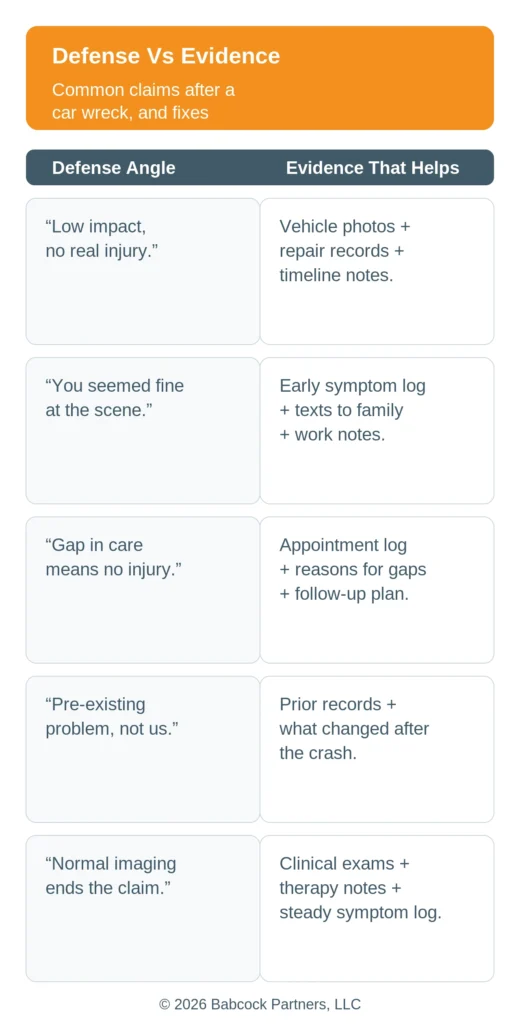
Defense Narrative Evidence Anchor That Helps
“Low impact means no injury.” Photos, repair records, and a same-day symptom log.
“You seemed fine at the scene.” Delayed-onset notes, texts to family, and work disruption proof.
“Normal imaging ends it.” Exam findings and consistent symptoms, since Cleveland Clinic explains CT and MRI do not detect concussion.
“Gap in treatment breaks causation.” Appointment log and written reasons for any gaps.
“Pre-existing problem, not this crash.” Prior baseline records and clear notes about what changed after impact.
Common insurer narratives—and the records that close the gaps.

This is why we treat early evidence as part of the medical story, not separate from it, because the defense will compare your words to your records line by line. That is what we mean by leverage when we build a file that answers the predictable questions before they become disputes.

What we see in practice

Common car accident injuries are rarely “one record and done,” and the people who get pressured the most are the ones with the messiest timelines. The best outcomes usually start with calm documentation, consistent follow-up, and a plan for insurer contact.

  • Early “I’m fine” statements get repeated, even when symptoms develop later.
  • Gaps in care get framed as recovery unless you document the reason.
  • Property-damage photos get used to argue force, even when injuries are real.
  • Concussion and soft-tissue cases get attacked as “subjective” unless the file shows function limits.

When to Call a Lawyer Quickly

You should talk to a lawyer quickly if deadlines, serious injuries, or multiple insurers are in play, or if you are being pushed to “wrap it up” before you know the full picture. Even when injuries are common, the evidence window can be short, and early mistakes are hard to fix later.

  • You have head symptoms, weakness, numbness, or signs of internal bleeding.
  • You missed work, cannot drive, or need ongoing treatment.
  • The other driver disputes fault or you are blamed for part of the crash.
  • You are asked for a recorded statement before you have your timeline together.
  • The crash involved a commercial vehicle or multiple cars.

Louisiana Law Snapshot (Updated 2026)

Louisiana injury claims usually face a two-year deadline, and fault rules can reduce or even bar recovery, so dates and details matter. La. Civ. Code art. 3493.1 sets a two-year liberative prescription for most delictual actions, which is why you should not wait to preserve evidence.

  • Two-year deadline: the clock generally starts on the day the injury or damage is sustained in most cases.
  • Comparative fault: La. Civ. Code art. 2323 now includes a 51% bar effective January 1, 2026, meaning 51% or more fault can block recovery.

Ready to Lock Down the Record?

We are not built for volume. We are built for leverage.

Leverage means we move fast to preserve evidence, organize the file, and manage insurer contact with a trial-ready mindset. If you are dealing with common car accident injuries, call (225) 500-5000 and use the free case review form so we can help you protect the record early.

Call sooner rather than later because vehicles get repaired, video can be overwritten, and symptom patterns change as you return to normal activity. Early calls also help you avoid signing a release before you understand the full medical picture.

These items are helpful to have with you when you call, but do not delay calling because you do not have them. If you have them handy, keep them nearby for the call.

  • Crash report number or exchange-of-info sheet
  • Photos of vehicles, the scene, and visible injuries
  • Insurance claim number and adjuster contact
  • List of providers and appointment dates
  • Work schedule impacts and missed time notes

Call Today If…

  • Your symptoms worsened after day one or you have head symptoms.
  • You are being blamed or pressured into a recorded statement.
  • You have a gap in care you need to explain and fix.
  • The insurer is pushing a quick release.

What Happens Next

  • Evidence triage: we identify the fastest-moving proof and send preservation requests.
  • Deadline spotting: we map the dates that control your options and reporting.
  • Insurer contact strategy: we help you avoid missteps while your record is still forming.

For more help with the overall claim process, see our Baton Rouge auto-accident practice. It walks through the steps in more detail.

×