


Fault in a Louisiana bicycle crash is not decided simply by who was driving the larger vehicle or who received a traffic ticket. It is determined by reconstructing the collision, identifying the duties that applied to each person, and deciding whose conduct caused the harm.
A useful liability analysis therefore begins with the movement of the bicycle and vehicle. Which direction was each traveling? Where did their paths cross? What could each person see? The answer should come from physical evidence, video, witnesses, and the roadway itself whenever possible.
Start with the collision path
Before assigning blame, map the final seconds before impact. The point of contact can distinguish a driver who turned across a cyclist’s path from a cyclist who entered the road without yielding. Damage to a mirror, front fender, door, or rear quarter panel can help place the bicycle in relation to the vehicle.
Common bicycle collisions include:
- Right-hook crashes: a driver passes or travels beside a cyclist and then turns right across the cyclist’s path.
- Left-turn crashes: an oncoming driver turns left across the cyclist’s lane.
- Driveway and parking-lot exits: a driver enters the road or crosses a bike lane without yielding.
- Close passes: a vehicle strikes the cyclist or forces the cyclist off a safe line while overtaking.
- Dooring: someone opens a vehicle door into the cyclist’s path.
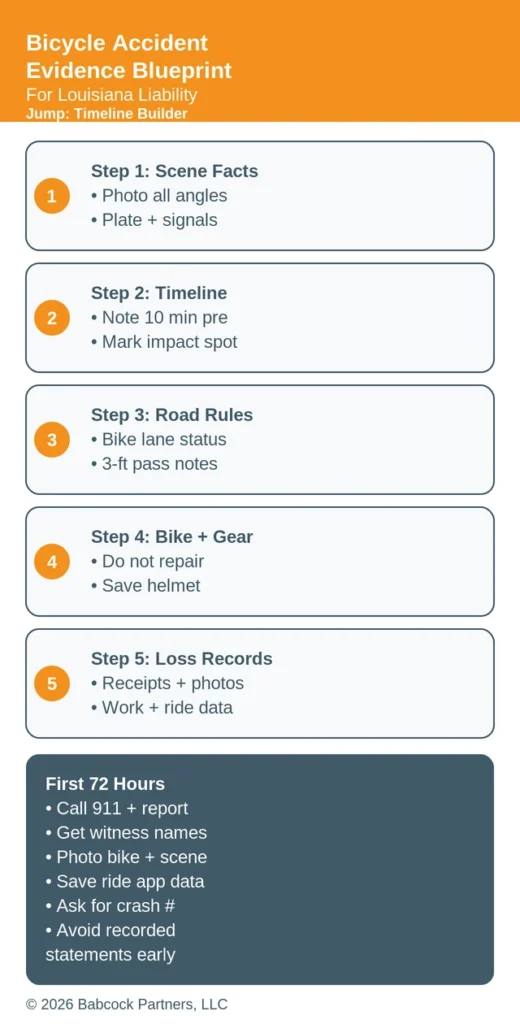
Each pattern involves different sight lines and duties. A single close photograph rarely tells the whole story. Take wide photographs from both directions of travel and include signals, signs, lane markings, parked vehicles, and any obstruction.
Which Louisiana road rules apply?
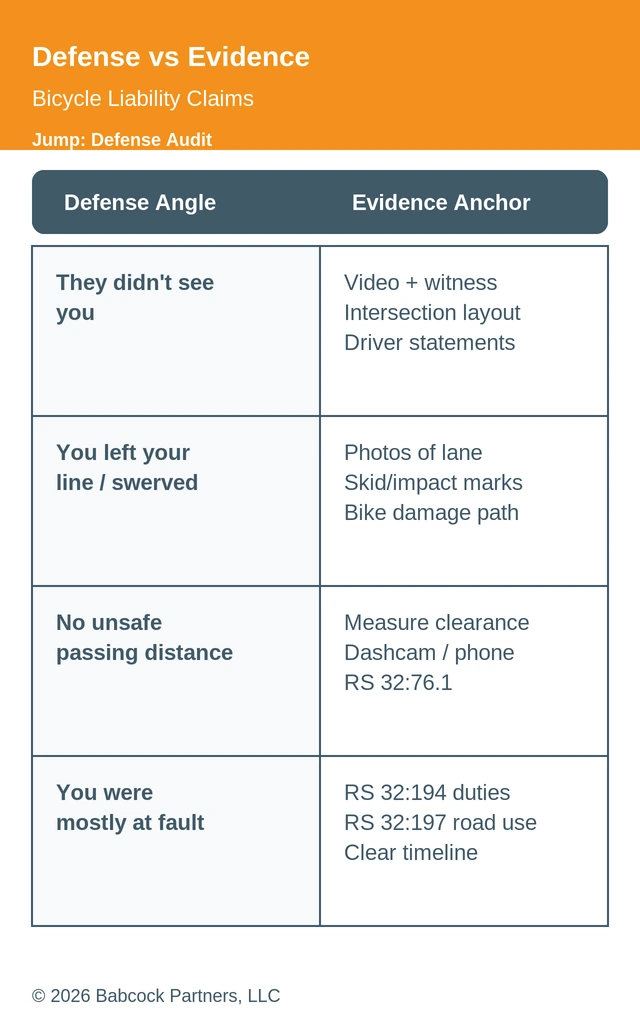
La. R.S. 32:194 generally gives a person riding a bicycle on a highway the rights and duties of a vehicle driver. Bicycle-specific statutes then address lane position, passing, bike lanes, equipment, and other recurring issues.
The rules most often connected to a fault dispute include:
- La. R.S. 32:197, which generally calls for riding as near the right side as practicable but recognizes exceptions for left turns, passing, hazards, narrow lanes, and places where right turns are authorized;
- La. R.S. 32:76.1, which requires due care and at least three feet of clearance when a motorist overtakes a bicycle;
- La. R.S. 32:203, which limits motor-vehicle use of a bicycle lane and requires a driver in the lane to yield to bicycles;
- La. R.S. 32:283, which requires precautions before opening any motor-vehicle door on a highway to avoid interfering with traffic or endangering another person or vehicle; and
- La. R.S. 32:329.1, which sets bicycle light and reflector requirements for the times described in La. R.S. 32:301.
The legal rule is only one part of the analysis. It must be tied to the collision. A missing light may matter in a nighttime visibility dispute, but it does not automatically excuse a driver who had already seen the cyclist or who turned across a marked bicycle lane.
The companion guide on cyclists’ rights on Louisiana roads explains these road-sharing statutes in more detail.
More than one person can share responsibility
A driver and cyclist are not always the only people whose conduct matters. A second vehicle may have forced the driver into the bicycle lane. A working driver may have been acting within the course and scope of employment, which can raise a separate question about the employer’s responsibility. A defective bicycle component or a dangerous roadway condition may require investigation, but neither should be assumed without evidence connecting the condition to the crash.
Identify every person or entity that may have relevant records early. Commercial vehicles may carry dashcams, telematics, dispatch messages, or driver logs. A public body may have work orders or prior complaints. Those records can have different preservation procedures and legal deadlines.
Evidence that can clarify fault
The most useful evidence is usually created before the parties know they will disagree. Preserve it before the bicycle is repaired, the vehicle is sold, or video is overwritten.
- Scene photographs: Include the full approach, lane markings, road width, visibility, traffic controls, debris, and final resting positions.
- Video: Check nearby homes, businesses, buses, and vehicles for doorbell, security, traffic, or dashcam footage.
- Witnesses: Record contact information and what each person observed. Do not rely on the police report to preserve every name.
- The bicycle and gear: Keep the bicycle, helmet, lights, clothing, and damaged electronics unchanged until they can be documented.
- Digital records: Save ride-app data, photographs in original form, location history, and relevant messages.
- Vehicle records: In a serious crash, inspection photographs, event data, dashcam footage, and commercial records may help establish speed, braking, or driver attention.
A police report is useful, but it is not the final civil-fault decision. An officer may not have witnessed the crash, and the report may be based on incomplete statements. The same is true of a citation. The article on crashes in which no ticket was issued explains why other evidence still controls the liability analysis.
How comparative fault affects a bicycle claim
Louisiana Civil Code article 2323 governs comparative fault. For accidents occurring on or after January 1, 2026, the current statute generally bars recovery when the claimant is 51 percent or more at fault. A claimant assessed 50 percent or less at fault may have damages reduced by that percentage. Earlier accidents may be governed by the prior version of the law, so the collision date must be checked before applying the current rule.
Comparative fault makes accurate scene evidence especially important. A driver may argue that the cyclist was too far into the lane, failed to use a light, or entered an intersection too quickly. The response should be evidence tied to the actual rule and conditions, not a general assertion that cyclists always have the right of way.
Fault and injury proof are separate questions
Showing that a driver caused the collision does not by itself establish every claimed loss. Medical records must connect injuries to the event. Employment and tax records may be needed for lost-income claims. Repair estimates and photographs document property damage. Prior medical conditions do not automatically defeat a claim, but the records should distinguish a new injury or aggravation from an unrelated problem.
Insurance coverage is another separate issue. The at-fault driver’s liability policy may not be the only available coverage. Depending on the facts and policy terms, uninsured or underinsured motorist coverage, an employer’s policy, or another responsible party’s coverage may require review.
Do not confuse the filing deadline with the evidence deadline
Civil Code article 3493.1 generally provides a two-year period for delictual actions arising on or after July 1, 2024. Earlier accidents and matters involving a public body, a minor, death, or another special circumstance may follow different rules.
Even when two years applies, evidence may disappear within days. Camera systems overwrite files, road conditions change, and damaged equipment is repaired. A filing deadline should never be treated as permission to postpone preservation work.
Related bicycle claim resources
The firm’s published Louisiana bicycle accident practice page explains the representation process. For broader context on collision patterns, see the guide to common vehicle crash types and causes.
This article provides general information, not legal advice. Liability, deadlines, available coverage, and proof must be evaluated for the particular crash.