


Editorial & Legal Accuracy Notice (Louisiana)
This blog contains general legal and safety information and is not legal advice. Laws and deadlines can change, and outcomes depend on specific facts.
Last reviewed / updated: March, 2026
Reviewed, updated, and authored by: Stephen Babcock, Louisiana injury lawyer
This guide explains how drowsy-driving crashes are investigated in Louisiana, what evidence can show driver fatigue, and what to do early to protect the record.
After a tired-driving wreck, we focus on fast, clean proof that holds up later. We are not built for volume. We are built for leverage. Speed + evidence preservation + insurer-insider knowledge + trial-ready preparation = The Babcock Benefit. In a drowsy driving accident, leverage often comes from time-stamped records that show delayed reaction.
Drowsy driving accidents can look “ordinary” until you line up the timeline, the lack of avoidance, and the driver’s schedule. This post is written for Louisiana drivers, including people in Baton Rouge who need a practical plan. Use it to preserve evidence before it is overwritten or “cleaned up.”
If you are inside the first 72 hours, call (225) 500-5000 or use the free case review form before evidence changes.
Firm links: Client Reviews | Contact | Locations
Download the printable toolkit (PDF) to print the evidence blueprint and the defense-audit table for your file. Keep it with your photos and notes.
What Should You Do After a Drowsy Driving Accident in Louisiana?
Start by making the scene safe, calling 911, and creating a time-stamped record of what you saw and heard. If you need help preserving proof quickly, our drowsy driving accident lawyer page explains how we approach early evidence in Baton Rouge and across Louisiana.
- Call 911 and get medical help if needed: Safety comes first, and the dispatch record helps lock in timing.
- Photograph the scene: Take wide shots and close-ups of lanes, debris, signs, and vehicle damage.
- Ask about cameras: Note nearby businesses, intersections, or homes that may have video.
- Get names and numbers: Witness contact details often disappear within days.
- Write your timeline immediately: Put times, locations, and symptoms in one place while memory is fresh.
Important: A drowsy driving accident is often proved by what did not happen, like no braking or no evasive steering. This is why we tell people to preserve video and vehicle data before it is overwritten.
If your crash is also a standard car accident claim issue like unsafe following distance or lane departure, you can still build a fatigue-focused record without guessing. The key is to collect objective, time-stamped facts and keep your story consistent.
How Can You Tell if a Crash Involved Driver Fatigue?
You rarely “prove sleep” with one dramatic fact, so you look for patterns that point to delayed reaction and inattention. NHTSA’s drowsy driving overview describes red flags like drifting, missing cues, and slow responses that often show up in fatigue crashes.
- No avoidance: Little or no braking, swerving, or steering correction before impact.
- Lane departure pattern: A gradual drift into a shoulder, median, or oncoming lane.
- Single-vehicle run-off-road: Leaving the roadway with no clear external cause.
- Time-of-day clues: Late-night or early-morning driving windows can matter for context.
- Post-crash statements: Comments like “I didn’t see you” can be important, but they must be documented correctly.
None of these points alone “wins” a case, and we do not assume facts that are not known. Instead, we treat them as leads to preserve proof that can be checked later.
How Do You Prove the Other Driver Was Too Tired to Drive?
You prove fatigue with time-stamped records that show the driver’s schedule, the crash pattern, and what they did right before impact. The goal is to build a packet that answers predictable defense themes with documents instead of arguments.
| Proof Area | Examples of Evidence | Why It Matters |
|---|---|---|
| Timing and route | Receipts, location history, tolls, call logs, texts | Helps show when driving started and how long the person was on the road |
| Crash pattern | Scene photos, skid marks or lack of them, lane evidence | Supports “delayed reaction” without speculation |
| Vehicle and tech data | EDR (“black box”), telematics, dashcam files, app logs | Locks in speed, braking, steering inputs, and timing |
| Third-party video | Business cameras, DOT/intersection feeds where available | Shows pre-impact behavior and lane control in real time |
| Witness documentation | Independent witness notes, 911 audio, responding officer observations | Captures early statements before stories shift |
If the crash involves a work vehicle or commercial driver, fatigue proof can include regulation-driven records. eCFR’s 49 C.F.R. § 395.3 sets core hours-of-service limits for many property-carrying commercial drivers, and FMCSA’s hours-of-service summary helps explain how those limits work in practice.
This is why we look for who had control of records and how long they keep them. If you suspect fatigue, preserving the evidence chain is often the difference between “we think” and “we can show.”
Timeline Builder: The First 72 Hours
A clean timeline turns scattered memories into proof that can be cross-checked against records. CDC’s NIOSH training on long work hours notes that fatigue risk is shaped by long shifts and circadian timing, which is why exact timestamps matter.
| Time Window | What to Write Down | What to Save |
|---|---|---|
| 0–6 hours | Location, lane positions, weather, what you saw the other driver do | Scene photos, witness names, 911 call details |
| 6–24 hours | Symptoms, pain changes, sleep disruption, missed work or duties | Medical visit paperwork, prescriptions, tow and repair documents |
| 24–72 hours | Follow-up symptoms, limitations, and daily-task impact | Any video leads, insurance communications, diary notes |
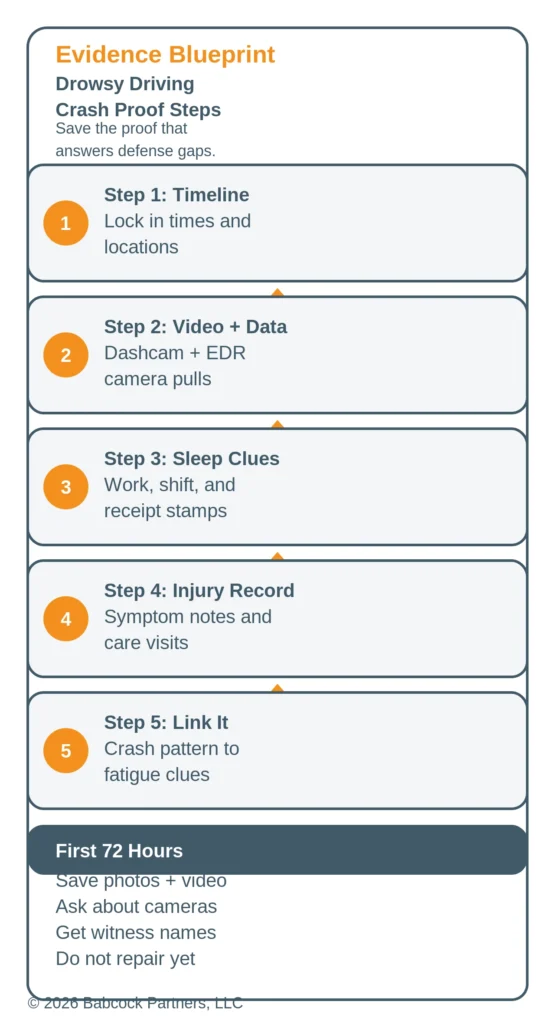
If you feel pressured to “sum it up” for an adjuster on day one, your timeline helps you stick to facts. That is what we mean by leverage when we say the record should answer the defense before it is raised.
Defense Audit: How Insurers Try to Explain Away Fatigue
Insurers often treat drowsy driving crashes as routine negligence unless you build a fatigue-focused record. NHTSA’s drowsy driving countermeasure guide explains why fatigue is hard to detect and underreported, which is one reason documentation matters.
| Common Defense Story | Evidence That Helps Answer It |
|---|---|
| No proof of fatigue | Shift schedules, receipts, timestamps, phone/location data, witness notes |
| No braking means nothing | EDR data, dashcam, third-party video, scene photos showing lane drift |
| You caused or contributed | Time-stamped photos, independent witnesses, lane evidence, diagram consistency |
| Delay or gaps hurt your claim | Timeline notes, early medical documentation, consistent reporting of limits |
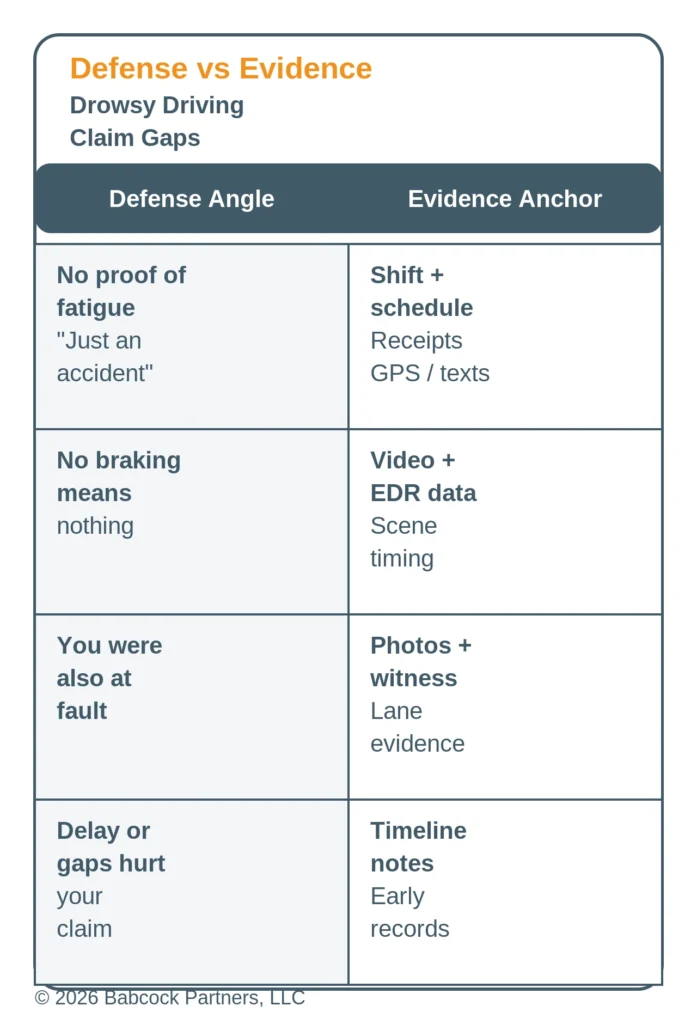
When your record is organized, you reduce the room for “alternative explanations” to grow. This is why we build the file as a timeline plus proof map, not a stack of unrelated documents.
How Should You Handle Symptoms and Medical Records?
If you have symptoms after a drowsy driving accident, get checked and follow medical advice, even if you hope it will “go away.” For a legal claim, consistent documentation matters most: what you felt, when it started, and how it limited daily life.
- Be consistent: Describe symptoms the same way to providers, insurers, and employers.
- Track function: Note sleep, driving anxiety, headaches, and work or parenting limitations.
- Save paperwork: Keep visit summaries, prescriptions, work notes, and therapy records.
- Avoid guessing: Report facts and changes, not diagnoses you are not qualified to make.
If you are dealing with another risk factor like distraction, keep the focus on what you can prove. We cover related issues on our distracted driving page without mixing topics in a way that dilutes the fatigue evidence.
What we see in practice
In drowsy driving accidents, we often see early proof vanish even when liability feels “obvious” to the people involved. We also see insurers push for quick statements before families have a timeline or the right documents in hand.
- Video gets overwritten: Businesses may only keep footage for days, not months.
- Vehicle data can be lost: Repairs, towing, and salvage decisions can disrupt EDR access.
- Fatigue gets reframed: The narrative shifts from “tired” to “unknown cause” unless records pin it down.
- Comparative fault gets introduced: Small facts about lane position or speed can become big arguments later.
That is why we treat the first calls as evidence triage, not storytelling. The goal is a clear record that stays consistent from the crash scene to any negotiation or litigation.
Call a Lawyer Quickly If Any of These Are True
You do not need to “wait and see” when evidence is time-sensitive or injuries are serious. Call quickly if the crash involves severe harm, commercial records, or a dispute about fault.
- Someone went to the ER: Serious injury claims need clean documentation from day one.
- A work vehicle was involved: Employer and carrier records may require prompt preservation.
- Video may exist: Stores, neighborhoods, and intersections can have short retention windows.
- The other driver left: Hit-and-run risk makes early reporting and documentation critical.
- You are hearing “shared fault”: Comparative fault arguments start early and grow fast.
If you want a focused overview of how we handle fatigue collisions, review our Baton Rouge fatigue-crash practice page and use it as a checklist for what to preserve.
Insurance Adjusters and Early Releases: What to Watch For
In the first week, insurance communications can shape your claim more than people realize. The safest approach is to keep statements factual, avoid speculation, and preserve documents before signing anything.
- Recorded statements: You can politely decline until you have a timeline and key documents.
- Broad medical authorizations: Ask what time periods and providers are being requested.
- Quick settlement offers: Early offers can arrive before symptoms, repairs, or totals are clear.
- Repair and salvage decisions: Confirm whether vehicle data preservation is needed before disposal.
That is what we mean by leverage in insurer conversations: you do not argue, you document. This is why we prefer to control early adjuster contact through a single channel and a clean record.
Download the printable toolkit (PDF) if you want a one-page first-72-hours checklist and the most common fatigue defense gaps. It is designed to be printed and kept in your glove box or file folder.
Louisiana Law Snapshot (Updated 2026)
Louisiana deadlines and fault rules create urgency, even when you are still recovering and gathering records. La. Civ. Code art. 3493.1 generally provides a two-year delictual prescription period for covered personal injury claims, which is why waiting can put your case at risk.
| Rule | Plain-English Meaning | Why It Matters in Fatigue Cases |
|---|---|---|
| Two-year prescription | Most covered delict claims must be filed within two years of the injury event. | Video, records, and witnesses can disappear long before the deadline. |
| Comparative fault | La. Civ. Code art. 2323 reduces recovery by your percentage of fault, and for crashes on or after Jan. 1, 2026, a claimant at 51% or more fault is barred. | Small disputed facts like lane position, speed, or evasive action can affect outcomes. |
If you are unsure which rule set applies to your situation, treat it as time-sensitive. Talk to a lawyer quickly if a commercial driver, multiple vehicles, or a death claim is involved.
Free Case Review: Protect the Record Early
We are not built for volume. We are built for leverage. Our Babcock Benefit approach is straightforward: preserve proof early and build the claim as if it may be tested later.
Call (225) 500-5000 and use the free case review form to get a fast, evidence-focused plan. In drowsy driving accidents, urgency comes from overwritten video, lost vehicle data, and shifting stories.
These items are helpful to have with you when you call, but do not delay calling because you do not have them. If you have them handy, keep them nearby for the call.
- Crash location and approximate time
- Photos or video you already have
- Witness names or phone numbers
- Your claim number and insurer contact (if assigned)
- Where the vehicles are located now (tow yard or shop)
Call Today If…
- You suspect the other driver fell asleep or drifted with no braking
- A business, intersection, or dashcam may have recorded video
- A commercial or work vehicle was involved and records may be controlled by a company
- Your vehicle may be repaired, totaled, or moved before data is preserved
- You are being pushed for a recorded statement or broad release
What Happens Next
- Evidence triage: Identify what can vanish first (video, EDR, logs) and act on it.
- Deadline spotting: Map prescriptive deadlines and comparative fault issues early.
- Insurer contact strategy: Set a plan for communications so the record stays clean and consistent.
If you need help with a driver-fatigue claim, start with the checklist above and call while proof is still available. Early preservation is how you keep options open without relying on assumptions.