Editorial & Legal Accuracy Notice (Louisiana)
This blog contains general legal and safety information and is not legal advice. Laws and deadlines can change, and outcomes depend on specific facts.
Last reviewed / updated: March top-5-tips-for-finding-the-best-mesothelioma-lawyer-toolkit, 2026
Reviewed, updated, and authored by: Stephen Babcock, Louisiana injury lawyer
This guide helps Louisiana families evaluate a mesothelioma lawyer using concrete, evidence-focused questions and red-flag checks.
Our approach is to treat lawyer-selection as an evidence project first and a paperwork decision second. We are not built for volume. We are built for leverage. Speed + evidence preservation + insurer-insider knowledge + trial-ready preparation = The Babcock Benefit. In mesothelioma cases, leverage often comes from how quickly your team locks down worksite and product proof before it disappears.
If you are inside the first 72 hours, call (225) 500-5000 or use the free case review form before evidence changes.
Firm links: Client Reviews | Contact | Locations
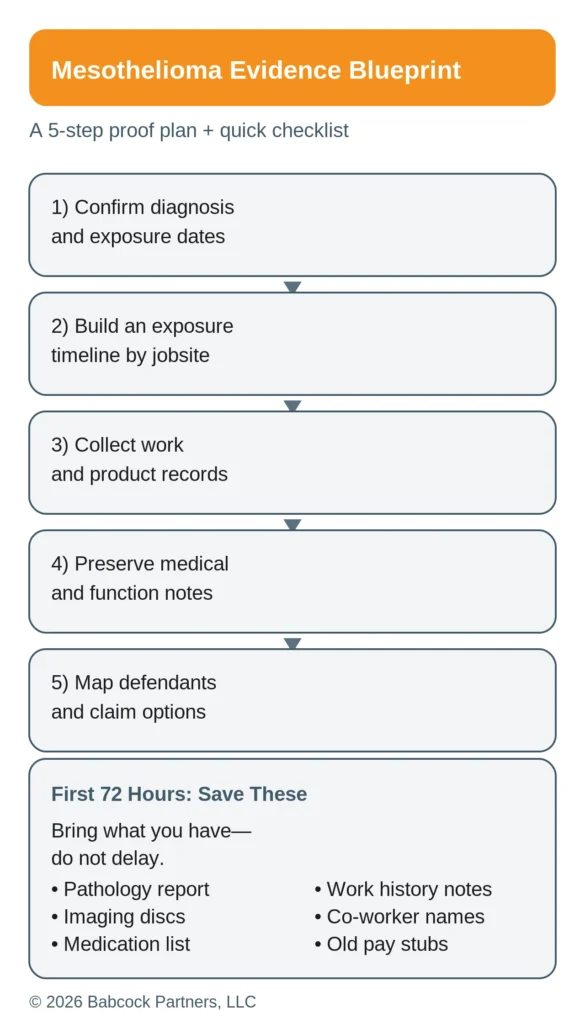
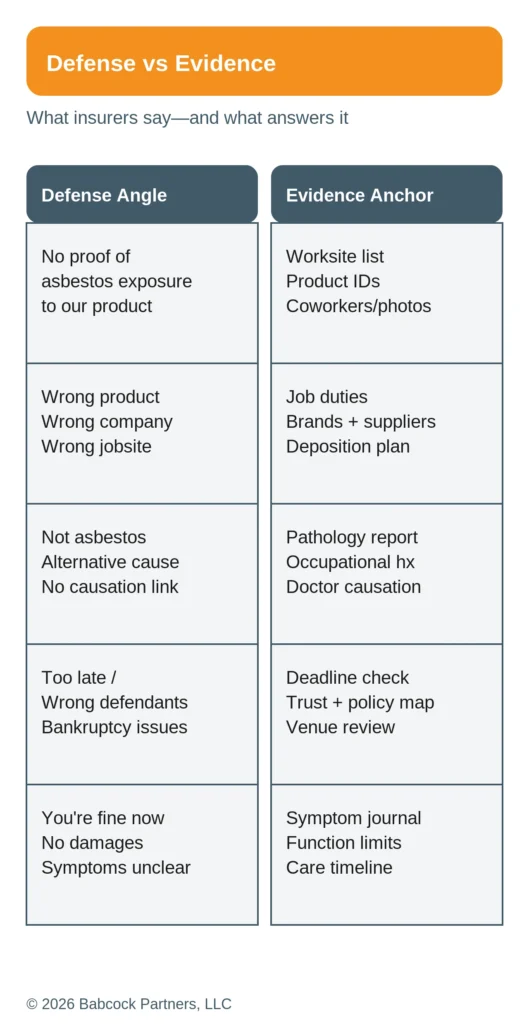
Want a printable version of the interview questions and checklists? Download the printable toolkit (PDF) and keep it with your medical and work records. It includes both infographics and a consult checklist so you can compare lawyers clearly.
How Do You Choose a Mesothelioma Lawyer in Louisiana?
Choose a mesothelioma lawyer by confirming asbestos-case experience, a clear plan for proving exposure, and a team structure that will move quickly on records and testimony. If you want to compare approaches, start with our Baton Rouge mesothelioma practice page and use the checklist below for any firm you interview.
- Ask how they will prove exposure at specific jobsites and products.
- Confirm who will handle the work day-to-day and how you will get updates.
- Get fees and case costs explained in writing before you sign.
- Verify the lawyer’s license status and any public discipline history.
- Watch for pressure to sign releases or settle before records are reviewed.
What Makes Mesothelioma Claims Different?
Mesothelioma cases are different because exposure often happened decades before diagnosis, so the proof is usually historical records and witness memory rather than a recent crash scene. A CDC MMWR report on asbestos-related disease describes latency periods that can span decades, which is why early timeline work matters.
- Old records matter: pay stubs, union logs, job badges, and product invoices can be key.
- Multiple sources: exposure may involve more than one jobsite or product line.
- Defense playbooks: expect “wrong product,” “alternative cause,” and “too late” themes.
- Health changes quickly: testimony preservation can become urgent as treatment progresses.
- Paperwork risk: early releases can close doors before facts are known.
Tip 1: Confirm Asbestos Litigation Experience
The best mesothelioma lawyer for your family is not the one with the loudest ads, but the one who can explain an exposure-proof plan in plain English. The EPA’s asbestos overview explains that asbestos exposure can cause serious disease, so case building often starts with identifying where asbestos was present and how contact occurred.
- Ask for the roadmap: “How do you identify jobsites, products, and companies?”
- Clarify the team’s tools: databases, document requests, and witness outreach.
- Check for focus: does the lawyer regularly handle asbestos cancer litigation?
- Get the timeline: what happens in week one, not “someday later”?
Tip 2: Ask Who Will Work Your File
A strong mesothelioma lawyer should be able to tell you who will interview you, collect records, and prepare witnesses, because those steps drive case quality. You should also know how the firm will coordinate with your medical schedule so appointments do not become a paperwork bottleneck.
- Point of contact: name the lead lawyer and the day-to-day case manager.
- Update rhythm: agree on how often you want status updates.
- Record retrieval: ask what you must get versus what the firm will request.
- Signature policy: you should approve settlements and key filings, not a “process.”
Tip 3: Protect Evidence and Testimony Early
Choosing a mesothelioma lawyer is time-sensitive because evidence is perishable even when exposure was long ago, especially witness memory and employer paperwork. If you need help sorting the first steps, you can talk with a Baton Rouge mesothelioma lawyer about how to preserve proof while you focus on treatment.
- Testimony first: identify who can confirm job duties, products, and worksites.
- Document sweep: collect pay stubs, W-2s, union records, badges, and old manuals.
- Medical packet: keep pathology, imaging reports, medication lists, and visit summaries.
- Do not sign fast: avoid broad releases until the exposure picture is clear.
This is why we treat the exposure timeline like the backbone of the case: it tells you which records to chase and which witnesses to prioritize. A good lawyer should be able to show you that plan before you sign anything.
Timeline Builder: Your Exposure and Medical Story
A timeline builder is a simple worksheet that links jobs, products, and symptoms to dates so your lawyer can request the right records quickly. Use the table below to draft the first version, then update it as you find pay stubs, union logs, or old photos.
| Timeline Question | Examples to Write Down | What It Helps Prove |
|---|---|---|
| Where did you work? | Employer names, job titles, unions, and locations | Exposure opportunity + witness list |
| What did you do daily? | Tasks, tools, materials handled, protective gear used | How contact could occur |
| Which products were around? | Brand names, packaging colors, suppliers, contractor names | Product identification and defendant mapping |
| What medical milestones matter? | Diagnosis date, pathology type, imaging dates, treatment start | Damages documentation + urgency planning |

Tip 4: Understand Fees and Costs in Writing
Before you hire a mesothelioma lawyer, get the fee agreement in writing and make sure it is signed, because it should explain both the fee and how costs are handled. The Louisiana Rules of Professional Conduct describe when contingency fee arrangements must be in writing, which helps you know what a complete agreement should look like.
- Fee structure: what percentage and when it applies.
- Case costs: who advances costs and when they are reimbursed.
- Medical liens: how the firm handles lien notices and negotiation.
- Client control: confirm you approve settlement decisions.
Tip 5: Verify License Status and Communication
Before you sign, use the Louisiana Attorney Disciplinary Board’s lawyer search to confirm active status and check for any public discipline history. You can also confirm the lawyer’s enrollment and contact details through the Louisiana State Bar Association’s public directory.
- Who is the lawyer? confirm the exact name spelling and bar number.
- Where is the office? verify a physical address and a direct phone line.
- Who communicates? ask how quickly calls are returned and by whom.
- What is the plan? require a clear next-step list after the first consult.
Defense Audit: Common Narratives and Proof Fixes
Most mesothelioma defense strategies aim to create doubt about exposure, product identification, timing, or causation, even when the diagnosis is clear. That is what we mean by leverage when we say you close the proof gaps before an insurer or defendant writes the story for you.
| Defense Theme | Evidence That Answers It |
|---|---|
| “No proof it was our product.” | Worksite list, product identifiers, co-worker confirmation, photos or manuals |
| “Wrong company / wrong jobsite.” | Pay stubs, union logs, badge records, contractor lists, job duty notes |
| “Alternative cause.” | Pathology summary, treating doctor notes, consistent exposure history documentation |
| “You waited too long.” | Date-of-diagnosis clarity, early deadline review, preserved testimony |
| “Damages are limited.” | Treatment records, symptom journal, caregiver notes, function impacts |

What we see in practice
We often see families arrive with strong medical documentation but scattered work history details, which creates avoidable proof gaps. We also see insurers and defendants push for a narrow story unless the evidence forces a broader, fact-driven exposure timeline.
- Memory fades: the sooner you write down names and places, the better.
- Records disappear: employers merge, vendors close, and files get purged.
- Early pressure: quick settlement talk can show up before full records are gathered.
- Proof needs structure: a clean timeline makes every record request sharper.
Talk to a Lawyer Quickly If…
You should talk to a lawyer quickly if your family is being asked to sign releases, if a key witness is aging or ill, or if your work history spans many jobsites and contractors. If you are in Baton Rouge, you can also use the Baton Rouge location hub to find local contact options and office details.
- You are asked to sign a medical authorization that is unlimited in time or scope.
- Someone wants a recorded statement before you have gathered basic records.
- A former co-worker with key knowledge is hard to locate or in poor health.
- You have exposure across multiple employers, trades, or job locations.
- A loved one passed away and you are unsure about a potential wrongful death claim.
If you want a print-and-share version for your family, Download the printable toolkit (PDF) before your next consultation. It is designed to help you keep the facts straight and avoid accidental gaps in your timeline.
Where Asbestos Exposure Often Shows Up
Exposure questions usually focus on job duties, maintenance tasks, and materials handled, not just employer names. The OSHA asbestos overview explains that asbestos can be found in certain work settings and that exposure can create serious health risks, which is why job-specific detail matters. We also cover broader exposure scenarios on our Baton Rouge toxic exposure page.
- Industrial maintenance and plant work
- Construction, renovation, and demolition
- Shipyard and maritime-related work
- Automotive and equipment brake work
- Insulation and piping work
This is why we never treat “where did you work?” as the whole story: job duties and materials are usually the key to product identification. The more specific you are, the fewer openings the defense has to shift the narrative.
Louisiana Law Snapshot (Updated 2026)
Many Louisiana personal injury claims are subject to a two-year delictual prescription period, as set out in La. Civ. Code art. 3493.1, so deadline-spotting should happen early. Louisiana also uses comparative fault, and for causes of action after Jan. 1, 2026, La. Civ. Code art. 2323 describes an updated rule that can bar recovery if a plaintiff is 51% or more at fault.
| Rule | Plain-English Meaning | Why It Matters |
|---|---|---|
| Two-year prescription | The lawsuit deadline can run quickly once the clock starts, and waiting can make proof harder to find. | Early review helps you avoid losing rights while records are still available. |
| Comparative fault (51% bar after 1/1/2026) | Fault can reduce or, in some situations, eliminate recovery depending on the percentage of fault. | Evidence and documentation shape how fault arguments play out. |
Free Case Review: Next Steps
We are not built for volume. We are built for leverage. The Babcock Benefit is our focus on fast evidence triage, disciplined documentation, and trial-ready preparation so you are not negotiating in the dark. Call (225) 500-5000 and use the free case review form to protect your options while evidence is still recoverable.
These items are helpful to have with you when you call, but do not delay calling because you do not have them. If you have them handy, keep them nearby for the call.
- Diagnosis and pathology summary (or the facility name where it was done)
- Basic work history list (employers, trades, and locations)
- Names of co-workers or family who can confirm job duties
- Any old pay stubs, union records, badges, or job photos
- Insurance letters, releases, or forms you were asked to sign
Call Today If…
- You were asked to sign a release or provide a recorded statement.
- A key witness is hard to locate or has serious health issues.
- You have exposure across multiple jobsites or contractors.
- A loved one passed away and your family needs a deadline check.
- You want a plan that starts with proof, not pressure.
What Happens Next
- We triage the evidence: medical records, work history, product identifiers, and witness targets.
- We spot deadlines and paperwork risks early so nothing closes your options prematurely.
- We handle insurer and defense contact strategy so communications support the record.
If you want to review our approach in more detail, see how we handle asbestos cancer claims and bring your questions to the consult. You can also print the PDF toolkit and use it as a side-by-side comparison sheet.