Boat Accident Prevention Tips for Louisiana Boaters


Editorial & Legal Accuracy Notice (Louisiana)

This blog contains general legal and safety information and is not legal advice. Laws and deadlines can change, and outcomes depend on specific facts.

Last reviewed / updated: March, 2026

Reviewed, updated, and authored by: Stephen Babcock, Louisiana injury lawyer

This guide explains practical ways to avoid a boat accident in Louisiana and what to document if one still happens.

Our job is to turn uncertainty into a clean, provable timeline—starting on the water. We are not built for volume. We are built for leverage. Speed + evidence preservation + insurer-insider knowledge + trial-ready preparation = The Babcock Benefit. In boat accident cases, that leverage starts with prevention and smart documentation.

Louisiana’s rivers, bays, and lakes mix fast boats, anglers, and renters, so small errors stack quickly. If you boat around Baton Rouge and a crash happens, our Baton Rouge boat accident page explains how we approach liability and proof for serious harm. This post stays focused on how to avoid a boat accident and how to preserve the facts when the story later gets contested.

If you are inside the first 72 hours, call (225) 500-5000 or use the free case review form before evidence changes.

Firm links: Client Reviews | Contact | Locations

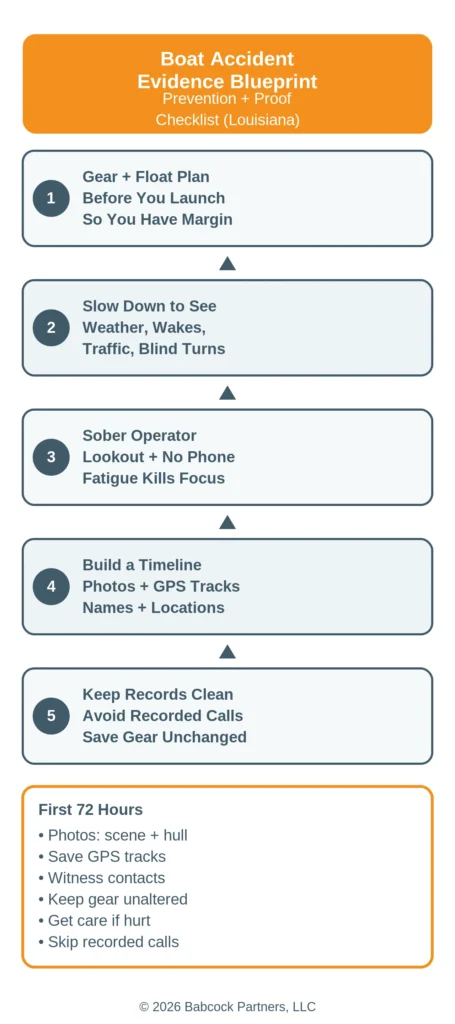
Download the printable toolkit (PDF) for a one-page checklist and the two infographics you can keep in your boat bag. The download is designed for quick reference, not as legal advice.

How Do You Prevent a Boat Accident in Louisiana?

To prevent a boat accident in Louisiana, run at a speed that matches visibility and traffic, keep a constant lookout, and plan for weather changes. Most crashes come from blind corners, wakes, storms, alcohol, or simple inattention, so the best prevention is a short routine you follow every launch.

  • Plan the trip: Check the forecast, pick a safe route, and tell someone your return time.
  • Dress for the water: Life jackets and a throw device should be reachable, not buried.
  • Slow down early: Reduce speed near docks, bends, bridges, and heavy traffic.
  • Use a lookout: Assign a passenger to help scan for hazards and wakes.
  • Stay sober and focused: No alcohol, no phone scrolling, no “just one more run.”
  • Think in margins: Leave space to stop, turn, and absorb sudden waves.

When we talk about “leverage” in a safety context, we mean reducing the number of ways a routine day turns into a crisis. This is why we prefer simple habits you can repeat under stress instead of long, perfect rules that get skipped.

What Safety Equipment Helps Prevent Boat Accidents?

LDWF’s required boating equipment page is the safest starting point for what you should have on board because it tracks Louisiana’s current checklist. The CDC’s drowning prevention guidance explains that consistent life jacket use is one of the most effective ways to prevent a fatal outcome when someone goes in the water.

Equipment Why It Matters for Prevention
Life jackets (PFDs) Turns a fall overboard into a survivable event while you regain control and call for help.
Sound signal Helps you warn other vessels in fog, around bends, or in heavy traffic.
Navigation lights Makes your position and direction visible at dusk, dawn, and in low visibility.
Fire extinguisher Gives you a chance to stop a small engine or fuel fire before it spreads.
Throwable device Provides immediate flotation for a passenger while you maneuver for pickup.

Equipment only works when it is reachable and the crew knows what it is for. That is what we mean by leverage on the water: a simple setup that still works when everything is loud and moving.

Do You Need Boater Education to Operate a Boat in Louisiana?

Many Louisiana operators need a boater education course depending on factors like age and the type of vessel. The easiest way to confirm the rule that applies to you is to start with LDWF’s boater education page before you hand the controls to a new driver.

  • Confirm who must comply: Check the LDWF rules for your operator’s age and the vessel type.
  • Keep proof available: Carry the card or completion proof where you can access it quickly.
  • Do a five-minute safety brief: Cover PFD locations, how to call for help, and the route plan.
  • Practice a “dead stop” drill: Make sure the driver can reduce speed fast without panic.

In our experience, education reduces accidents because it makes the basics automatic. It also reduces confusion later if someone tries to claim the operator “didn’t know better.”

How Do Weather, Visibility, and Speed Cause Boat Crashes?

Weather and visibility change fast on Louisiana waters, and speed is what turns a surprise into a collision. The National Weather Service’s safe boating thunderstorm guidance explains how wind shifts, lightning, and rapid wave growth can make small boats unstable in minutes.

  • Before leaving: Check forecast timing and look for storm lines moving toward your route.
  • On the water: Reduce speed near bends, bridges, wakes, and dock entrances.
  • When visibility drops: Slow down until you can stop within the distance you can see.
  • When thunder is nearby: Seek a safe harbor early rather than trying to “beat it home.”
  • After a close call: Write down time, location, and what the sky and water looked like.

This is why we tell families to save weather screenshots after an incident, even if the storm seems obvious. Those simple records can prevent an insurer from rewriting the conditions later.

How to Reduce Risk From Alcohol, Distraction, and Fatigue

Alcohol and drugs raise crash risk and can expose an operator to serious legal trouble after a boating incident. The U.S. Coast Guard’s boating under the influence overview describes why impairment is especially dangerous on the water, where waves, wind, and vibration already reduce balance and reaction time.

  • Designate a sober operator: Make the decision before you cast off, not after a few drinks.
  • Use a lookout: The operator’s eyes stay on traffic while the lookout scans hazards and wakes.
  • Build a phone rule: If you need navigation, mount the phone and use voice prompts.
  • Plan breaks: Fatigue shows up as late turns, missed buoys, and sloppy docking.
  • Set passenger boundaries: No standing on seats, no riding the bow, no horseplay.

If you are hosting guests, prevention is mostly choreography. Assign roles, keep the boat predictable, and avoid the situations where one mistake becomes two.

What to Do After a Boat Accident to Protect Yourself

After a boat accident, your first job is safety and medical care, and your second job is preserving a clean record of what happened. U.S. Coast Guard Navigation Center radio guidance explains the basics of marine radio information for boaters, which matters when you need help and cell service is weak.

  1. Stabilize the scene: Account for passengers, control bleeding, and keep everyone afloat and visible.
  2. Call for help early: Use the most reliable option available, including VHF when appropriate, and keep your message simple.
  3. Document before repairs: Take wide and close photos of boats, hull marks, props, docks, and fixed objects.
  4. Save device data: Screenshot GPS tracks, speed, and time stamps before apps refresh or batteries die.
  5. Collect witness info: Get names and numbers, and ask what they saw in one or two sentences.
  6. Be careful with statements: Tell the truth, but avoid recorded interviews until you understand what is being alleged.

Timeline Builder

A good timeline is a prevention tool and a proof tool. This is why we build the story in time order rather than arguing about fault first.

Time Window What to Capture
0–30 minutes Photos of the scene, names of everyone on board, and a quick note of the location and conditions.
Same day GPS tracks and app screenshots, witness contacts, and a short symptom log if anyone is hurt.
First 72 hours Medical visit documentation if needed, copies of any reports, and preserved gear in the condition you found it.
Quick reference: the 5-step boat accident evidence blueprint plus the first 72-hour checklist, with a printable version in the PDF below.

If your situation involves serious injury, wrongful death, or a disputed story, getting guidance early can protect the record. We describe our approach to boat accident claim help on our main practice page.

How Insurance Companies Shift Blame After Boat Accidents

Insurance adjusters often test for shared fault because Louisiana allocates damages by percentage under La. Civ. Code art. 2323. That is why the first question is rarely “How are you?” and is usually “Tell me what happened” while the facts are still messy.

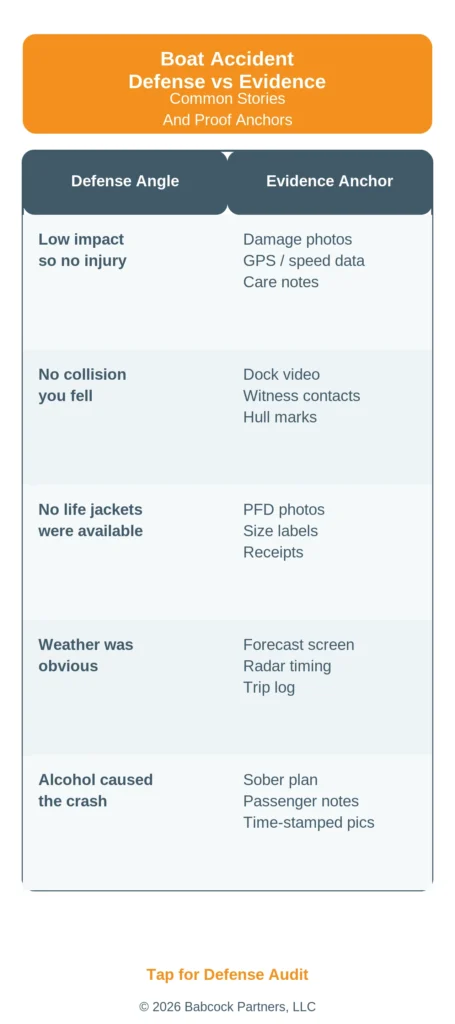
Common Defense Theme Documentation That Helps
“You were speeding.” GPS track, time stamps, and photos showing visibility and traffic conditions.
“Weather was obvious.” Forecast screenshots, radar images, and notes on when conditions changed.
“No collision occurred.” Photos of hull marks, dock damage, and witness names while people are still nearby.
“You were impaired.” Receipts, passenger notes, and any objective time-stamped documentation of the day.

Defense Audit

That is what we mean by leverage against insurer tactics: your records answer the predictable narratives before they harden. If the adjuster cannot “fill gaps” with assumptions, the evaluation tends to be more reality-based.

Common boat accident defense narratives—and the records that close the gaps.

If you want the statutory and reporting overview in one place, LDWF’s boating regulations page is a reliable reference for Louisiana boating rules. Use it for compliance, but do not let it replace the evidence checklist above.

What we see in practice

We often see boat accidents where the physical damage is repaired before anyone captures clear photos, which later turns into an argument about impact and speed. We also see incidents where the only “timeline” is a memory that changes each time the story is retold. When that happens, insurance companies have room to reframe what you did and why it mattered.

We also see how fast third-party evidence disappears. Marina cameras overwrite, phones get replaced, and GPS apps reset without warning. This is why we treat the first days as a documentation sprint, even when everyone feels “mostly fine.”

When to Talk to a Lawyer After a Boat Accident

You should talk to a lawyer quickly after a boat accident if there is a serious injury, a fatality, a commercial operator, or a real dispute about who caused what. Early advice can help you avoid common proof traps, especially when comparative fault arguments are already forming.

  • Call quickly if: someone went under water, hit their head, or symptoms are changing over 24–72 hours.
  • Call quickly if: the operator may be accused of impairment or reckless operation.
  • Call quickly if: there is boat-to-boat damage and witnesses are leaving the scene.
  • Call quickly if: an insurer asks for a recorded statement or a fast release.
  • Call quickly if: there was a fatality and your family needs next-step guidance; our wrongful death resource covers related issues.

If you want a print copy you can hand to a family member or keep in your glove box, use the toolkit link here. Download the printable toolkit (PDF).

Louisiana Law Snapshot (Updated 2026)

Most Louisiana personal injury cases have a two-year delictual prescription deadline, and missing it can end the claim. The rule is stated in La. Civ. Code art. 3493.1, and it is one reason we encourage families to get advice early rather than “wait and see.”

Louisiana also uses comparative fault, which means the percentage of fault assigned to each person can change the final recovery. Under La. Civ. Code art. 2323, and with the post–Jan. 1, 2026 51% bar, being more than 50% at fault can prevent recovery in many cases.

Free Case Review: Next Steps After a Boat Accident

We are not built for volume. We are built for leverage.

When the story is disputed, leverage comes from a fast timeline, clean documentation, and insurer communication that protects you from trap questions. Call (225) 500-5000 and use the free case review form, especially when evidence is disappearing or you are being pushed to “wrap it up.”

These items are helpful to have with you when you call, but do not delay calling because you do not have them. If you have them handy, keep them nearby for the call.

  • Photos and videos of boats, docks, and any visible injuries.
  • Names and numbers for witnesses and passengers.
  • GPS track or app screenshots showing time and location.
  • Any report numbers or agency contact information.
  • Insurance policy details for the boat and involved parties.

Call Today If…

  • Someone hit their head, went under water, or symptoms are changing.
  • The other side claims you were speeding, impaired, or “at fault.”
  • An insurer asks for a recorded statement or a quick release.
  • The boat is about to be repaired, sold, or moved.

What Happens Next

  • Evidence triage: we identify what to preserve first and where it can be found.
  • Deadline spotting: we map key dates and reporting issues based on the facts.
  • Insurer contact strategy: we plan communications to reduce misunderstandings and avoid avoidable admissions.

If you want to understand how we evaluate liability and proof, start here: talk with a boat accident lawyer. That page walks through the basics in plain English.

×