


Editorial & Legal Accuracy Notice (Louisiana)
This blog contains general legal and safety information and is not legal advice. Laws and deadlines can change, and outcomes depend on specific facts.
Last reviewed / updated: March, 2026
Reviewed, updated, and authored by: Stephen Babcock, Louisiana injury lawyer
This guide explains what documentation matters after a Louisiana automobile accident and how to organize it quickly. Use it as a practical checklist for your file.
After an automobile accident, most people remember the impact, not the paperwork that follows. Insurance decisions often turn on what can be proven with dates, records, and consistent notes. The goal of this rewrite is to help you build a clean documentation file that is easy to share and hard to dismiss.
Our approach is simple: treat documentation like a case file from day one, because the insurer will. We are not built for volume. We are built for leverage. Speed + evidence preservation + insurer-insider knowledge + trial-ready preparation = The Babcock Benefit. In an automobile accident claim, leverage is a clean timeline, objective records, and fewer gaps to attack.
Firm links: Client Reviews | Contact | Locations
Prefer a print-friendly version? Download the printable toolkit (PDF) and keep it with your claim file.
If you are inside the first 72 hours, call (225) 500-5000 or use the free case review form before evidence changes.
What Documents Do You Need After a Louisiana Automobile Accident?
After a Louisiana automobile accident, you need a core set of records that proves what happened, what it did to your day-to-day life, and what it cost. If you are unsure what matters most, start with the checklist we use when reviewing cases through our Baton Rouge car accident page.
- Scene proof: photos/video of vehicles, roadway, weather, and visible injuries.
- People and identifiers: driver info, plate numbers, witnesses, and responding agency.
- Crash report details: report number, incident number, and where to request a copy.
- Medical documentation: visit summaries, prescriptions, and a symptom-and-function log.
- Vehicle and cost proof: estimates, invoices, towing, rental, and out-of-pocket receipts.
- Work and income proof: employer notes, missed time records, and pay documentation.
- Insurance file: claim numbers, adjuster contacts, and every written communication.
Put everything in one folder with dates in the filenames so you can find it quickly later. If you share documents, send copies and keep originals untouched. Good organization also reduces stress, because you stop searching when the adjuster asks a surprise question.
How Do You Build a Timeline That an Adjuster Can’t Rewrite?
A timeline turns scattered notes into a clear sequence that supports your claim decisions and medical care. The NHTSA MMUCC overview explains how crash reports capture standardized fields, so your timeline supplies the everyday context that a form can miss.
| Time Window | What to Write Down | What to Save |
|---|---|---|
| 0–2 hours | Location, direction of travel, point of impact, and who said what at the scene. | Photos, short video walkthrough, witness contacts, tow receipt. |
| First 72 hours | Symptoms that show up, daily tasks you cannot do, and when you start missing work. | Urgent care/ER discharge papers, prescriptions, employer messages. |
| Week 1–2 | Follow-up appointments, referrals, and any new pain patterns or sleep issues. | Portal visit summaries, PT/home-exercise notes, mileage/transport receipts. |
| Ongoing | Good days vs bad days and how the injury changes driving, work, and family routines. | Updated estimates, wage records, insurer letters, and a running expense list. |
This is why we start with the timeline: it preserves details while memory is fresh and before the file gets shaped by other people’s questions. Keep your entries short and dated, and avoid guessing at speeds or distances. If you need a simple structure, copy the table above into a notes app and add a new row after each major event.
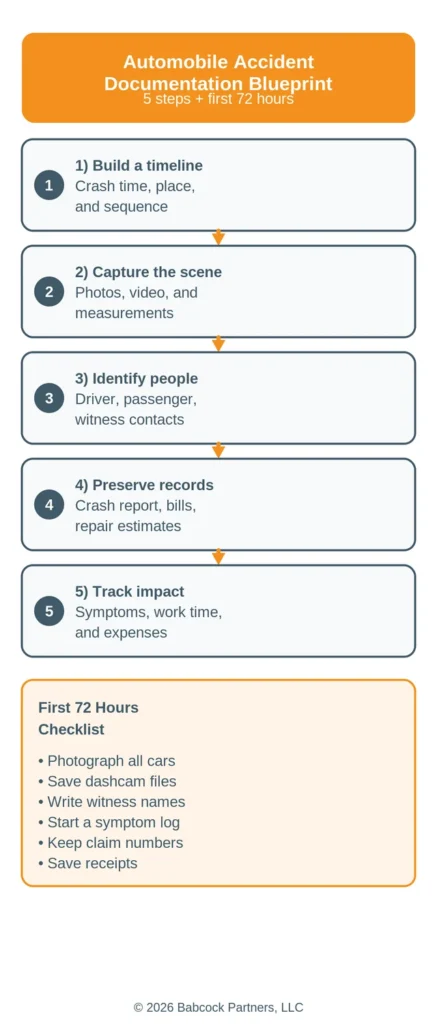
What Are the 7 Documentation Tips That Matter Most?
The best documentation is consistent, dated, and easy to share without exposing private originals. Use the seven tips below to build a clean claim file while you decide whether you need Baton Rouge-based help.
- Make a “one-folder rule” for the entire claim. Create one folder for photos, one for medical, one for work, and one for insurance, then keep everything dated.
- Photograph vehicle damage before repairs. If there is a dispute about repair scope or total loss, the documentation tips on our property damage claim help page explain why before-and-after photos matter.
- Write down witnesses the same day. Get names and phone numbers and add one sentence about what each witness actually saw.
- Track commercial involvement early. When a company vehicle or heavy truck is involved, quick identification can matter, so save DOT markings and consider the resources discussed in our truck accident cases page.
- Keep a symptom-and-function log. MedlinePlus’s whiplash overview notes that some pain can show up hours or days later, so date your first symptoms and tie them to daily tasks.
- Document head and neuro symptoms carefully. CDC’s concussion symptom guidance is a useful checklist for what to record and report to a clinician.
- Keep insurer communications in writing when possible. Save every email and letter, and write a short note after phone calls with the date, time, and what was said.
One more practical tip: take screenshots of important phone screens like claim numbers, appointment confirmations, and mileage logs. If you are unsure whether a detail matters, save it anyway and sort it later. The work is not collecting more paper, it is keeping a clean sequence and a clean copy trail.
How Do You Protect Digital Evidence Like Dashcam and Phone Data?
Digital evidence can disappear quickly because many systems overwrite data on a loop or get wiped during repairs. That is what we mean by leverage: preserved video, metadata, and download timestamps leave less room for later debates.
- Dashcam: pull the original file and save a duplicate copy to cloud storage the same day.
- Phones: screenshot call logs and texts with dates, then back up your device before it auto-cleans.
- Photos: keep the originals and also export a “share” set with filenames that include the date.
- Maps and location history: export a copy of your route if it helps explain where the crash occurred.
- If distraction is suspected: document what you observed and discuss next steps with counsel familiar with distracted driving cases.
Do not edit images in a way that overwrites the original file, because it can create questions later about when a photo was taken. If you need to annotate a photo, make a separate marked-up copy and keep the original untouched. This is also why cloud backups matter: lost phones and damaged devices are common after a serious automobile accident.
How Do Insurance Companies Attack Documentation Gaps?
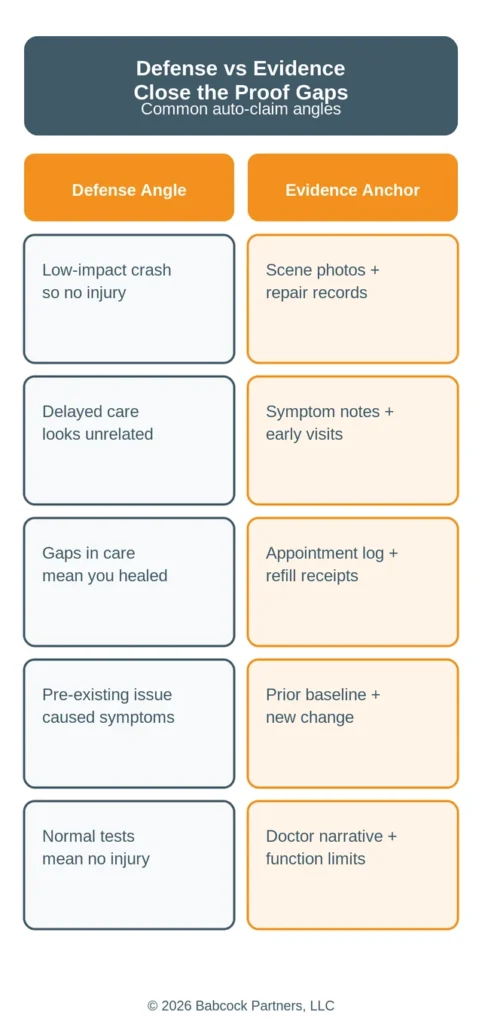
Insurance companies often reframe a claim around “missing proof,” not the crash itself. Under Louisiana Civil Code article 2315, fault-based claims still depend on evidence, so closing gaps early helps prevent “not enough documentation” from becoming the theme.
| Common Defense Angle | Evidence That Counters It |
|---|---|
| “The impact was minor.” | Wide-angle scene photos, close-up damage photos, repair invoices, and a dated timeline of symptoms. |
| “You waited too long to seek care.” | Symptom notes, appointment confirmations, and records showing when you first reported pain. |
| “Gaps in care mean you healed.” | Appointment logs, pharmacy refills, and written explanations for interruptions (work, cost, scheduling). |
| “This was pre-existing.” | Prior baseline records, then clear notes showing what changed after the crash. |
| “Normal tests mean no injury.” | Mayo Clinic’s whiplash overview can help you describe symptoms that do not show on a simple image, along with clinician notes about function limits. |
This is why we document in categories insurers use to discount claims: it lets you answer predictable questions with clean records instead of memory. If a record is missing, write down why it is missing and what you did instead, because silence is often treated like a gap. Your goal is not to argue, it is to show a consistent story across photos, timelines, medical notes, and expense proof.
What we see in practice
We see documentation problems happen for normal reasons: people are hurting, cars are getting fixed, and insurers move fast with forms and phone calls. We also see that the strongest files are not the biggest files, they are the cleanest files.
- Photos exist, but they are not labeled, so nobody can tell what they show or when they were taken.
- People treat “pain” and “limitations” as the same thing, so the record never explains how the injury changed daily life.
- The claim file is split across texts, emails, and paper, which leads to missing items when deadlines hit.
- A fast settlement offer shows up before medical treatment stabilizes, and the paperwork creates pressure to decide too soon.
When we are involved early, we focus on building a timeline, preserving third-party evidence, and keeping communications consistent. We do not need perfect paperwork on day one, but we do need a plan that prevents avoidable gaps.
When Should You Talk to a Lawyer Quickly?
You should talk to a lawyer quickly when evidence is likely to disappear or when the claim is already getting complicated. If you want a starting point on how we handle these cases, review our auto accident practice and then use the triggers below to decide how urgent your situation is.
- Serious injury signs: head symptoms, numbness/weakness, or worsening pain.
- Commercial involvement: a company vehicle, delivery van, or heavy truck is part of the crash.
- Multiple policies: rideshare, employer vehicle, or unclear coverage layers.
- Pressure to “just sign”: broad releases, blanket medical authorizations, or deadlines attached to offers.
- Fault disputes: conflicting stories, no witnesses, or a sudden claim you were partially at fault.
Even if you are not ready to hire anyone, a short legal consult can help you spot deadlines and preserve evidence sources you did not know existed. This is why we focus on early leverage: the fastest gains often come from preventing one bad paperwork moment.
What Should You Avoid When Collecting Crash Documentation?
Avoid mistakes that create preventable credibility issues or destroy original records. Small documentation errors can become big arguments later, even when the underlying claim is valid.
- Do not lose originals: keep originals and send copies, especially for photos and medical records.
- Do not “fill in” facts: if you do not know a detail, write “unknown” and update later.
- Do not edit away metadata: keep original photo/video files and save annotated copies separately.
- Do not ignore follow-up care: gaps happen, but document why they happened and what you did.
- Do not let paperwork drift: set a weekly reminder to download portals, save receipts, and update your timeline.
Keep a copy of your file for yourself, then share clean duplicates when needed. For a print-ready checklist, Download the printable toolkit (PDF) and add it to your folder.
Louisiana Law Snapshot (Updated 2026)
Louisiana deadlines and fault rules shape how fast you should preserve documents and how carefully you should handle statements. Two rules show up in many automobile accident cases: the two-year filing deadline and comparative fault.
| Rule | What It Means | Why Documentation Matters |
|---|---|---|
| Two-year prescription | The Louisiana Civil Code article 3493.1 two-year rule generally gives you two years from the date of injury to file a lawsuit in many personal-injury matters. | Waiting can mean lost records, overwritten video, and missing witnesses even before the deadline arrives. |
| Comparative fault | Under Louisiana Civil Code article 2323, fault is allocated by percentage, and the post–Jan. 1, 2026 rule can bar recovery if you are 51% or more at fault. | Your timeline, photos, and witness notes help reduce “shared fault” arguments that cut value or end the claim. |
Talk to a lawyer quickly if an insurer is already blaming you, if there is a commercial vehicle involved, or if you are facing pressure to sign releases. Deadlines matter, but evidence loss often matters sooner than the calendar does.
Free Case Review While the Evidence Still Exists
When you are hurt, the hard part is not “getting documents,” it is getting the right documents before the story changes. We are not built for volume. We are built for leverage. The Babcock Benefit is our evidence-first way of preserving proof early and staying trial-ready if the insurer refuses to take the claim seriously.
Call (225) 500-5000 and use the free case review form so we can triage evidence and protect deadlines. If you want the bigger picture, review how we handle motor-vehicle claims and then come back to the checklist above.
Acting quickly matters because video systems overwrite, vehicles get repaired or totaled, and witnesses become harder to reach. The two-year deadline for many injury claims is another reason to avoid delay. Even if you feel mostly fine today, early documentation protects you if your condition changes.
These items are helpful to have with you when you call, but do not delay calling because you do not have them. If you have them handy, keep them nearby for the call.
- Crash date, time, and location
- Photos/videos (or the folder link where they are saved)
- Claim numbers and adjuster contact info
- A list of medical visits so far and upcoming appointments
- Any repair estimates, towing, rental, or receipt totals
Call Today If…
- You have head symptoms, numbness, weakness, or worsening pain
- The other side is blaming you or witnesses are hard to locate
- A company vehicle, delivery van, or truck is involved
- You are being pushed to sign releases or give a recorded statement quickly
- Your car is about to be repaired, sold, or moved from storage
What Happens Next
- We triage evidence sources and lock down the items most likely to disappear first.
- We spot deadlines and coverage issues early, then map out a documentation plan.
- We set an insurer-contact strategy that protects you from avoidable proof gaps.