

This guide explains how to obtain a police crash report after a Louisiana car accident and how to use it to organize evidence and avoid preventable claim delays.
A Louisiana police crash report is often the first document an insurer asks for after a wreck. Getting the report early helps you verify the basics, request missing supplements, and protect time-sensitive proof. If you were hurt, our case preparation approach for serious wrecks starts the same way: lock down the record, then build the evidence around it. This article walks you through the request process and a practical review checklist.
Our team treats the crash report as a starting point, not the finish line, because early paperwork can be incomplete. We are not built for volume. We are built for leverage. Speed + evidence preservation + insurer-insider knowledge + trial-ready preparation = The Babcock Benefit. For a police report in a Louisiana car accident, leverage often means getting the right version of the report, plus the photos and supplements, before an adjuster treats an error as fact.
If you are inside the first 72 hours, call (225) 500-5000 or use the free case review form before evidence changes.
Firm links: Client Reviews | Contact | Locations
Download the printable toolkit (PDF) if you want the request checklist and the two infographics in a clean format. The toolkit is designed for your phone or a printer.
How Do I Get a Police Report After a Car Accident in Louisiana?
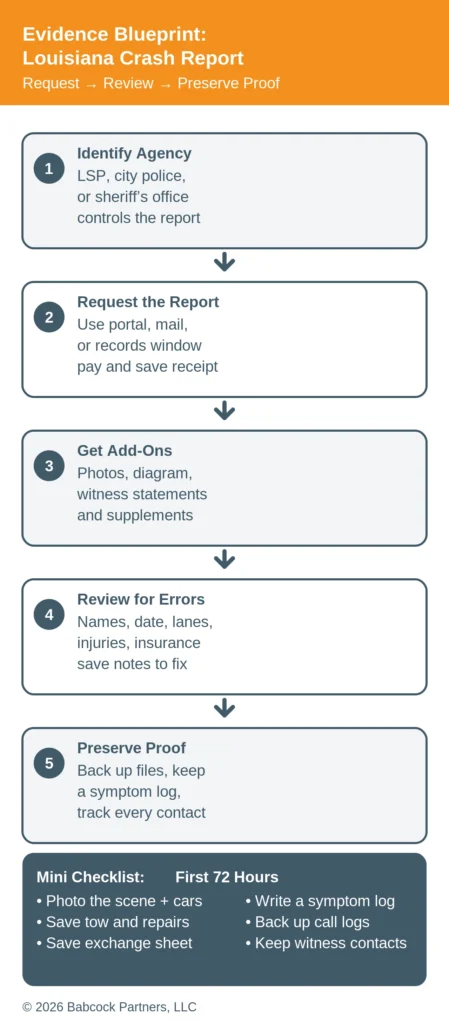
In Louisiana, you usually request the crash report from the agency that investigated the wreck, and the Louisiana crash report portal can be a fast starting point when the report is available online. If the portal does not have it, identify whether Louisiana State Police, a city police department, or a sheriff’s office responded, then use that agency’s records process to order the report and any supplements.
- Find the investigating agency and report number on the driver exchange sheet.
- Request the report online, by mail, or through the agency’s records office.
- Ask for supplements, diagrams, and any available photos at the same time.
- Save a clean PDF copy and keep notes of what looks wrong or missing.
People often say “police report” and “crash report” interchangeably, but what matters is who wrote it and what pages exist. The report may include a narrative, a diagram, and coded fields that insurers use for quick decisions. That is what we mean by leverage: when you control the paper trail early, you reduce the chance an insurer locks in the wrong story.
Step 1: Identify the Investigating Agency
If you are unsure who investigated, start with the exchange sheet from the scene, the 911 call information, or the citation number if one was issued. When Louisiana State Police handled the crash, their Traffic Records Unit is a key reference point for how reports are requested. If a local department investigated, the request usually goes through that city or parish records office.
Step 2: Request the Report and Supplements
Order the report first, but do not stop there if your claim may be disputed. A diagram, photo set, or supplemental statement can matter as much as the main narrative when an insurer reviews liability. This is why we look for the add-ons that are not always included in the first PDF you receive.
What Information Do I Need to Request a Louisiana Crash Report?
Most agencies can locate the correct report if you provide the crash date, location, and at least one driver’s name, but a report number is even better. The LSP crash report request form is a good example of the identifiers records units commonly use to pull the right file.
- Crash report number (or incident/case number), if you have it
- Date and approximate time of the crash
- Crash location (street, parish/city, mile marker if relevant)
- Driver names (and passenger name if you were not the driver)
- Vehicle details (plate, make/model, VIN if available)
- Your contact information and your relationship to the crash (driver, passenger, owner)
Bring the exchange sheet, a photo of your driver’s license, and a payment method if the request is in person. If you are requesting records for someone else, ask what authorization the agency requires before you make a trip. To avoid delays, keep a screenshot or receipt of the request so you can prove what you ordered and when.
Where Should I Request the Report if Louisiana State Police Investigated?
If Louisiana State Police investigated, start with the statewide portal for the basic report, then use the formal request path for anything missing. The state crash report portal can be convenient, while the Traffic Records Unit guidance and the request form help when you need a specific certified copy or additional pages.
- Check the portal first if you need a fast PDF version.
- If you need a certified copy, use the request form and follow the submission instructions.
- Request supplements (diagram pages, citations, measurements) when you submit the request.
- If photos are available, ask about the process described by the LSP Photo Lab.
The most common avoidable mistake is ordering the report and assuming it includes everything the agency has. Many insurance disputes are really “missing attachment” disputes. This is why we recommend you ask one clear question when you request the report: “Does this file have any photos, diagrams, supplements, or attachments that are not included in the first report PDF?”
What If a City Police Department or Sheriff’s Office Investigated?
If a city police department or sheriff’s office investigated, the request usually runs through that department’s records office rather than State Police. The City of Baton Rouge crash report FAQ shows how local agencies may handle pick-up, fees, and identification, but the process can vary by parish.
- Call the department’s records unit and ask how to order crash reports (online, mail, or in person).
- Ask whether the report has supplements and whether they are included automatically.
- Confirm what ID or proof of involvement is required.
- Keep a receipt or confirmation number for your file.
If the crash happened outside Baton Rouge, the same approach applies: locate the investigating agency, then request the report through that agency’s process. If you need to focus on a Baton Rouge area claim, the Baton Rouge hub page explains where our team works and how we approach local evidence issues. For property-only disputes, we also cover documentation strategy on our property damage claim page.
How Long Does It Take for a Louisiana Crash Report to Be Available?
Crash report availability depends on when the officer completes and submits the report and when the agency processes it for release. Some reports show up quickly, while others take longer when the crash is complex, involves injuries, or requires additional review.
| Why It Can Take Longer | What You Can Do While You Wait |
|---|---|
| Multiple vehicles, conflicting statements, or unclear fault | Save photos, videos, and witness contacts now so the timeline is not built from memory later |
| Serious injuries, a fatality, or a commercial vehicle | Preserve dashcam/phone files and identify potential camera sources before footage is overwritten |
| Supplements, diagrams, or photos are stored separately from the basic report | Ask specifically whether attachments exist and how to request them in the same order |
This is why we push evidence preservation even before the report is in your hands. If you wait for the police report before backing up phone photos, bodycam requests, or nearby business video, those records may be gone. The goal is simple: keep your proof options open while paperwork catches up.
What Should I Check for Errors in the Police Report?
Read the report with a proof mindset because small errors can steer an adjuster’s liability decision or send the claim to the wrong insurer. Start by checking identifiers and the crash diagram, then compare the narrative to your photos and the physical damage pattern.
- Names, addresses, and driver/passenger roles are correct
- Vehicle information matches (plate, VIN, make/model, insurer fields)
- Crash date, time, and exact location are accurate
- Diagram matches the lanes, directions, and point of impact
- Witnesses are listed with usable contact info
- Your complaints or symptoms are not missing or misstated
When something is wrong, keep your response factual and documented. Take screenshots of the error, attach your photos, and ask the investigating agency what their correction process is, because agencies often handle corrections differently. That is what we mean by leverage: insurers tend to lean on the first written story unless you show them a cleaner, better-supported record.
Timeline Builder: How Do I Turn the Crash Report Into a Proof Timeline?
Use the crash report as the backbone of your timeline, then attach time-stamped proof that supports each key fact. A clean timeline helps your medical records, photos, and witness information tell the same story when an insurer looks for gaps.
| Timepoint | What to Capture | Proof to Save |
|---|---|---|
| At the scene | Who was involved, where vehicles ended up, weather and lighting | Photos/video, witness names, 911 call details, tow receipt |
| Same day | Symptoms, pain changes, and what you reported to others | Symptom notes, texts to family, urgent care or ER discharge papers |
| First 72 hours | Consistency between the report, your photos, and your early medical notes | Backed-up phone media, appointment confirmations, mileage/time logs |
| After the report arrives | Corrections and supplements, plus any missing attachments | Clean PDF copy, request receipts, written notes of errors and fixes |
Build the timeline in one place, then keep adding to it as new records arrive. Use consistent labels like “Report PDF,” “Scene Photos,” and “Medical Visit #1” so nothing gets lost. This is why we create a single evidence map early: it makes it harder for an insurer to cherry-pick one detail and ignore the rest.
Defense Audit: What Do Insurers Look for in a Crash Report?
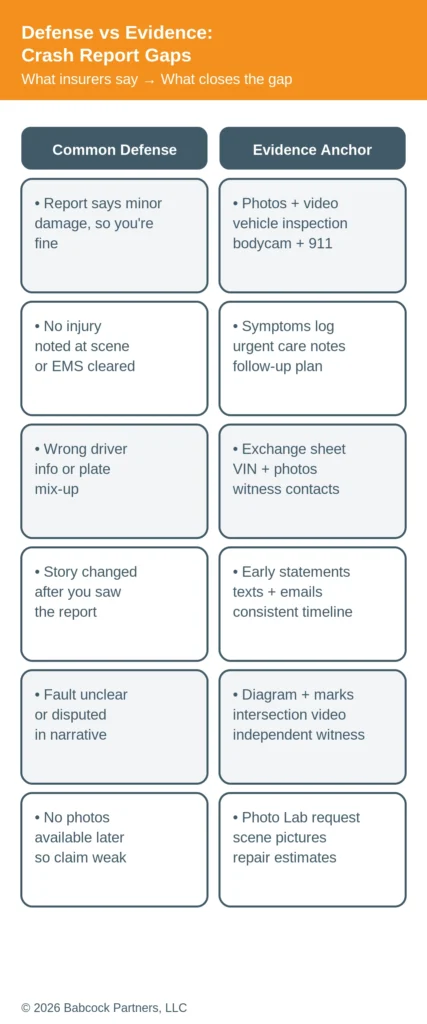
Adjusters often scan for gaps they can label as uncertainty, such as unclear fault, missing injury notes, or inconsistent statements. If you know the common narratives, you can collect records that answer them without guessing or arguing.
| Common Defense Narrative | Evidence Anchor That Helps |
|---|---|
| “The damage looks minor, so you’re fine” | Scene photos, repair documents, and a consistent symptom timeline |
| “No injury was noted at the scene” | Early medical notes, symptom log, and follow-up plan documentation |
| “Your story changed later” | Early texts/emails, witness contacts, and a single timeline document |
| “Fault is unclear in the narrative” | Diagram consistency, intersection camera sources, and independent witnesses |
| “There are no photos to verify impact” | Requesting agency photos and preserving your own media backups |
This is where recorded statements and early settlement pushes can create problems, because an insurer may try to lock you into phrasing that does not match the paper record. That is what we mean by leverage: when your documents and timeline are organized, you can respond with proof instead of memory.
What we see in practice
We see police reports help establish the basic framework, but they are not always complete on the details insurers fight about. We also see that a missing attachment or a small factual error can become the center of a claim dispute if nobody fixes the record early.
- Injury fields left blank even when pain started later the same day
- Diagrams that do not match the actual lane layout or point of impact
- Witnesses who were present but not listed with usable contact details
- Photos stored separately from the report and never requested
- Adjusters treating the report narrative as a final liability ruling
We build claims by cross-checking the report against photos, vehicle damage, medical records, and any available recordings. We do not assume the first version is perfect, and we do not assume the insurer will look for missing pages. Instead, we organize the file so the story is consistent across documents and so deadlines do not sneak up while people wait for paperwork.
What Should I Do in the First 72 Hours to Preserve Evidence?
Use the first 72 hours to preserve proof that changes quickly, even if the crash report is not ready yet. Focus on backing up photos and videos, capturing witness information, and writing a short symptom and activity log so the early record stays consistent.
- Back up all phone photos and videos to a second location
- Write down witness names and numbers while they are fresh
- Save tow, rental, and repair paperwork in one folder
- Keep a symptom log with time stamps and functional limits
- List every insurer and adjuster contact with date and topic
This is why we tell people not to wait for the police report to begin documentation. The report is important, but it is only one piece, and your time-stamped proof often fills the gaps. If you do not have the report number yet, write down the responding agency and the location so you can follow up efficiently.
When Should I Talk to a Lawyer About a Crash Report Problem?
Talk to a lawyer quickly if the report blames you, the report is missing key facts, or an insurer pressures you to give a statement or sign paperwork before the record is complete. You should also get help early when the crash involves serious injury, a commercial vehicle, or a dispute over who had the right of way.
- The report lists the wrong driver, vehicle, insurer, or witness
- The narrative conflicts with your photos or physical damage pattern
- You are being pressured to accept “property damage only” or to sign a release
- You suspect camera footage exists but may be overwritten soon
- You are unsure how to request supplements, photos, or corrections
If you want a deeper overview of how we build these cases, start with our Baton Rouge car accident page and focus on the evidence checklist and timeline approach. Even if you are still waiting on the report, you can keep organizing your documentation so the file is ready when the insurer starts asking questions. The earlier you spot a report gap, the easier it is to plan around it.
Download the printable toolkit (PDF) before you talk to an adjuster if you want a one-page checklist for ordering the report and reviewing common errors. The toolkit also includes the defense-audit table and both infographics.
Louisiana Law Snapshot (Updated 2026)
Two legal concepts shape how quickly you should act after a car accident: the filing deadline (prescription) and comparative fault. The Louisiana Civil Code article 3493.1 explains the two-year delictual prescription for many injury claims, and Louisiana Civil Code article 2323 covers comparative fault, including the post–Jan. 1, 2026 51% bar.
- Two-year clock: In many cases, waiting too long can bar the claim even if liability is clear.
- Comparative fault: Fault can reduce recovery, and after the 2026 update a party at 51% or more fault may be barred from recovery under the statute.
- Practical takeaway: Preserve evidence early and get legal guidance on deadlines before you assume you can “wait for the report.”
Free Case Review: Build the Record Before the Story Sets
If you are dealing with a missing, wrong, or incomplete police report after a Louisiana car accident, you do not have to guess your next move. We are not built for volume. We are built for leverage.
Evidence can disappear quickly, and small report mistakes can harden into the story an insurer repeats. Photo requests, witness contacts, and correction options can also get harder as days pass.
Our version of the Babcock Benefit is simple: move fast, preserve evidence, and build a trial-ready file so the insurer cannot win by exploiting gaps. Call (225) 500-5000 and use the free case review form so we can triage the report, the attachments, and the proof that supports your version of the crash. If you want to understand our broader approach, start with car accident claim help and focus on evidence preservation.
These items are helpful to have with you when you call, but do not delay calling because you do not have them. If you have them handy, keep them nearby for the call.
- Crash report number or a copy of the report PDF you have
- Photos/videos from the scene and vehicle damage
- Witness names and contact information
- Insurance policy and claim number (if opened)
- A short symptom timeline and any visit summaries
Call Today If…
- The report blames you or leaves out key facts
- You are being pressured to sign a release or give a recorded statement
- You suspect camera footage exists and may be overwritten soon
- The crash involves a serious injury or a commercial vehicle
- You cannot find the report or the agency process is unclear
What Happens Next
- Evidence triage: We identify what records matter most and what is at risk of disappearing.
- Deadline spotting: We flag key timing issues and paperwork risks tied to your facts.
- Insurer contact strategy: We plan communications so the insurer gets clear proof, not confusion.