

The public record of the Patrick J Studdert collision contains more than a finding about cell-phone distraction. It contains a timed sequence of vessel movement and radio calls, a carrier-recorded outgoing call, the captain’s interview, and explicit limits on what investigators could verify. Reading those records together shows both the evidence supporting the investigation and the assumptions a reader should avoid.
On December 29, 2024, the towing vessel collided with the bulk carrier Clara B near mile 122 of the Lower Mississippi River, northwest of Luling, Louisiana, and sank. The NTSB’s final report, MIR-26-13 attributes probable cause to the towboat captain’s phone distraction and resulting failure to maintain a proper lookout. The timeline below identifies the records supporting each event. Updated October 17, 2026.
The final minutes, with the source for each event
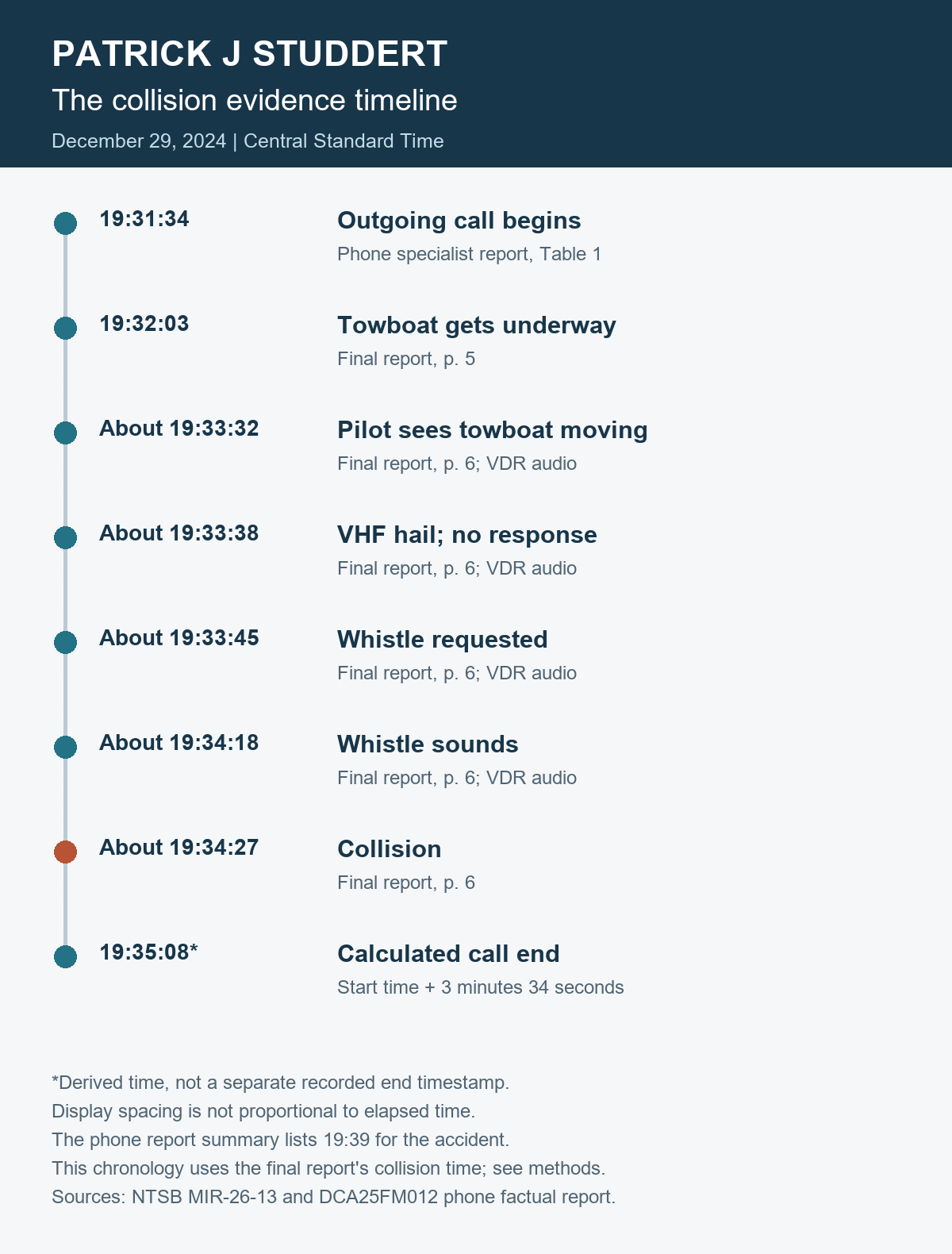
Scroll horizontally to see all columns. Use the arrow keys when the table is focused.
| Time on December 29, 2024 (CST) | Event | Source and qualification |
|---|---|---|
| 19:31:34 | Outgoing call begins on the captain’s cell phone. | Phone specialist factual report, Table 1, printed p. 2 (PDF page 3). Recorded duration: 3 minutes 34 seconds. |
| 19:32:03 | Patrick J Studdert gets underway from the fuel dock. | Final report, p. 5. The report separately explains that AIS showed the vessel crossing the channel directly after departure. |
| About 19:33:32 | The pilot on Clara B sees the towboat underway. | Final report, p. 6, based on Clara B voyage data recorder (VDR) audio. |
| About 19:33:38 | The pilot hails the towboat on VHF channel 67; there is no response. | Final report, p. 6. A recorded transmission does not prove the receiving radio was correctly tuned or audible. |
| About 19:33:45 | The pilot asks the chief officer to sound the ship’s whistle. | Final report, p. 6. A request is distinct from the sound actually being produced. |
| About 19:34:18 | One short whistle blast is followed by a continuous blast. | Final report, p. 6. These are approximate event times. |
| About 19:34:27 | The vessels collide. | Final report, p. 6. This is the collision time used in this chronology. |
| 19:35:08, calculated | End of the 3-minute-34-second call interval. | Our addition of the Table 1 start time and duration; not a separate end-time field reproduced in the phone report. |
The published times place the start of the call 29 seconds before departure and its calculated end about 41 seconds after the collision time stated in the final report. Those intervals depend on the accuracy and consistency of the timestamps in the two reports. The records establish an overlap with the underway sequence; they do not disclose what was said during the call.
The reports give different collision times
The phone specialist’s accident summary lists 19:39 CST. The later final report places the collision at approximately 19:34:27. The timeline uses the final report’s collision time and the call information in Table 1 of the specialist report. The specialist converted the phone records from UTC to Central Standard Time, six hours behind UTC.
The discrepancy matters when measuring the call’s precise overlap with the collision. A definitive timing opinion would require the original records and an assessment of how the vessel and phone timestamps relate. The published reports support the sequence shown here, subject to that limitation.
What the phone records establish—and what they do not
Scroll horizontally to see all columns. Use the arrow keys when the table is focused.
| Record | Supported reading | Unsupported leap |
|---|---|---|
| Outgoing call, Table 1 | The carrier records a call starting at 19:31:34 lasting 3:34. This conflicts with the captain’s recollection that he was not using a phone after departure. | The table does not establish the conversation’s words, who was holding the device, whether a headset was used or exactly where the captain looked. |
| SMS activity, Table 2 | The report lists carrier SMS records. It expressly says investigators did not know whether or when the incoming texts were read. | A delivered incoming text is not proof the captain read it at that time. The table is not a complete record of app-based messages. |
| Internet connections, Table 3 | The carrier recorded data transfers. The specialist explains that automatic background transfers cannot be distinguished here from user-initiated activity. | A data session is not proof of browsing, scrolling or active use throughout that session. |
| 60-minute data entries | The specialist describes a 60-minute maximum duration per data record, after which a continuing session generates another record. | A 60:00 entry does not establish an hour of continuous screen use. |
The captain’s December 31, 2024 interview, page 39, lines 14–24 records his recollection that he was not using a personal or company phone as the vessel departed. The final report’s page 9 compares that account with the call records. That conflict concerns the captain’s recollection and the recorded call. It does not establish that he was texting during the crossing or explain why his account differed.
AIS, radio audio and interviews answer different questions
Scroll horizontally to see all columns. Use the arrow keys when the table is focused.
| Evidence | Question it helps answer | Limit that matters |
|---|---|---|
| AIS track discussed in the final report, p. 5 | Did the vessel wait near the bank or proceed across the channel? The NTSB says the track showed a direct crossing after departure. | A position track does not record the operator’s gaze, awareness or every control input. This article relies on the NTSB’s description rather than claiming a fresh analysis of raw AIS. |
| Clara B VDR audio discussed on pp. 5–6 | When were danger, radio calls and whistle requests voiced on the ship? | A transmission or bridge instruction does not establish what was audible inside the towboat. We use the report’s timed account, not a claimed independent audio transcription. |
| Captain’s interview, pp. 23 and 59 | What did the captain say about radio monitoring, hearing calls and trying to change or use the radio? | An interview preserves a person’s account. It is not an instrument log verifying the receiver’s channel or volume. |
| Post-salvage findings, final report p. 8 | What equipment conditions could investigators establish after the sinking? | Investigators could not confirm the towboat radio channel settings, volume levels or radar status. The missing verification should remain a limitation. |
| Final report analysis and probable cause, pp. 10–12 | How did the NTSB synthesize the record for its transportation-safety investigation? | The Board’s probable-cause finding is not a civil judgment allocating damages among litigants. |
The final report considers both distraction and possible receiver settings as explanations for the unanswered radio calls. The captain’s actual channel and volume settings were not verified. That unresolved question remains separate from the NTSB’s finding that phone distraction caused the failure to maintain a proper lookout.
Why the safety report and a court case are different
Federal law places limits on using NTSB reports in damages litigation. 49 U.S.C. § 1154(b) addresses Board reports, and 49 C.F.R. § 835.2 distinguishes a Board accident report containing the Board’s determinations from an investigator’s factual accident report. The regulation describes the statutory bar on the former and the absence of that statutory bar for the latter.
That distinction does not mean every document in the public docket is automatically admissible. Authentication, hearsay, relevance and other applicable evidentiary rules still need to be considered. Nor does publication in the docket itself decide negligence, comparative responsibility or damages. A useful evidence review identifies the underlying record and the fact it may support, rather than treating the probable-cause paragraph as a substitute for a court’s findings.
How to use this source trail
- Start with the final report’s event sequence, then open the phone report’s Table 1. Keep the 19:39 versus 19:34:27 discrepancy visible in any downstream timeline.
- Label each entry as a recorded value, an approximate event time, a witness account or a calculation. Preserve the original document and page reference.
- Separate absence of evidence from a negative finding: unverified radio settings do not prove that a radio was off, and carrier SMS records do not exclude app messaging.
- For another maritime incident, preserve relevant original files and metadata promptly through authorized channels. Do not assume a published summary contains all records needed for a particular claim.
Public records and legal authorities
- NTSB MIR-26-13, dated April 22, 2026: event sequence, equipment limitations, analysis and probable cause.
- DCA25FM012 Mobile Phone Records, Specialist’s Factual Report, April 15, 2026: call, SMS and internet activity.
- Patrick J Studdert captain interview, December 31, 2024: cited testimony on phone and radio use.
- NTSB public docket: source documents and additional investigation materials.
- 49 C.F.R. § 835.2 and 49 U.S.C. § 1154.
The timeline is based on the NTSB’s published reports and interview transcript. An expert reconstruction would require review of the original recordings and vessel-tracking data. The public docket does not establish the status or merits of any private claim. Legal authorities are current through October 17, 2026.
Related Louisiana guidance. The public safety investigation and an injury claim serve different purposes. Our New Orleans maritime-injury guide explains the importance of a worker’s status and the vessel records. Our New Orleans boat-accident guide addresses operator negligence and collision evidence. Browse the full Louisiana Legal Research collection for additional topics.