


Editorial & Legal Accuracy Notice (Louisiana)
This blog contains general legal and safety information and is not legal advice. Laws and deadlines can change, and outcomes depend on specific facts.
Last reviewed / updated: June 1, 2026
Reviewed, updated, and authored by: Stephen Babcock, Louisiana injury lawyer
This guide explains how to document and prove a knee injury from a car accident in Louisiana, with practical steps to reduce proof gaps and protect your claim.
If you are inside the first 72 hours, call (225) 500-5000 or use the free case review form before evidence changes.
Firm links: Client Reviews | Contact | Locations
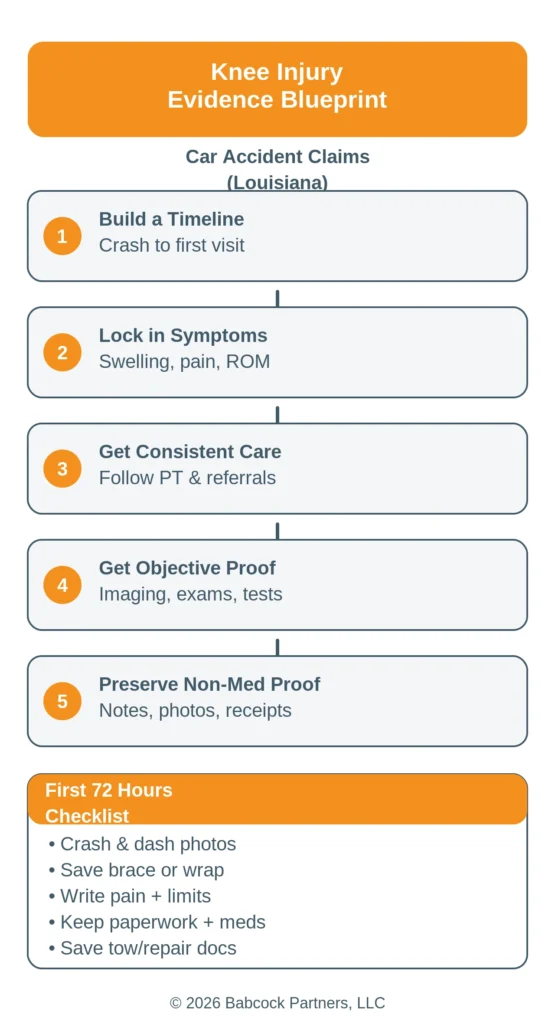
Download the printable toolkit (PDF) if you want a clean checklist to use at appointments and during insurance calls. It includes both infographics plus a short “what to bring” page.
What Should I Do After a Knee Injury From a Car Accident in Louisiana?
Get evaluated, describe how the knee was stressed in the crash, and then document swelling, instability, and activity limits every day. Next, preserve crash evidence, follow through with referrals and therapy, and keep copies of all records so your claim is not defined by gaps.
- Get checked fast: Tell the provider whether the knee hit the dash, twisted, or buckled.
- Track function: Note stairs, driving, sleep, work tasks, and “giving way.”
- Take progress photos: Bruising and swelling change quickly.
- Keep every document: Discharge instructions, referrals, and prescriptions matter.
- Follow through: Missed appointments create avoidable proof gaps.
- Be careful with releases: Broad record requests can distract from the knee timeline.
Many knee injury claims are won or lost on consistency rather than drama. A clear story in the medical chart helps you, and it also makes it harder for the insurer to argue “nothing happened.” This is why we emphasize early documentation before the record goes quiet.
Which Knee Injury Symptoms Matter Most for a Claim?
Symptoms matter most when they show a change in function, such as instability, locking, swelling, or pain with stairs and turns. In its knee injuries and disorders overview, MedlinePlus explains that knee problems can affect motion and daily activity, which is why clear symptom reporting matters.
| Symptom to Track | How to Document It (Simple and Specific) |
|---|---|
| Swelling and bruising | Photo daily for a week and note when swelling peaks and fades. |
| Locking, catching, or clicking | Write what movement triggers it and whether you can fully straighten the knee. |
| Instability or “giving way” | Note the activity and whether you needed a rail, brace, or help walking. |
| Stair and walking limits | Record distance, pace, and what you avoided that day. |
| Sleep disruption | Note nights you wake up, position changes, and what helps or fails. |
Different injuries create different red flags, so the detail matters. In its meniscus tears guide, Johns Hopkins Medicine describes symptoms like pain, swelling, and catching or locking, which people often notice after a twist injury. In its ACL injury overview, Mayo Clinic lists a pop sensation, swelling, and instability as common signs that should be clearly reported in the chart.
What Tests and Records Help Prove a Knee Injury?
The most helpful proof usually combines a focused exam, the right imaging when indicated, and follow-up records that show function over time. In its ACL injuries article, AAOS OrthoInfo explains that MRI can show injuries to ligaments and meniscus that X-rays do not show well.
- Exam findings: Range of motion, stability tests, and gait notes from the first few visits.
- Imaging reports: X-ray reports and MRI reports, plus the radiology disc if you receive one.
- Physical therapy notes: Strength deficits, swelling, balance limits, and specific task restrictions.
- Work and activity limits: Clear restrictions tied to real tasks, not vague “light duty.”
- Medication and brace notes: What was prescribed and whether it helped.
Soft-tissue injuries are common in knee injury from a car accident scenarios, and they do not always show up on early X-rays. In its torn meniscus guide, Cleveland Clinic explains that meniscus tears can cause pain, swelling, and a catching sensation, which is why a normal X-ray does not automatically end the story. If you want a deeper overview of common fracture and ligament patterns we see in crash cases, review our orthopedic injuries page and then return here for the knee-specific proof checklist.
What Evidence Should I Save in the First 72 Hours After a Knee Injury Crash?
The first 72 hours are about capturing evidence that disappears: crash details, visible swelling changes, and early statements in the medical chart. Save a small set of items that make it easier to prove mechanism, timing, and daily impact.
- Vehicle photos: Include the dash, footwell, seat position, and any interior contact points.
- Knee photos: Bruising, swelling, and brace use over the first week.
- Symptom log: Pain triggers, stairs, driving limits, and “giving way” events.
- Paper trail: Tow receipt, repair estimate, rental paperwork, and discharge instructions.
- People: Names of witnesses and who saw you limping or icing the knee.
This is why we ask clients to save photos and repair paperwork immediately, while they are easy to pull from a phone or shop email. Evidence preservation is not about theatrics; it is about keeping the insurer from rewriting the early timeline.
Timeline Builder: Map the Crash to the First Ortho Visit
A strong timeline makes it easier for doctors to document the right details and harder for an adjuster to claim “delayed symptoms.” Build a simple map from the crash to the first orthopedic-focused visit, and keep it updated as treatment continues.
| Time Point | Write Down (One or Two Lines Each) |
|---|---|
| Crash day | How the knee was hit or twisted, immediate pain level, and whether it felt unstable. |
| First medical visit | Exact words you used to describe symptoms, plus what the provider wrote as the chief complaint. |
| First week | Stairs, driving, sleep, and work limits; note any buckling or locking events. |
| Follow-up / ortho | Exam findings, imaging ordered, and the plan (PT, brace, restrictions). |
| Therapy phase | PT goals, setbacks, and what tasks you still cannot do safely. |
Two details to add that many people skip
- Mechanism: “My knee hit the dash” is different from “my knee twisted while braking.”
- Function: “I cannot safely carry groceries down stairs” is more useful than “it hurts.”
How Do Insurers Dispute Knee Injuries After a Crash?
Most disputes follow a script: low-impact crash, normal imaging, pre-existing arthritis, or “you got better.” Your job is to build records that answer those points early and consistently.
| Common Defense Angle | Evidence That Counters It |
|---|---|
| “Low impact means no injury.” | Photos, repair records, and early symptom notes that match the crash mechanism. |
| “No swelling was documented.” | Daily photos, a symptom log, and follow-up exams that document effusion and ROM. |
| “X-ray was normal.” | Focused orthopedic exams, PT findings, and MRI when clinically indicated. |
| “It was pre-existing.” | Prior records plus clear change after the crash in stability, pain triggers, or activity limits. |
| “You’re fine now.” | Work restrictions, activity modifications, and continuing care notes tied to real tasks. |
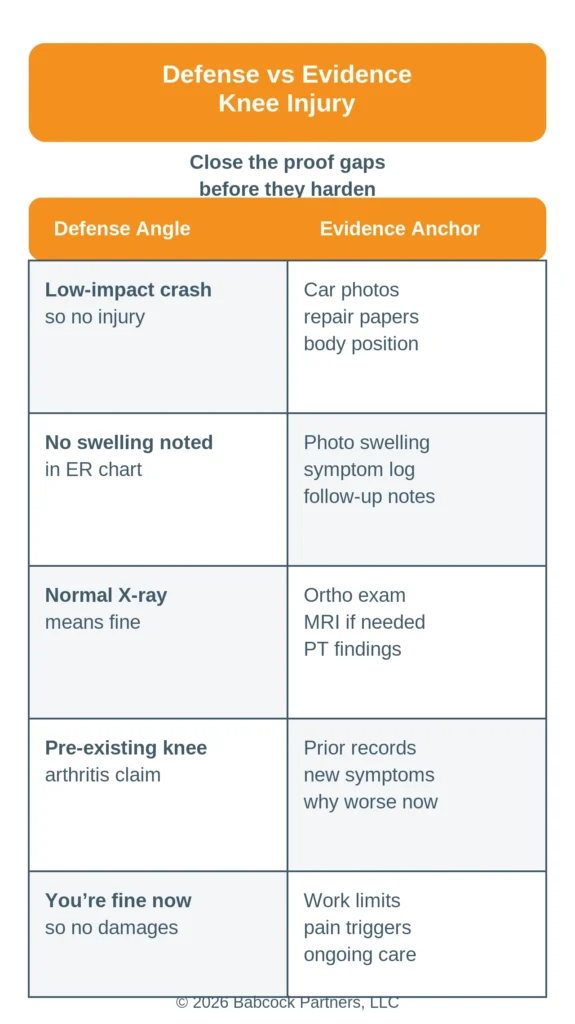
That is what we mean by leverage: when your records answer the defense script before it is spoken. If you were hurt in Baton Rouge, our Baton Rouge car accident case page explains how we build trial-ready proof from day one without relying on hype.
What we see in practice
Knee injury cases often look simple until the insurer highlights gaps and inconsistencies. We see the strongest files when the medical chart, the timeline, and the daily-life impact all tell the same story.
- Early visit notes matter: The first chart entries often shape the whole claim narrative.
- Function beats adjectives: “Cannot kneel at work” is stronger than “severe pain.”
- Consistency wins: Missed care and changing symptom stories invite disputes.
- Non-med evidence helps: Photos and repair records support the injury mechanism.
We also see knee injury from a car accident claims get discounted when people try to “tough it out” and only return weeks later. That delay can be understandable, but it creates a question the insurer will use: why did the record go silent? This is why we encourage early evaluation and steady follow-through even when symptoms fluctuate.
When Does a Knee Injury Claim Get Complicated?
A knee injury claim gets complicated when the insurer can plausibly argue a different cause, a different timeline, or a different level of impact. The fix is usually not more words; it is better documentation and fewer gaps.
- Pre-existing arthritis accusations: In its osteoarthritis overview, NIAMS notes that osteoarthritis commonly affects joints like the knee, so insurers often point to it even when the crash made symptoms worse.
- Delayed ortho care: The longer the gap, the easier it is to argue “something else” caused the problem.
- Surgery discussions: Surgical recommendations raise stakes and increase scrutiny of imaging and prior history.
- Work-related limits: Claims tighten when restrictions are vague instead of tied to real tasks.
If the crash happened in Baton Rouge or nearby, it can also help to keep your location and scene details consistent across records and photos. The Baton Rouge hub page is a starting point for local resources and related practice areas. Talk to a lawyer quickly if a commercial vehicle was involved, if there is a hit-and-run, or if you are being pushed to sign documents you do not understand.
Download the printable toolkit (PDF) before your next appointment if you want a short list of questions to ask and documents to bring. It is designed to help you avoid the most common proof gaps in a knee injury from a car accident.
Louisiana Law Snapshot (Updated 2026)
Louisiana deadlines and fault rules can change how a knee injury from a car accident claim is valued and defended. In La. Civ. Code art. 3493.1, Louisiana provides a two-year delictual prescription for many personal injury claims, so delay can destroy leverage even when the injury is real.
- Two-year deadline: Treat the two-year period as an evidence clock as well as a legal clock, because records and witnesses fade before the filing date.
- Comparative fault: Under La. Civ. Code art. 2323, fault is allocated by percentage, and after Jan. 1, 2026, a 51% bar can block recovery if you are found primarily at fault.
If you suspect an argument about fault, pre-existing conditions, or gaps in care, treat that as a sign to get guidance early. Paperwork and medical records shape these issues long before any courtroom becomes relevant.
Talk to a Lawyer About a Knee Injury Crash
We are not built for volume. We are built for leverage. If you want help applying the Babcock Benefit to a knee injury from a car accident, call (225) 500-5000 and use the free case review form.
Call quickly because knee symptoms change, repair evidence gets harder to obtain, and insurers tend to form an early narrative. If you are being asked for a recorded statement or a broad release, that is another reason to get guidance before you sign. For a broader view of how we build crash claims, review our crash case page and bring your questions to the call.
These items are helpful to have with you when you call, but do not delay calling because you do not have them. If you have them handy, keep them nearby for the call.
- Crash location, date, and the other driver’s insurance information
- Photos of vehicles and the knee (bruising/swelling changes)
- ER/urgent care paperwork and a current medication list
- Orthopedic and PT visit dates, plus any imaging reports
- Notes about work limits, stairs, sleep, and driving restrictions
Call Today If…
- Your knee is buckling, locking, or you cannot bear weight safely
- The insurer is pushing fast settlement before you finish evaluation
- You had a prior knee issue and the crash clearly changed your function
- You missed work or your job duties are now restricted
- You are unsure what documents you are being asked to sign
What Happens Next
- Evidence triage: We help identify what to preserve now and what to request later.
- Deadline spotting: We look for Louisiana timing issues and fact patterns that tighten the clock.
- Insurer contact strategy: We help control the narrative so your file reflects facts, not pressure.