Editorial & Legal Accuracy Notice (Louisiana)
This blog contains general legal and safety information and is not legal advice. Laws and deadlines can change, and outcomes depend on specific facts.
Last reviewed / updated: March, 2026
Reviewed, updated, and authored by: Stephen Babcock, Louisiana injury lawyer
This article explains why texting-and-driving crashes often require faster evidence work and what Louisiana drivers can do to protect a claim.
Many cases also become Baton Rouge cases in practice because that is where adjusters, courts, and medical providers often intersect. If you are looking for a Baton Rouge-focused overview, start with our crash practice page for texting cases and then use the sections below to preserve the proof. Our Baton Rouge page also collects location-specific information that can matter when you are trying to get records quickly.
In texting-and-driving cases, we treat the first week like an evidence project so the story stays anchored to proof instead of assumptions. We are not built for volume. We are built for leverage. Speed + evidence preservation + insurer-insider knowledge + trial-ready preparation = The Babcock Benefit.
If you are inside the first 72 hours, call (225) 500-5000 or use the free case review form before evidence changes.
Firm links: Client Reviews | Contact | Locations
Download the printable toolkit (PDF) to keep the evidence blueprint and the defense checklist in one place. It is designed for printing and quick reference.
What Should You Do After a Texting and Driving Accident in Louisiana?
After a texting-and-driving accident, prioritize safety and then document the facts fast because the best proof changes by the hour. You want a clean record of the scene, the timeline, and the early symptoms or limitations before the insurance file fills gaps with assumptions.
- Call 911 if anyone may be hurt, and ask for police to respond when appropriate.
- Photograph vehicles, plates, debris, lane markings, traffic controls, and lighting.
- Get names, phone numbers, and short statements from witnesses.
- Look for cameras and write down exact locations so you can request video quickly.
- Write a timeline while it is fresh, including what you saw right before impact.
- Keep all receipts, tow paperwork, estimates, and insurer messages in one folder.
Do not try to “win the argument” at the curb, and do not assume the other driver will admit to texting later. The NHTSA distracted driving page explains that sending or reading a text can take your eyes off the road for about five seconds, which is why distraction can turn a simple crash into a high-stakes proof question.
Talk to a lawyer quickly if a commercial vehicle was involved, if the crash caused a fatality, or if you know there is key video you need to preserve. Those situations move fast and often require targeted requests to keep evidence from getting overwritten or lost.
Why Texting-and-Driving Crashes Create Different Proof Problems
Texting crashes are different because liability often depends on digital and third-party evidence that is not automatically saved forever. Without early preservation, insurers can argue “no proof,” shift blame, or treat the case like a routine fender-bender.
| Proof That Fades Fast | Why It Matters |
|---|---|
| Video from businesses and homes | Video can confirm lane position, signal use, and whether the driver looked down. |
| Phone activity and carrier records | Phone proof can support distraction timing, but it often requires formal requests. |
| Witness memory | Witnesses drift, change numbers, or forget the small details that matter later. |
| Vehicle condition and data | Repairs and towing can erase damage patterns and access to onboard data. |
| Early symptom and work-impact notes | Delays let insurers frame the injury as unrelated or exaggerated. |
This is why we treat the first week as an evidence project, not just a paperwork project. When the file shows a clear timeline and preserved sources, the defense has less room to speculate.
Is Texting While Driving Illegal in Louisiana?
Louisiana’s wireless-device rule in La. R.S. 32:59 generally prohibits operating a wireless telecommunications device while driving unless the vehicle is lawfully stationary, with limited exceptions. The same La. R.S. 32:59 also limits device seizure and search based solely on certain traffic enforcement scenarios, which is one reason civil proof often relies on independent evidence.
- Core idea: Build the case around objective proof, not just what someone says happened.
- Practical impact: A ticket is helpful, but it is not the only way to prove distraction.
- Best move: Preserve video, witnesses, and your timeline while records are still available.
In a civil claim, “texting caused the crash” still needs a timeline that makes sense to an adjuster, a judge, or a jury. If the story relies only on suspicion, insurers often respond with denial language and comparative-fault arguments.
Timeline Builder: Reconstruct the Minutes Before Impact
A timeline turns a texting allegation into a provable sequence of events by locking down where each vehicle was and what each driver could see. When your timeline matches photos, video, and scene geometry, it becomes much harder for the defense to rewrite the crash as “unclear.”
| Time Marker | What to Write Down |
|---|---|
| 10 minutes before | Route, traffic flow, weather, and whether you noticed erratic driving. |
| 1 minute before | Signals, brake lights, lane changes, speed changes, and spacing. |
| Impact | Point of contact, direction of force, and where each vehicle came to rest. |
| After | What the other driver said or did, witnesses present, and nearby cameras. |
That is what we mean by leverage: we lock down the timeline before video loops and digital logs rotate. If you want a deeper walk-through of proof sources, we outline them on our Baton Rouge texting-and-driving accident page in plain language.
Phone Proof You Can Preserve Immediately
Do not try to access the other driver’s phone, and do not “collect evidence” by grabbing it. Instead, preserve what you control: your photos, your notes, and the list of evidence sources that can be requested through proper channels.
Camera Map: Where to Look
Write down addresses and business names for any camera that might have a view of the road, the intersection, or the parking-lot entrance. Even when a camera did not capture the impact, it can still capture the “before” conduct that explains why the crash happened.
Defense Audit: The Narratives Insurers Use in Texting Cases
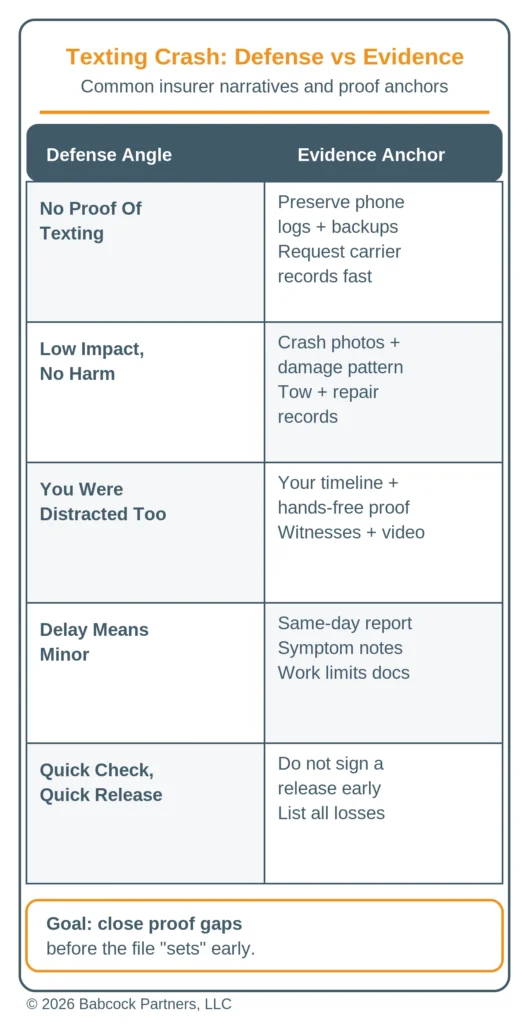
Insurers often respond to texting allegations with a short list of repeat defenses meant to create doubt and reduce value. You can counter most of them by building the file around objective anchors like video, phone records, and a clean timeline.
- No proof of texting: “You can’t show phone use at the time.”
- Low impact: “The crash wasn’t severe enough to matter.”
- Shared distraction: “You were distracted too.”
- Delay: “If it mattered, you would have documented more sooner.”
- Quick-release pressure: “Sign now and we’ll take care of it.”
That is what we mean by leverage: we build the file to answer the insurer’s script before it drives the valuation. Texting is one part of a broader distraction picture, and we explain other distraction patterns on our Baton Rouge distracted driving practice page.
| Defense Angle | Evidence Anchor |
|---|---|
| No proof of texting | Camera video, witness statements, and fast requests for carrier or app records. |
| Low impact, no harm | Damage photos, tow and repair records, and consistent symptom documentation. |
| You were distracted too | Your timeline, hands-free usage proof if relevant, and independent witnesses. |
| Delay means minor | Same-day notes, prompt reporting, and clear records of work or daily limitations. |
| Quick check, quick release | Do not sign early releases, and document all loss categories before settlement talk. |
What we see in practice
We see texting cases turn on small details that are easy to miss in the first few days. We also see how quickly an insurer’s “early story” becomes the default story if no one preserves the digital and third-party proof.
- We see surveillance systems overwrite footage unless a request happens quickly.
- We see witnesses become hard to find unless someone gets contact information early.
- We see vehicle repairs destroy damage patterns that help explain force and angles.
- We see claim files get framed around “no proof of distraction” when the record is thin.
This is why we push evidence preservation before negotiations. When the proof is organized early, the case stays grounded in facts instead of insurance assumptions.
How Fault Works When Both Drivers Are Distracted
Even when the other driver was texting, insurers often argue you share some percentage of fault to reduce the claim’s value. Under La. Civ. Code art. 2323, Louisiana uses comparative fault, and the post–Jan. 1, 2026 rule can bar recovery if you are 51% or more at fault.
- Your goal: Prove the other driver’s distraction with objective anchors.
- Your risk: The defense tries to shift attention to your speed, lane choice, or reaction time.
- Your best tool: A timeline that matches video, scene photos, and witness accounts.
Comparative fault arguments tend to grow when the record is thin. A clear file that shows what you were doing and what the other driver was doing helps keep the blame where it belongs.
Talking to the Other Driver’s Insurer: What to Avoid Early
In texting cases, early insurer contact often focuses on getting a recorded statement and steering you toward a fast settlement. You can protect yourself by keeping communications simple, avoiding speculation, and refusing to sign anything until you understand what evidence still needs to be preserved.
- Do not guess about speed, distance, or “maybe I could have avoided it.”
- Do not sign a medical or wage release “just to get the process started.”
- Do not hand over your phone or provide screenshots out of context.
- Do not accept a settlement that resolves everything before your losses are documented.
Even in traffic enforcement, the limits in La. R.S. 32:59 highlight why device access is not something that happens casually on the roadside. In civil cases, phone-related proof usually comes through formal requests, and it works best when it is paired with video, witnesses, and a clean timeline.
Evidence Checklist for the First 72 Hours
The first 72 hours are about capturing what will never look the same again: the scene, the vehicles, and the earliest version of the timeline. If you do these basics well, you reduce the room insurers have to argue “no proof” and shift blame.
- Photograph the scene from wide and close angles, including signs and lane markings.
- Write a short timeline the same day, including what you noticed before impact.
- Identify every nearby camera and write down exact addresses and business names.
- Get witness contact info and save it in more than one place.
- Save all receipts, tow paperwork, repair estimates, and insurer communications.
- Keep your social media quiet about the crash and your symptoms.
Download the printable toolkit (PDF) if you want the two infographics and checklists in a clean print format. If you need a deeper walk-through of how these claims get proven, see our evidence-focused texting crash guidance and use it as a roadmap for what to gather.
Louisiana Law Snapshot (Updated 2026)
Deadlines and fault rules shape how fast you need to act after a texting crash, even when liability feels obvious. The two big concepts are the filing deadline and comparative fault, and both can change outcomes if you wait too long or leave proof gaps.
| Rule | What It Means for a Texting Crash Claim |
|---|---|
| Two-year delictual prescription | La. Civ. Code art. 3493.1 sets a two-year deadline for many injury claims, so delaying can risk losing the claim entirely. |
| Comparative fault and the 51% bar | Under La. Civ. Code art. 2323, fault is allocated by percentage, and the post–Jan. 1, 2026 rule can bar recovery if you are 51% or more at fault. |
Because insurers use these rules strategically, the best time to strengthen the file is early. Preserved proof helps reduce comparative-fault arguments and keeps the claim focused on what the other driver did.
Free Case Review: Protect the Evidence Before It Changes
Texting-and-driving claims reward fast, organized proof because the key records are often digital and time-sensitive. We are not built for volume. We are built for leverage. If you are dealing with a texting crash, call (225) 500-5000 and use the free case review form because video overwrites, timelines fade, and insurers often push early statements and releases.
These items are helpful to have with you when you call, but do not delay calling because you do not have them. If you have them handy, keep them nearby for the call.
- Crash report number or the responding agency name
- Photos or video links from the scene
- Witness names and contact information
- Tow and repair paperwork or estimates
- Any claim numbers or adjuster contact details
Call Today If…
- You know there is a camera video that could be overwritten
- The crash involved a commercial vehicle or multiple vehicles
- You are being pushed to give a recorded statement
- You are being asked to sign a release quickly
- You have new symptoms or work limitations developing
What Happens Next
- We triage evidence sources and preservation steps so nothing obvious is lost.
- We spot deadlines and comparative-fault risks early, before the file “sets.”
- We plan insurer communications to avoid gaps, speculation, and unnecessary concessions.