Editorial & Legal Accuracy Notice (Louisiana)
This blog contains general legal and safety information and is not legal advice. Laws and deadlines can change, and outcomes depend on specific facts.
Last reviewed / updated: March 2, 2026
Reviewed, updated, and authored by: Stephen Babcock, Louisiana injury lawyer
This guide explains the difference between asbestos exposure and mesothelioma in plain English. It also highlights the records that usually matter when Louisiana families need answers.
People often search “asbestos vs mesothelioma” when a doctor uses a new diagnosis term or a jobsite memory returns. The key is simple: asbestos is the exposure, while mesothelioma is the disease that may develop later.
We build these cases like a record project, not a slogan. We are not built for volume. We are built for leverage. Speed + evidence preservation + insurer-insider knowledge + trial-ready preparation = The Babcock Benefit. In an asbestos vs mesothelioma question, leverage means separating exposure proof from diagnosis proof before anyone rewrites the story.
If you are trying to connect an asbestos work history to a confirmed diagnosis, our Baton Rouge mesothelioma lawyer page explains how we approach mesothelioma cases in Louisiana. This article stays focused on definitions, documentation, and the first evidence steps.
If you are inside the first 72 hours, call (225) 500-5000 or use the free case review form before evidence changes.
Firm links: Client Reviews | Contact | Locations
Want a print-friendly version of the checklists? Download the printable toolkit (PDF).
What Is the Difference Between Asbestos and Mesothelioma?
EPA’s asbestos overview explains that asbestos is a naturally occurring mineral fiber found in some older materials, and it can be dangerous when disturbed fibers become airborne. Mesothelioma is a cancer of the lining around organs, and the National Cancer Institute’s mesothelioma overview describes it as a disease often linked to asbestos exposure.
| Term | Plain-English Meaning | What You Typically Need to Prove |
|---|---|---|
| Asbestos | An exposure source: fibers from certain materials at work, at home, or around products. | A dated exposure story: where, when, what material, and who can confirm it. |
| Mesothelioma | A diagnosis: a cancer confirmed by medical testing and pathology. | Medical anchors: diagnosis date, pathology identifiers, and treating specialist records. |
| Why “Asbestos vs Mesothelioma” Matters | It separates the exposure question from the diagnosis question so evidence stays consistent. | A clean record that connects the two without guessing or backfilling. |
Families often lose time because they try to solve everything at once. Instead, treat asbestos vs mesothelioma as two folders: one for exposure facts and one for medical proof.
Safety note: do not disturb suspect materials for “proof.” EPA guidance on asbestos emphasizes that disturbing asbestos can release fibers, so safety comes first.
How Does Asbestos Exposure Cause Mesothelioma?
The NCI asbestos fact sheet explains that inhaling or swallowing asbestos fibers can increase the risk of mesothelioma and other diseases. ATSDR’s health effects overview notes that illness can take many years to appear after exposure, which is why old work history still matters.
- Fibers are released when material is cut, sanded, drilled, or broken.
- Fibers are inhaled or swallowed and can lodge in the body.
- Over time, inflammation and cell damage can develop.
- In some people, that process leads to mesothelioma.
That long gap is also why documentation matters more than memory. When years pass, the best “witness” is often a record: a job site, a product name, or a union card.
Where Is Asbestos Still Found in Louisiana Homes and Worksites?
EPA’s asbestos overview describes asbestos as a material used in some older products, which means it can still appear in older buildings and equipment. For work settings, OSHA’s asbestos standard for construction shows how seriously regulators treat airborne fiber risk during renovation and demolition.
- Pipe and boiler insulation in older facilities
- Ceiling tiles, floor tiles, and older adhesives
- Roofing materials and siding on older structures
- Industrial gaskets, packing, and heat-resistant materials
- Brake and clutch components on some older vehicles or equipment
In Louisiana, we also see exposure questions tied to industrial and refinery work, ship and offshore-related tasks, and long-term maintenance roles. If your concerns fit a broader chemical-exposure issue, our toxic exposure practice page explains how we handle other exposure claims and documentation.
What Are Common Mesothelioma Symptoms?
Mayo Clinic’s mesothelioma overview notes that symptoms vary based on where the cancer develops and may include breathing-related complaints and chest discomfort. Cleveland Clinic’s mesothelioma guide explains that symptoms can look like other conditions, which is why people often get answers later rather than sooner.
- Shortness of breath or trouble breathing
- Chest pain, rib pain, or persistent discomfort
- Ongoing cough or fatigue
- Unexplained weight loss
- Abdominal swelling or pain in some cases
If your imaging looks “normal” early, do not assume that ends the story. MedlinePlus explains that diagnosing mesothelioma involves specific medical evaluation and testing, which can evolve over time.
How Is Mesothelioma Diagnosed and Documented?
Mayo Clinic’s diagnosis and treatment guide explains that doctors use imaging and procedures to confirm mesothelioma and guide care. The American Cancer Society’s diagnosis overview explains how tests and staging workups help confirm the condition.
- Imaging: CT, X-ray, PET, or other scans with written radiology reports.
- Procedures: fluid sampling or biopsies when needed.
- Pathology: lab confirmation with specimen identifiers and report addenda.
- Specialist notes: oncology or pulmonology records that explain the basis for diagnosis.
This is why we ask families to request records early, even if treatment is still in motion. Records requests slow down later when facilities change systems or when a provider retires.
Timeline Builder: Your Exposure and Medical Story
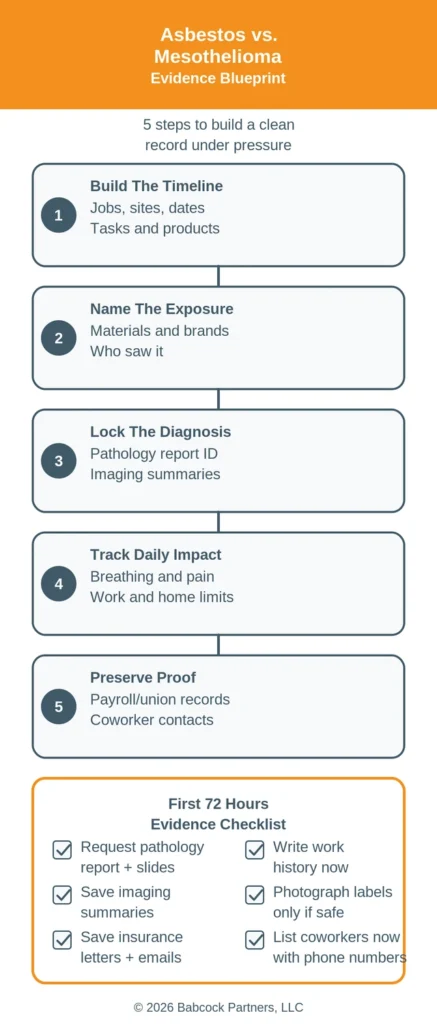
A strong asbestos vs mesothelioma record usually starts with a timeline that is dated, specific, and easy to follow. The goal is not perfection; it is consistency that you can support with documents.
| Timeline Block | What to Write Down | Records That Help |
|---|---|---|
| Work History | Employer, job title, site, and rough dates. | W-2s, pay stubs, union records, badges, HR files. |
| Exposure Tasks | What you did that could release fibers. | Work orders, maintenance logs, training records. |
| Materials | Product names, labels, or descriptions. | Photos, invoices, manuals, coworker contacts. |
| Medical Anchors | First symptoms, first evaluation, diagnosis date. | Radiology reports, pathology report identifiers, specialist notes. |
This is why we start with a written timeline and a record-request list before we argue about fault. When the story is dated and consistent, it is harder to distort later.
Exposure Timeline Template
Use a simple template and update it only when you can tie the change to a record. If you are in Baton Rouge or nearby, you can also reference your work locations using the Baton Rouge hub for local context and resources.
- Date range: Month/year to month/year
- Site: Plant, shop, vessel, building, or job location
- Task: Insulation work, maintenance, teardown, cleanup
- Material: Tile, insulation, gasket, cement board, unknown
- Witnesses: Coworkers who saw the material or the task

Defense Audit: Common Ways Insurers and Defendants Push Back
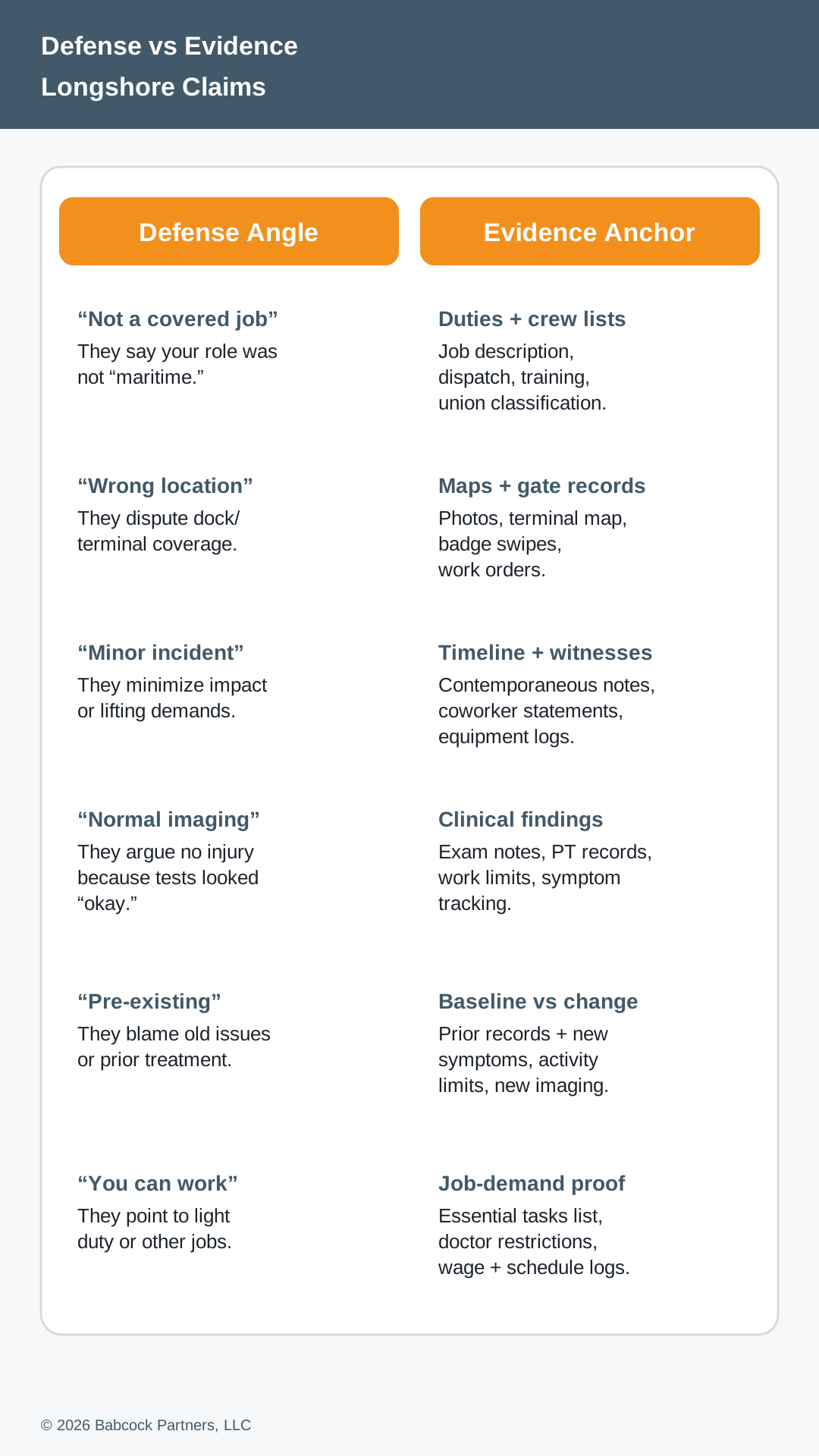
In many asbestos and mesothelioma claims, the fight is not about whether illness is real; it is about proof and causation. Louisiana’s Products Liability Act is one reason documentation matters when a case involves products and manufacturers.
| Common Pushback | Evidence That Helps |
|---|---|
| “We cannot identify a product or source.” | Work history timeline, site records, product names, coworker confirmation. |
| “The exposure was too small or too brief.” | Task details, duration notes, training records, maintenance logs. |
| “The diagnosis is not confirmed.” | Pathology identifiers, biopsy report, specialist narrative notes. |
| “Something else caused this.” | Consistent medical history and a clear exposure timeline that does not shift. |
| “You waited too long or records are missing.” | Diagnosis date tracking, early record requests, preserved correspondence. |
That is what we mean by leverage: you connect each pushback to a document, not a debate. Insurers move faster when the file answers basic questions early.
What we see in practice
We often see families arrive with strong memories but thin paper, and that gap creates delays. When we rebuild the record early, we can usually clarify what happened without guesswork.
- Exposure stories that mix multiple jobs into one timeline
- Missing pathology identifiers or missing report addenda
- Early “normal” imaging that gets overstated as a final answer
- Pressure to give a recorded statement before records are gathered
- Insurance letters and claim numbers saved in different places
First 72 Hours: What to Do After a Diagnosis or Serious Exposure Concern
The first 72 hours is not about proving every detail; it is about stopping evidence loss and reducing confusion. NIOSH guidance on asbestos fibers underscores why exposure settings and materials should be documented carefully rather than guessed later.
- Request the pathology report and ask for any addenda.
- Save imaging summaries and the written radiology reports.
- Write a first draft work timeline while memories are fresh.
- Save insurance letters, claim numbers, and voicemail screenshots.
- List coworkers or supervisors who can confirm materials and tasks.
This is why we push record requests early even when you feel overwhelmed. The fastest way to reduce stress later is to lock the basics now.
Talk to a Lawyer Quickly If Any of These Are True
Some situations create fast deadlines or fast evidence loss, even in long-latency cases. If any of these apply, consider reviewing options on our mesothelioma case page so you do not rely on guesswork.
- You have a new mesothelioma diagnosis and need to preserve medical anchors.
- An employer, insurer, or manufacturer asks for a recorded statement.
- A facility is being renovated, demolished, sold, or cleaned out.
- A key witness is elderly, ill, moving away, or hard to locate.
- You cannot find work records, and you need help requesting them.
Want a print-friendly checklist you can share with family? You can Download the printable toolkit (PDF).
Louisiana Law Snapshot (Updated 2026)
Louisiana deadlines and fault rules can shape what evidence matters and how quickly you should act. La. Civ. Code art. 3493.1 sets a two-year delictual prescription period for many tort claims, and the deadline details can depend on the facts.
| Rule | What It Means in Plain English | Why It Matters for Your File |
|---|---|---|
| Two-year prescription | Many tort claims have a two-year deadline, and timing can depend on the facts. | Track diagnosis dates and key events so a deadline is not missed. |
| Comparative fault + 51% bar | The text of La. Civ. Code art. 2323 describes comparative fault and includes a post–Jan. 1, 2026 bar when a plaintiff is 51% or more at fault. | Insurers look for arguments to shift blame, which is why consistent records matter. |
If you are unsure how these rules apply, focus on preserving evidence first and then get legal guidance quickly. The record you preserve early often controls the options you have later.
Free Case Review for Asbestos and Mesothelioma Questions
We are not built for volume. We are built for leverage. If you are dealing with an asbestos vs mesothelioma question, the Babcock Benefit is about moving fast on records and building a file that can stand up under pressure. Call (225) 500-5000 and use the free case review form so we can triage evidence, spot deadlines, and reduce preventable proof gaps.
These items are helpful to have with you when you call, but do not delay calling because you do not have them. If you have them handy, keep them nearby for the call.
- Pathology report and any addenda
- Imaging reports and visit summaries
- Work and site timeline (even a first draft)
- Product names, photos, or descriptions
- Insurance letters and claim numbers
Call Today If…
- You have a new diagnosis and need to request records fast.
- You are being asked for a statement or broad medical authorization.
- A worksite is changing and materials may be removed or destroyed.
- You cannot locate key work records and need help requesting them.
What Happens Next
- We triage what you have and identify the missing anchor records.
- We spot deadlines and set a plan for record requests and witness preservation.
- We map an insurer communication strategy that protects your story and avoids avoidable gaps.
If you want a structured checklist while you gather documents, you can also Download the printable toolkit (PDF). For claim-specific guidance, review options on help with asbestos cancer claims.