

A car crash can injure the brain even when there is no open wound and the person never loses consciousness. The diagnosis may be a concussion, bruising of brain tissue, bleeding, or another traumatic brain injury. Those terms describe different problems, and they do not all show up on the same test.
If you are trying to understand an emergency-room report, start with what the doctors found, what they ruled out, and what follow-up they recommended. A scan result is one part of that picture.
When head symptoms need emergency care
Call 911 or seek immediate emergency care for a worsening headache that will not go away, repeated vomiting, seizures, weakness or numbness, slurred speech, increasing confusion, unequal pupils, loss of consciousness, or difficulty waking. These are among the CDC’s danger signs after a possible brain injury. Do not wait for a legal consultation or a routine follow-up appointment.
Other symptoms, including dizziness, fogginess, trouble concentrating, or changes in sleep, also deserve medical attention after a crash. Some appear hours or days later. Tell the provider when you first noticed each symptom rather than assuming it must have started at impact.
What the diagnosis may mean
MedlinePlus describes traumatic brain injury, or TBI, as brain damage caused by an outside force. A closed injury can occur without anything penetrating the skull. Its effects may range from temporary problems to lasting disability.
- Concussion: a form of mild TBI that can affect thinking, balance, memory, mood, and sleep. The word “mild” is a medical classification; it does not tell you how disruptive the symptoms will be in daily life.
- Contusion: bruising of brain tissue. The location and extent of the injury matter to the medical assessment.
- Intracranial bleeding: bleeding inside the skull, which may be within or around the brain. It can require urgent treatment.
- Diffuse injury: damage involving more widespread areas or nerve connections, rather than one isolated point of impact.
Johns Hopkins Medicine’s head injury overview explains these distinctions. Ask the treating clinician to explain the exact diagnosis in the record. Symptoms alone do not reliably distinguish these injuries, and a person can have more than one injury from the same collision.
“But my head never hit anything”
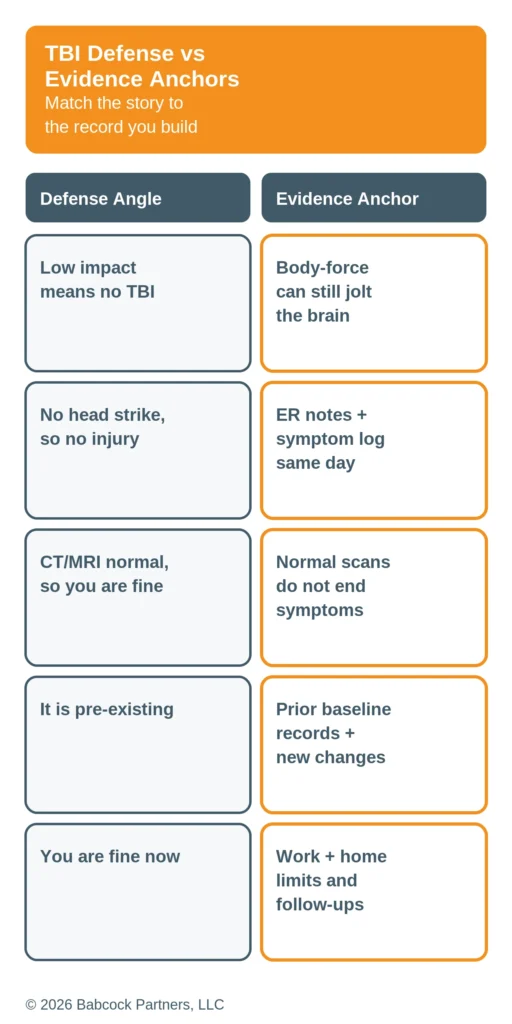
A direct head strike is not required for a concussion. Johns Hopkins Medicine explains that force from an injury elsewhere in the body can travel to the head. The sudden motion of a collision can therefore matter even if there is no mark on the forehead.
Describe the movement you remember: whether the vehicle spun, whether your body was thrown sideways, and whether there is a gap in your memory. Do not guess about forces or speeds. Photographs and witness accounts may help reconstruct the collision, but a medical provider must evaluate the injury.
What a normal scan does, and does not, answer
A normal CT scan can be reassuring about the conditions it was used to investigate. It does not, by itself, rule out a concussion. Cleveland Clinic explains that imaging cannot diagnose a concussion; doctors may order imaging to look for complications such as bleeding.
The rest of the evaluation matters: your medical history, examination, symptoms, and changes in function. Depending on the circumstances, clinicians may assess balance, attention, or memory, or refer you for further testing. The CDC’s Acute Concussion Evaluation tool illustrates why the history and symptom pattern belong alongside test results.
Keep the radiology report and the discharge instructions. If symptoms persist or change, follow up with the treating provider and explain what has happened since the scan. Our separate article on concussion symptoms after a crash describes the symptom groups in more detail.
Describe what changed in ordinary life
“I have trouble concentrating” is useful information. “I could not finish the invoices I normally process before lunch” gives the provider a more concrete starting point. Similar examples might involve losing your place while reading, becoming dizzy in a grocery aisle, or needing help remembering appointments.
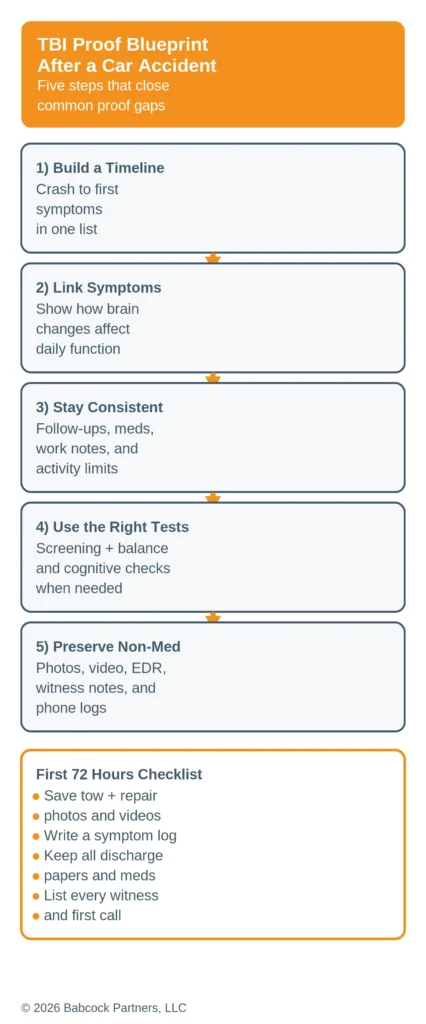
Keep brief, dated notes in your own words. Include improvement as well as difficulty. If you had migraines, a previous concussion, sleep problems, or another relevant condition before the crash, disclose that history. Comparing the before and after accurately is more useful than trying to make every symptom sound new.
Family observations, work restrictions, appointment summaries, and treatment records can help explain changes that are hard to describe in one visit. If cost or transportation prevents a follow-up, tell the provider and keep a note of the obstacle.
How the medical record fits into a Louisiana claim
A claim involves both what happened in the collision and what the collision caused. The insurer may question the connection between the crash and the symptoms, especially where there was no head strike, the scan was normal, or similar symptoms existed before. Those questions should be answered with the medical evidence and an accurate history.
Preserve photographs, witness details, repair records, and any available video. Some vehicles also record crash-related information; NHTSA explains the role of event data recorders. That information may help establish how a collision occurred. It does not replace a medical diagnosis.
For the broader liability investigation, see our Baton Rouge car accident guidance. If weakness or paralysis is part of the medical picture, our article on paralysis after a car wreck addresses the records and daily-care questions that can follow.
Keep the filing deadline separate from recovery
Louisiana Civil Code article 3493.1 provides a two-year period for many injury claims arising on or after July 1, 2024, generally measured from when injury or damage is sustained. Earlier events and special types of claims require a separate deadline check. Continuing treatment or settlement discussions do not automatically stop that clock.
Fault also matters. The version of article 2323 effective January 1, 2026 generally bars recovery at 51% or greater claimant fault and reduces recovery below that threshold. The event date determines which version must be considered.
If a brain injury is affecting your work or daily life and you need help with the claim, our Baton Rouge brain injury lawyers can review the collision, medical record, insurance, and deadlines. Call (225) 500-5000 or use the case review form below.