

Archive note: This article was first published in 2019 and discusses an initial account of a fatal Whiskey Bay crash. The cited news reports describe what authorities said during the early investigation. They do not supply the investigation’s final findings or establish civil responsibility.
Shortly before 7:30 a.m. on October 21, 2019, Louisiana State Police began investigating a single-vehicle tractor-trailer crash on westbound I-10 at the Whiskey Bay exit in Iberville Parish. WAFB reported that a 2001 Peterbilt left the roadway, struck a concrete bridge rail and fell beneath the Atchafalaya Basin Bridge. The driver, John Cloninger of Pearl, Mississippi, died at the scene.
The WAFB account said investigators had not determined why the truck left the road. It also reported that the driver was unrestrained and that a toxicology sample was collected. A pending toxicology test does not establish impairment. This update did not locate a final crash report, a later toxicology result or an official final cause determination.
Early reports identify questions, not answers
WBRZ’s contemporaneous account described damage near the area where the main highway and exit ramp separate. It also relayed an early suggestion that fatigue might have been involved, while noting that State Police did not adopt or explain that theory in the crash report released later that day.
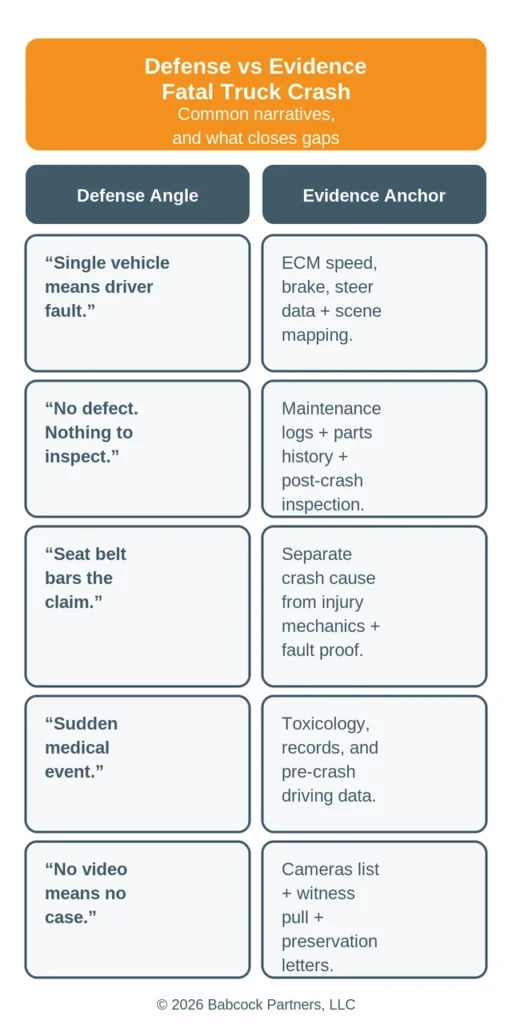
That distinction matters. A news report can identify the time, place, vehicle and statements attributed to authorities. It cannot prove why the driver left the road. Fatigue, a medical event, a mechanical problem, another vehicle, the load, the roadway and driver conduct are different theories. Each requires its own evidence.
The seat-belt detail also needs careful treatment. Restraint use may be relevant to injury causation or damages. It does not, by itself, explain why a tractor-trailer left the travel lane.
Start with the truck’s last minutes
A sound investigation works backward from the loss of control. Electronic control module data may show speed, braking and other vehicle information, depending on the truck and the available system. An electronic logging device may help establish duty status, but it is not a complete reconstruction of the driver’s condition. GPS, toll, fuel, dispatch and phone records can fill other parts of the timeline.
The tractor and trailer also need separate attention. Inspection and maintenance records can identify prior work on steering, brakes, tires and other components. Load documents and securement evidence may show how the trailer was configured. None of those records proves a defect merely because it exists. The point is to test possible causes against objective information.
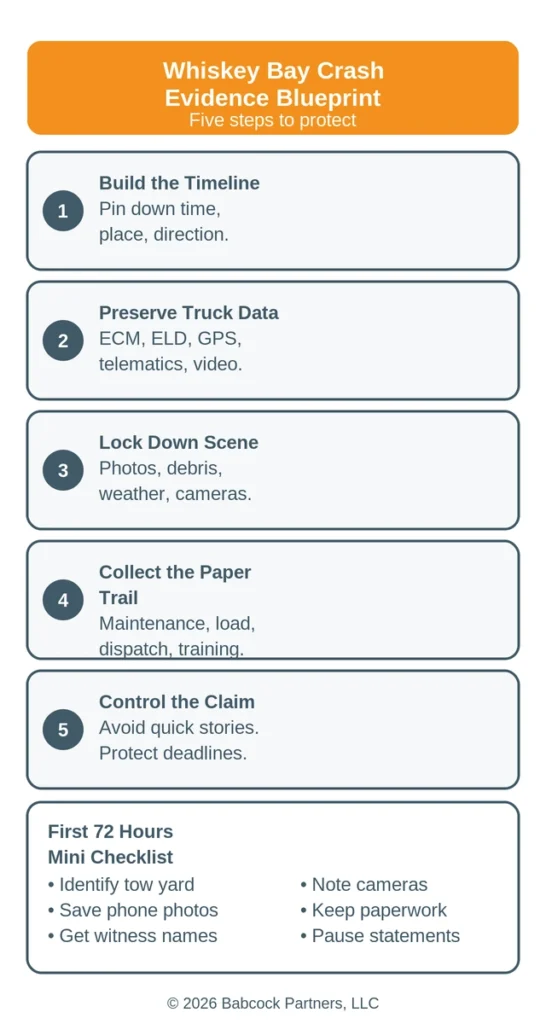
Preservation should occur through lawful arrangements with the vehicle owner, storage facility and other parties. Families should not enter a tow yard, handle damaged equipment or interfere with an official investigation. A written request can identify the vehicle, the types of data and parts to preserve, and the people who should receive notice.
The scene may tell a different part of the story
Scene photographs, measurements and roadway records can help explain the truck’s path. Investigators may examine tire marks, damaged barrier components, debris, roadway geometry, signs, visibility and weather. Video from traffic systems or passing vehicles can be valuable, but its absence does not decide the case.
Roadway damage after impact does not necessarily show a preexisting defect. The sequence matters. The investigation should distinguish the condition before the truck arrived from damage caused during the crash and repairs made afterward.
If another vehicle was involved without making contact, witness accounts and video may become especially important. A theory that another driver forced an evasive move should be supported by evidence rather than assumed from the lack of an immediate explanation.
Responsibility depends on the evidence and the relationship
Civil Code article 2315 and article 2316 provide Louisiana’s general fault framework. A viable claim requires proof connecting a person’s or company’s conduct to the crash and resulting loss.
When a driver is working, employer responsibility may depend on the employment relationship and whether the driver was acting within the course and scope of the job. Dispatch records, the assigned load, trip purpose and the company’s actual control can matter. Our article on potentially responsible parties after a truck crash discusses why the carrier, truck owner, maintenance provider, loader and manufacturer should be evaluated by role instead of grouped together.
A company may also face questions about its own conduct, such as maintenance, qualification or safety decisions. Records must support the particular allegation and its connection to the crash. The mere fact that a company could have followed a different practice does not establish causation.
Wrongful-death and survival claims address different losses
Civil Code article 2315.1 addresses the injured person’s survival action, while article 2315.2 addresses qualifying survivors’ wrongful-death claims. The family relationships, sequence of events and proof determine who may bring each claim and what losses can be supported.
These claims should not be reduced to a checklist of expenses. The records may include funeral costs, financial contributions, household services and the effect of the death on qualifying family members. A survival claim may concern losses experienced between injury and death when the facts support them. Our Louisiana wrongful-death and survival page explains the distinction.
Later Louisiana law should not be applied backward
This reported crash occurred in 2019. Later changes to Louisiana prescription and comparative fault should not be presented as if they governed the event.
For many negligence claims arising on or after July 1, 2024, Civil Code article 3493.1 generally provides a two-year prescriptive period. The version of Civil Code article 2323 effective January 1, 2026 bars recovery when an injured person’s negligence is 51% or more and proportionally reduces damages below that threshold. Earlier events may be governed by prior law.
Wrongful-death and survival claims also require separate, date-specific deadline analysis. This article does not suggest that a claim arising from the 2019 crash remains timely.
For a recent commercial-vehicle collision, our Baton Rouge truck accident page describes the evidence and claim process. Keep the incident date, agency report number, vehicle location and any correspondence you have received together. Missing documents do not prevent an initial inquiry.
Last reviewed: September 26, 2026. Sources checked: September 27, 2026.
This article provides general Louisiana legal information. Responsibility, available claims and deadlines depend on the facts and applicable law.