


Editorial & Legal Accuracy Notice (Louisiana)
This blog contains general legal and safety information and is not legal advice. Laws and deadlines can change, and outcomes depend on specific facts.
Last reviewed / updated: June 1, 2026
Reviewed, updated, and authored by: Stephen Babcock, Louisiana injury lawyer
This guide explains secondary asbestos exposure, what evidence matters, and how Louisiana deadlines can affect families.
The National Cancer Institute’s asbestos fact sheet explains that family members can be exposed when asbestos fibers are carried home on shoes, clothing, skin, or hair. In practice, the hardest part is rarely the label “secondary exposure.” The hard part is building a timeline and proving where the fibers likely came from.
For secondary asbestos exposure claims, we start with the record you can build, not the story you wish you had. We are not built for volume. We are built for leverage. Speed + evidence preservation + insurer-insider knowledge + trial-ready preparation = The Babcock Benefit. In take-home asbestos cases, leverage comes from proving where fibers likely traveled and closing documentation gaps early.
If you are inside the first 72 hours, call (225) 500-5000 or use the free case review form before evidence changes.
Firm links: Client Reviews | Contact | Locations
Download the printable toolkit (PDF)
What Is Secondary Asbestos Exposure?
Secondary asbestos exposure means you were exposed away from the jobsite because fibers traveled home on a worker’s clothing, body, or gear. The term “take-home exposure” is common, and the National Cancer Institute describes this household pathway when asbestos dust comes home on shoes and clothing.
- Primary exposure: the worker breathes asbestos fibers at work.
- Secondary exposure: fibers leave the worksite and reach the home, car, or family members.
- Why it matters legally: the case often turns on proving the pathway, not proving “a big accident.”
People hear “secondary asbestos exposure” and assume it is impossible to prove. It is often provable, but it is document-heavy and detail-driven. That is what makes it different from many other injury claims.
Where Does Secondary Asbestos Exposure Usually Happen?
Secondary exposure usually happens during ordinary routines: riding home in a dusty vehicle, handling work clothes, and doing laundry. The NIOSH “Protect Your Family” guidance warns that hazardous dust can travel home on clothing, bodies, and tools and expose family members without anyone realizing it.
- Clothing and shoes: uniforms, jackets, boots, and gloves stored in a car or closet.
- Laundry areas: shaking out clothing, sorting loads, or cleaning lint traps.
- Vehicles and furniture: dust settles into seats and fabric over time.
- Small keepsakes: tools, hard hats, and bags stored in garages or sheds.
If you are already dealing with a diagnosis, start by reading our Baton Rouge mesothelioma practice page so you understand how asbestos cases are investigated. We also handle broader chemical harm cases through our toxic exposure practice when the facts point beyond asbestos.
This is why we begin with preservation: names, places, and work records disappear faster than people expect. Even in “old exposure” cases, today’s proof can be lost tomorrow when employers close or records are purged.
Why Does Evidence Matter More Than Memory in Take-Home Asbestos Claims?
Evidence matters because asbestos-related diseases often show up decades after exposure, which makes timelines hard to reconstruct from memory alone. The CDC’s MMWR overview of mesothelioma notes a typical latency period of 20 to 40 years, so the paperwork is often older than the people involved.
- Latency: the time gap means employers, worksites, and products may be gone.
- Proof gaps: insurers look for missing links in the “how did fibers reach you?” story.
- Defense strategy: many arguments target dose, alternative exposures, or timing.
That is what we mean by leverage in these cases: you do not “out-argue” missing records. You replace uncertainty with a timeline, independent documents, and consistent medical proof.
Timeline Builder: Build the Household + Work Map
A strong secondary asbestos exposure case starts with a simple map of who lived where and who worked where, then matches the two timelines. The goal is not to create a perfect narrative on day one; the goal is to create a roadmap for record requests and witness outreach.
| Timeline Prompt | What to Write Down |
|---|---|
| Worker’s job history | Employer names, job titles, work locations, and approximate years. |
| Household addresses | Addresses and date ranges where family members lived together. |
| Clothing handling | Who did laundry, where clothing was stored, and whether clothes were shaken out. |
| Potential witnesses | Co-workers, neighbors, relatives, and anyone who remembers uniforms or dust. |
This is why we start with a timeline before we argue about anything else. The timeline tells you what to request, who to contact, and where the “missing years” are hiding.
Practical Tip: Use Ranges, Not Guesswork
If you do not know whether a job started in 1978 or 1979, write “late 1970s” and keep moving. Consistency matters more than perfection at the beginning. You can tighten dates later with pay stubs, W-2s, union records, or a Social Security earnings history.
Evidence Checklist for Secondary Asbestos Exposure
The best checklist breaks evidence into categories so you can see what is missing at a glance. A clean file also helps you avoid repeated interviews and reduces the chance of accidental inconsistencies.
- Work records: pay stubs, W-2s, union cards, training materials, jobsite badges, and old résumés.
- Home pathway proof: who handled laundry, where clothing was stored, and how work gear entered the home.
- Product clues: photos of equipment, manuals, safety sheets, and brand names remembered by co-workers.
- Witness list: names and phone numbers, plus what each person specifically remembers.
- Medical file: diagnosis documents, pathology reports, imaging summaries, and provider lists.
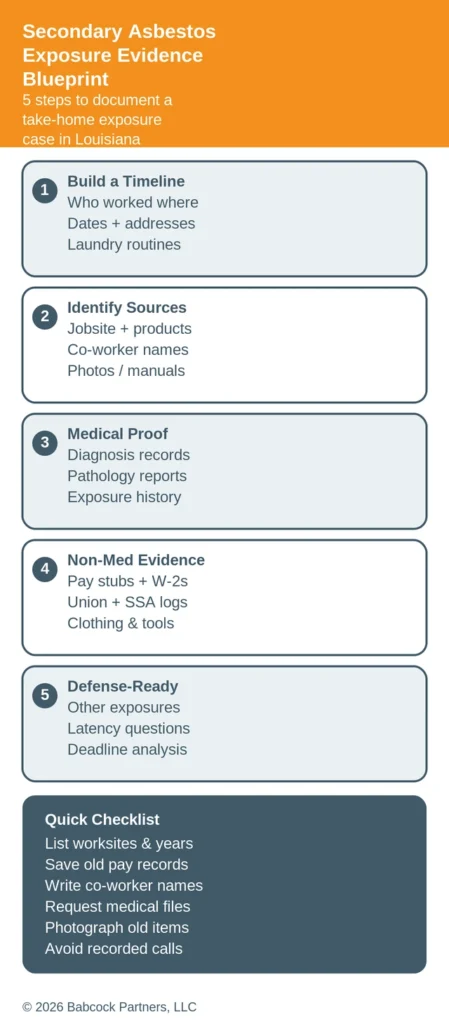
If you want a one-page summary for your family, use Download the printable toolkit (PDF) and keep it with your notes. Keep the download focused on organizing the record, not on rewriting your story.
Medical Proof Without Overdoing It
In asbestos cases, “medical proof” usually means documenting the diagnosis accurately and collecting the records that show how the condition was identified. The MedlinePlus mesothelioma overview explains that mesothelioma involves the mesothelium lining and can take a long time to form after asbestos exposure.
- Diagnosis documents: pathology reports, operative notes, and specialist letters.
- Exposure history in the chart: consistent notes that match the timeline you built.
- Related conditions: records of pleural plaques, effusions, or lung scarring when relevant.
The EPA’s asbestos overview lists mesothelioma, lung cancer, and asbestosis as health effects from exposure, which is why insurers scrutinize the medical file. You do not need to “prove the medicine” on your own, but you do need to keep the diagnosis documents complete and consistent.
That is what we mean by leverage on the medical side: we focus on clarity, consistency, and the records the defense will actually request. When people rely on summaries or memory alone, insurers often argue the case is “too uncertain” to value fairly.
Defense Audit: Common Pushbacks and the Records That Counter Them
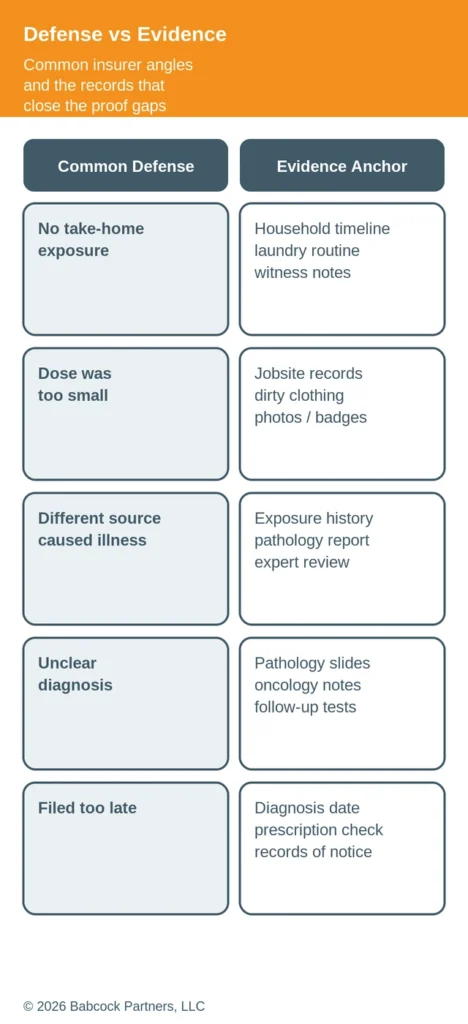
Insurance and defense teams often try to break the chain between the worksite and the household, not by calling anyone a liar but by pointing to missing documentation. If you expect these pushbacks early, you can build the file in a way that answers them without constant back-and-forth.
| Common Pushback | Evidence That Helps |
|---|---|
| “There was no take-home pathway.” | Household timeline, laundry routine notes, and witness statements tied to specific years. |
| “The dose was too small.” | Jobsite records, co-worker recollections, and consistent details about dusty work clothing. |
| “It came from somewhere else.” | Full exposure history, medical records, and a documented list of all relevant worksites. |
| “The diagnosis is unclear.” | Pathology and specialist records that show how the diagnosis was reached. |
| “You waited too long to file.” | Diagnosis date, notice timeline, and a prescription analysis based on Louisiana law. |
This is why we treat insurer communications as part of the evidence plan. A rushed recorded statement can lock in a timeline error, and later corrections may be framed as “inconsistency.”
If you need a place to start, you can review how we approach mesothelioma and asbestos cases and then focus on building the records that match your timeline. For location-specific resources, our Baton Rouge hub explains how our Louisiana practice is organized.
What we see in practice
We see that take-home asbestos claims rise or fall on whether the household timeline is backed by independent records. We also see insurers press for details people cannot recall, then treat normal uncertainty as a “credibility” issue.
- Missing years: the work history has gaps that could hide key exposure sites.
- No product identifiers: the file names no brands, materials, or job tasks.
- Thin medical records: summaries exist, but pathology and specialist notes are missing.
What we see most often is that families have a real exposure story but do not have it written down in a usable way. Jobs blur together, worksites change names, and the person who remembers the most is often not the person who handled the clothing.
We also see records that exist but are scattered: a union card in a drawer, a few pay stubs in a box, and a medical portal download on a phone. When those pieces get organized into a timeline, the case gets clearer and the defense angles narrow.
When Should You Call a Lawyer After Learning About Possible Exposure?
You should talk to a lawyer quickly when a new diagnosis appears, when an insurer denies a claim, or when you are struggling to locate work and medical records. The goal is to protect evidence and spot deadlines early, not to rush you into a decision.
- Call quickly if: you received a mesothelioma or asbestos-related diagnosis.
- Call quickly if: a former employer or worksite is shutting down or changing ownership.
- Call quickly if: you are asked for a recorded statement about decades-old dates.
- Call quickly if: the family is unsure which jobs or products matter most.
Download the printable toolkit (PDF)
Louisiana Law Snapshot (Updated 2026)
Louisiana has firm time limits, and asbestos cases often hinge on when a condition is diagnosed and when the claim should have been discovered. The two-year delictual prescription is set out in La. Civ. Code art. 3493.1, so missing the deadline can end a claim regardless of merit.
| Rule | Plain-English Meaning |
|---|---|
| Two-year prescription | Most injury claims must be filed within two years under Louisiana’s delictual prescription rule. |
| Comparative fault (2026 update) | La. Civ. Code art. 2323 provides comparative fault rules and adds a 51% bar after Jan. 1, 2026, meaning recovery is barred if a person is 51% or more at fault. |
Deadlines and fault allocation can be complicated in occupational and household exposure cases, especially when multiple worksites and products are involved. A quick legal review can help you avoid common timing mistakes without turning your life into a paperwork project.
Free Case Review: Protect the Record Before It Changes
Secondary asbestos exposure cases can feel overwhelming because the key facts often span decades. We are not built for volume. We are built for leverage.
We use the Babcock Benefit approach to focus on the few records that move the case forward, then build a file that is ready for negotiation or trial preparation. If you want a deeper overview, talk with a mesothelioma attorney about take-home exposure and then keep your evidence plan simple. Call (225) 500-5000 and use the free case review form so we can help you prioritize the evidence that matters. Urgency usually comes from disappearing records, pressure for statements, and hard deadlines.
These items are helpful to have with you when you call, but do not delay calling because you do not have them. If you have them handy, keep them nearby for the call.
- A simple list of the worker’s employers, worksites, and years.
- Any pay stubs, W-2s, union cards, or training documents.
- Names of co-workers or relatives who remember dusty clothing or uniforms.
- Diagnosis documents, especially pathology and specialist notes.
- A short list of questions you want answered.
Call Today If…
- You have a new mesothelioma or asbestos-related diagnosis.
- You are being asked for a recorded statement about old dates.
- A former employer is closing or records are hard to obtain.
- You are unsure which worksites or products matter most.
What Happens Next
- We triage the evidence: timeline first, then the highest-value record requests.
- We spot deadlines early and map the legal issues that fit your facts.
- We plan insurer communications so you do not strengthen defense narratives by accident.