Editorial & Legal Accuracy Notice (Louisiana)
This blog contains general legal and safety information and is not legal advice. Laws and deadlines can change, and outcomes depend on specific facts.
Last reviewed / updated: March, 2026
Reviewed, updated, and authored by: Stephen Babcock, Louisiana injury lawyer
This guide explains what to do after a Louisiana boat accident so you can protect your health, preserve evidence, and avoid preventable claim problems.
A boat accident can turn into a paperwork and proof problem fast, especially on busy waterways near Baton Rouge. If you need legal help now, start with our boat accident lawyer in Baton Rouge page so you can see how we triage evidence and deadlines. This article stays practical: what to do first, what to document, and how to keep insurers from defining the story for you.
Because boating cases can involve local law enforcement, the Louisiana Department of Wildlife and Fisheries, and sometimes federal rules, small details matter. We also point you to the Baton Rouge hub at our Baton Rouge office page for local resources and contact options.
Our approach is simple: we build the claim like it will be challenged from day one, and we start by protecting the evidence you cannot recreate later. We are not built for volume. We are built for leverage. Speed + evidence preservation + insurer-insider knowledge + trial-ready preparation = The Babcock Benefit. In a Louisiana boat accident, leverage often comes from a clean timeline, preserved boat evidence, and consistent documentation.
If you are inside the first 72 hours, call (225) 500-5000 or use the free case review form before evidence changes.
Firm links: Client Reviews | Contact | Locations
Want a print-friendly checklist you can keep on your phone or print for your folder. Download the printable toolkit (PDF).
What Should You Do After a Boat Accident in Louisiana?
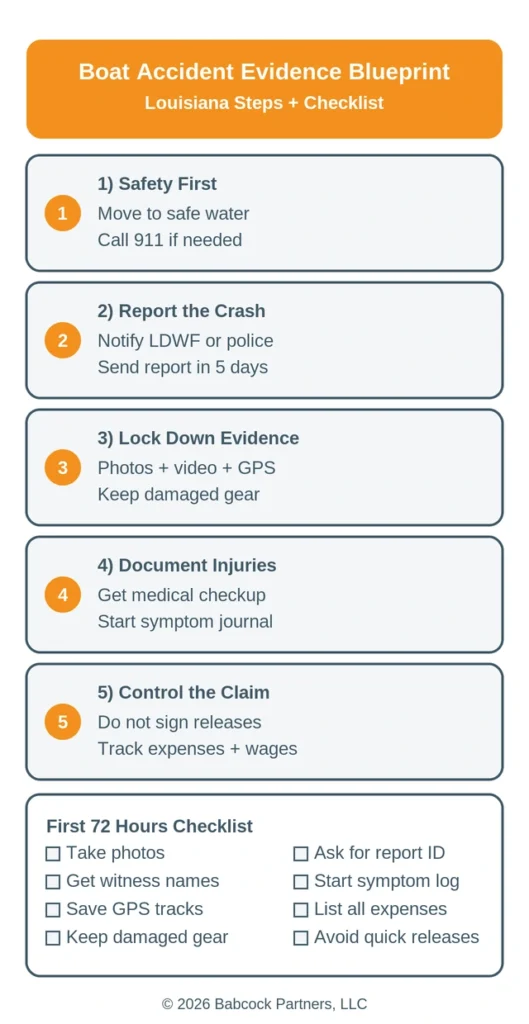
Start by getting everyone safe, calling for help, and creating a clean record of what happened before boats move or repairs begin. Next, report the crash to the right authority, collect basic operator and vessel information, and preserve the evidence insurers use to argue fault and injury.
- Call 911 for emergencies, get to a safe location, and account for every person.
- Exchange names, contact details, vessel registration numbers, and insurance information.
- Photograph the boats, damage, the waterway, and any hazards from multiple angles.
- Identify witnesses and ask them to text you their name and what they saw.
- Report the incident and write down the report number and responding agency.
- Get medical care and keep a simple symptom and activity log for the next few weeks.
This is why we focus on the first 72 hours: once a boat is hauled out, repaired, or scrapped, the most persuasive physical evidence can disappear. Even if you feel “mostly fine,” document the basics now so later questions have objective answers.
Do You Have to Report a Boat Accident in Louisiana?
Yes in many situations, and reporting is also a practical way to lock in time, location, and witness information while memories are fresh. The Louisiana Department of Wildlife and Fisheries boat crash reporting guidance explains the immediate duties boat operators typically have after a collision or casualty.
- The LDWF Operator Boating Incident Report form lists reportable incidents such as death or disappearance, injuries needing medical treatment beyond first aid, and property damage over $500 or total loss.
- The same LDWF form references a five-day deadline for submitting the report in reportable incidents, so do not wait until “things calm down” to start the paperwork.
- For some events, the eCFR timing rules in 33 C.F.R. § 173.55 require a written report within 48 hours for certain serious outcomes and within 10 days for other reportable events.
If you are unsure who takes the report, the U.S. Coast Guard’s recreational boating accident reporting page explains that reports are generally filed with the state reporting authority, even when federal rules apply. If anyone may have been impaired, keep the interaction calm and factual because Louisiana’s watercraft impairment statute includes rules about chemical testing and implied consent after an arrest.
| What to Record | Why It Matters Later |
|---|---|
| Agency name + report number | Lets you request the report and confirm the official time and location. |
| Operator identities + vessel registration | Helps identify owners, insurers, and any commercial use issues. |
| Witness names + contact method | Independent witnesses often decide disputed fault stories. |
What Evidence Matters Most After a Louisiana Boat Accident?
The strongest boating cases usually have two tracks of proof: what happened on the water and how the injury changed real life afterward. If you preserve the boat evidence, digital data, and a consistent timeline, you reduce the room insurers have to argue “unclear fault” or “no real harm.”
- Scene proof: photos, videos, weather and water conditions, and hazard markers.
- Boat proof: hull damage, propeller and steering condition, and any broken parts saved.
- People proof: witness contacts, passenger statements, and operator identities.
- Digital proof: GPS tracks, chartplotter data, app messages, and time-stamped phone media.
- Life impact proof: medical visit dates, symptom notes, missed work records, and receipts.
That is what we mean by leverage: you make the defense argue against time-stamped, organized records instead of fuzzy memory. If you want a deeper overview of how we build these cases, see our boat accidents practice page and use it as a checklist for what to preserve.

Who Can Be Liable for a Boat Accident?
Liability depends on who controlled the boat, who maintained it, and what decisions caused the collision or injury. Louisiana’s general fault rule in La. Civ. Code art. 2315 is the starting point for many boating injury claims, but some cases involve product defects or federal maritime issues too.
- The at-fault operator for speed, lookout, wake, or unsafe maneuver decisions.
- The vessel owner if they entrusted the boat to an unsafe operator or ignored known issues.
- A rental, tour, or charter company for training, supervision, or maintenance failures.
- A marina or event organizer if a dangerous condition or crowding played a role.
- A manufacturer if a defect contributed, which can trigger the Louisiana Product Liability Act framework.
Boating accidents on navigable waters can also raise maritime jurisdiction questions, and 28 U.S.C. § 1333 is the federal statute courts use for admiralty jurisdiction. The Supreme Court’s opinion in Sisson v. Ruby is one example of how federal courts analyze whether a recreational vessel incident falls under maritime rules, which is why we evaluate location and vessel use early.
How Do Boat Accident Insurance Claims Usually Unfold?
Most claims start with an insurer trying to narrow the story into a simple fault narrative and a limited set of documents. You protect yourself by keeping communications factual, preserving evidence before repairs, and tracking every loss category so the claim does not get defined by the first adjuster call.
- A report gets made and an adjuster asks for a recorded statement and documents.
- The insurer requests photos, repair estimates, and medical information releases.
- Fault gets argued using damage photos, witness stories, and any digital data.
- The insurer tests causation by comparing early symptoms to later treatment records.
- Settlement discussions often follow once medical status stabilizes and records are complete.
This is why we document “before and after” function: insurers often treat gaps as a defense, not a mistake. That is what we mean by leverage when we say we prepare for the defense audit, not just the claim submission.
| Adjuster Request | Better Documentation Move |
|---|---|
| “Tell me what happened” recorded call | Use your written timeline first so your story stays consistent. |
| Broad medical release | Ask what date range and providers are needed and keep a copy of what is sent. |
| Quick settlement paperwork | Do not sign until you understand what rights the release ends and what it covers. |
How Do You Build a Timeline After a Boat Accident?
A good timeline is a simple, date-stamped record that connects the on-water event to symptoms, treatment, and daily life impact. When your notes match your records, it becomes harder for an insurer to claim your injury appeared “out of nowhere” weeks later.
- Start with the exact time, location, and direction of travel when the incident occurred.
- Add a short “what changed” note each day for the first week (pain, sleep, work limits).
- Record every medical visit date, provider, and the specific complaint you reported.
- Track repair steps and keep parts, photos, and estimates tied to specific dates.
- Save a call log of every insurance contact, including who called and what they asked for.
| Time Window | What to Capture | Why It Helps |
|---|---|---|
| Day 0–2 | Photos, witness contacts, report number, boat condition | Preserves facts before the scene and damage change. |
| Week 1 | First medical visit, symptom log, work restrictions | Creates a consistent record of early complaints. |
| Weeks 2–4 | Follow-ups, therapy, repair status, expense tracking | Shows continuity and total claim impact over time. |
What Defenses Do Insurers Raise in Boat Accident Cases?
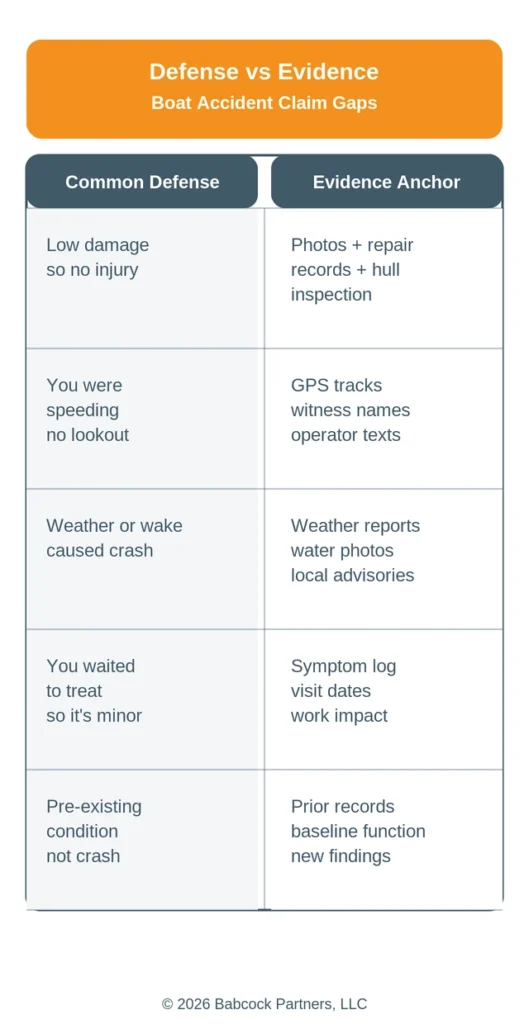
Insurers often defend boat accident claims by attacking fault, timing, and medical consistency rather than the headline facts. If you expect those arguments early, you can preserve the records that answer them and avoid getting trapped by “it’s unclear” narratives.
| Defense Narrative | Evidence Anchor That Helps |
|---|---|
| “Low damage, so no injury” | Detailed photos, repair records, and medical documentation that matches the mechanism and timing. |
| “You caused it by speed or no lookout” | GPS tracks, witness statements, operator admissions, and consistent timeline notes. |
| “Weather or wake did it” | Water and weather photos, local advisories, and witness descriptions of conditions. |
| “You waited to treat, so it’s minor” | Symptom log, appointment dates, and proof of work or activity limits during the gap. |
| “It was pre-existing” | Prior baseline records, your functional history, and new complaints documented after the event. |
This is why we preserve non-medical evidence, not just records: the defense often attacks the “how” before it attacks the “how much.” When we can show a clean chain from scene proof to life impact proof, leverage shifts.

What we see in practice
Boating cases often turn on small facts that get lost when people wait: who was actually operating, what the boat looked like before repairs, and what witnesses said before stories hardened. We also see insurers push early for broad releases and quick settlements when evidence is thin and the injury story is still developing.
- Witnesses disappear quickly when the marina, launch, or sandbar clears out.
- Boat repairs happen fast, and parts get thrown away unless someone puts a hold on them.
- People under-document symptoms because they try to “tough it out,” which creates gaps.
- Fault narratives can shift when alcohol is suspected or when passengers blame each other.
- Commercial trips, rentals, and navigable-water issues can add extra layers of rules.
When Should You Talk to a Lawyer Quickly After a Boat Accident?
Talk to a lawyer quickly when the stakes are high or the facts are likely to be disputed, because early decisions can permanently shape the claim record. Louisiana’s general two-year deadline in La. Civ. Code art. 3493.1 can sound like “plenty of time,” but evidence and witness issues usually move much faster.
- A death, drowning event, or a person missing from the water.
- Any fatality risk or family claim issues, because La. Civ. Code art. 2315.1 and art. 2315.2 govern survival and wrongful death claims.
- A commercial charter, work boat, or rental situation with multiple policies and contracts.
- Alcohol suspicion or an arrest scenario, because Louisiana’s watercraft testing rules can change the investigation fast.
- Serious injury signs like loss of consciousness, neck or back symptoms, or hospitalization.
If your injuries are severe, you may also need focused documentation for brain or spine issues, and we cover those proof gaps on our brain injury page and spinal cord injury page. If a loved one died, our wrongful death page explains next steps families often face in Louisiana.
What Mistakes Can Hurt a Boat Accident Claim?
Most claim damage comes from avoidable proof gaps, not from what happened on the water itself. If you keep the evidence, keep your records consistent, and avoid rushed paperwork, you usually prevent the defenses that reduce value or create delay.
- Letting the boat get repaired or disposed of before detailed photos and inspection.
- Assuming the report will be “handled” without confirming the report number and agency.
- Posting on social media in ways that conflict with your symptom or activity story.
- Waiting weeks to treat and then trying to backfill details with memory alone.
- Signing a release or accepting a payment without understanding what it covers.
If you are unsure whether a document is a “release,” treat it like a stop sign until you understand it. That extra day to clarify paperwork is often the difference between a clean claim file and a closed case you cannot reopen.
Printable Toolkit You Can Download
The fastest way to reduce stress after a boat accident is to use a checklist so you do not rely on memory during calls and appointments. Our printable toolkit combines the two infographics, a timeline builder, and a defense audit so you can keep everything in one place.
- Download the printable toolkit (PDF) and save it to your phone.
- Use the checklist before you authorize repairs or discard damaged gear.
- Bring it to medical visits so your history stays consistent visit to visit.
Louisiana Law Snapshot (Updated 2026)
Many Louisiana personal injury claims use a two-year delictual prescription period, and La. Civ. Code art. 3493.1 is the main reference attorneys check for that general clock. Because exceptions and special rules can apply, the safe move is to talk to a lawyer early enough to investigate and calendar the right deadline.
Louisiana also uses comparative fault, and La. Civ. Code art. 2323 governs how fault can be assigned among multiple people. After Jan. 1, 2026, a 51% bar can block recovery if you are assigned most of the fault, which is one reason boating cases with disputed operator conduct should be documented carefully.
- Deadline risk: Evidence can disappear long before the legal deadline expires.
- Fault allocation risk: Passenger conduct and operator decisions can both get blamed.
- Record consistency risk: Gaps in treatment and missing boat evidence invite defenses.
Free Case Review: Next Steps
We are not built for volume. We are built for leverage. If you were hurt in a boat accident, the Babcock Benefit mindset means we move fast to preserve evidence, spot defenses early, and build a trial-ready record even if the case never goes to trial.
Call (225) 500-5000 and use the free case review form if you need help protecting the timeline, boat evidence, and insurance communications. Common urgency reasons in boating cases include fast repairs, missing witnesses, and early pressure to sign a release before you know the full impact.
These items are helpful to have with you when you call, but do not delay calling because you do not have them. If you have them handy, keep them nearby for the call.
- The date, time, and location of the boat accident
- Names and contact info for operators, owners, and witnesses
- Photos or video of the boats and the waterway
- Report number and responding agency (if available)
- A list of medical visits and current symptoms
- Any insurance claim numbers or letters
Call Today If
- Someone died, is missing, or needed emergency care
- The boat is about to be repaired, sold, or disposed of
- Fault is disputed or multiple boats and passengers are blaming each other
- You are being asked for a recorded statement or to sign a release
- You want focused help with a boating injury claim, including next steps on help with a boating injury claim
What Happens Next
- Evidence triage: we identify what can vanish first and act on it.
- Deadline spotting: we map the right prescriptive deadline and any notice requirements.
- Insurer contact strategy: we plan communication so early statements do not box you in.