Editorial & Legal Accuracy Notice (Louisiana)
This blog contains general legal and safety information and is not legal advice. Laws and deadlines can change, and outcomes depend on specific facts.
Last reviewed / updated: March 2, 2026
Reviewed, updated, and authored by: Stephen Babcock, Louisiana injury lawyer
This guide explains why hiring a mesothelioma lawyer can change what evidence gets saved, what deadlines get spotted, and how claim decisions get made in Louisiana.
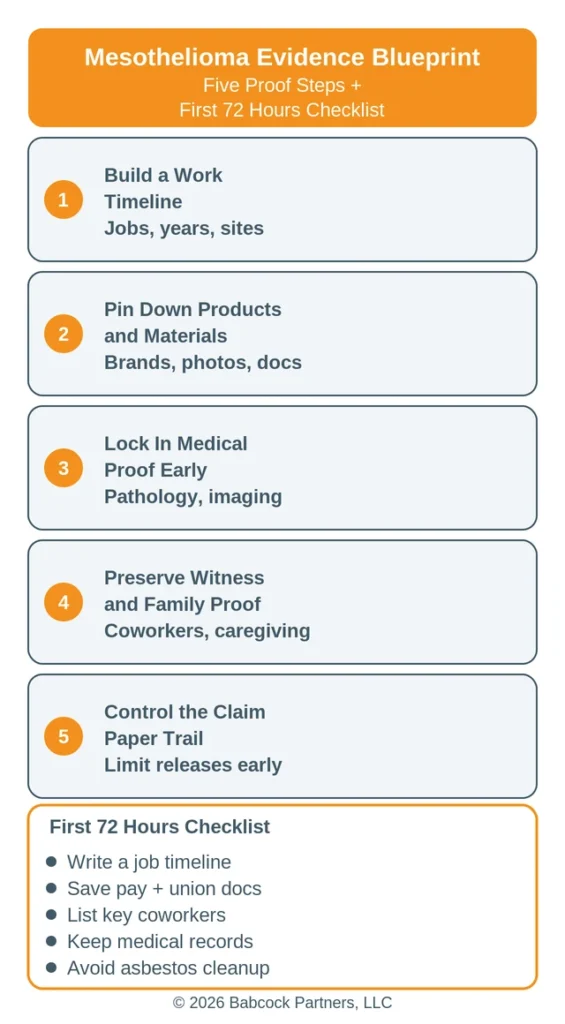
Most families are not looking for a legal lecture after a mesothelioma diagnosis; they are looking for a plan that protects proof and reduces regret. We are not built for volume. We are built for leverage. Speed + evidence preservation + insurer-insider knowledge + trial-ready preparation = The Babcock Benefit. In asbestos disease cases, leverage often comes from building a clear exposure timeline before records and memories fade.
A mesothelioma case is not just a form you fill out once; it is an investigation that usually reaches back decades. The National Cancer Institute’s asbestos fact sheet explains that asbestos exposure is a major risk factor for mesothelioma and that the disease can appear long after exposure. Because the timeline is long, your first practical step is to gather work history and product clues before they disappear. If you want to see how our approach fits this kind of case, start with our Baton Rouge mesothelioma practice page.
If you are inside the first 72 hours, call (225) 500-5000 or use the free case review form before evidence changes.
Firm links: Client Reviews | Contact | Locations
Download the printable toolkit (PDF)
Do You Need a Mesothelioma Lawyer in Louisiana?
If you have a mesothelioma diagnosis, you usually need a lawyer because the case is evidence-heavy and often involves multiple potential defendants. A lawyer’s early work is less about paperwork and more about protecting the exposure timeline, medical proof, and witness records before they get lost.
- You have a confirmed diagnosis, pending biopsy results, or a strong suspicion of asbestos exposure.
- Your exposure likely happened at more than one jobsite, facility, or product type over time.
- You are already getting calls about releases, statements, or quick “closure” paperwork.
- A key witness is aging, moving, or hard to locate.
Mesothelioma commonly shows up years after exposure, so you are often proving events from another decade. OSHA’s asbestos safety guidance explains that asbestos-related diseases can take many years to develop, which is one reason old job and product records matter so much. This is why we push early timeline work, because the best proof is often ordinary records that are easy to lose.
What Does a Mesothelioma Lawyer Actually Do?
A mesothelioma lawyer builds a proof package that connects a person’s work history, product exposure, and medical diagnosis in a way a judge, jury, or insurer can follow. In practice, that means collecting records fast, deciding which claims fit the facts, and preventing early missteps that can narrow your options.
- Exposure investigation: identify jobsites, products, and likely asbestos sources.
- Medical proof assembly: gather pathology, imaging lists, and treating-provider records.
- Defendant mapping: match products and sites to responsible companies.
- Claim strategy: coordinate the order and timing of claims so nothing conflicts.
- Pressure management: handle insurer and defense contact to reduce misquotes and rushed releases.
A Louisiana mesothelioma lawyer should also spot when a case crosses into adjacent legal issues, such as a product-liability theory or a survival and wrongful-death question for families. For product-based liability concepts, the Louisiana Products Liability Act provides the framework for many defective-product claims in the state. If your family needs broader context on toxic exposures beyond asbestos, we also cover that on our toxic exposure page.
What Evidence Do You Actually Need for a Mesothelioma Claim?
You usually need three categories of evidence: work-and-exposure proof, product identification proof, and medical diagnosis proof. The goal is to make the story testable, meaning a neutral person can verify the who, what, when, and where.
| Evidence Bucket | Examples That Help | Why It Matters |
|---|---|---|
| Work and site history | Resumes, pay stubs, union records, job badges, site lists | Builds a timeline that can be checked against records |
| Product identification | Brand names, photos, invoices, maintenance logs, parts lists | Connects exposure to specific products and companies |
| Medical proof | Pathology report, imaging history, treating notes, symptom timeline | Shows diagnosis and ties it to functional impact |
| Witness support | Coworker names, supervisors, family caregivers, written recollections | Fills gaps when paper records are incomplete |
Evidence gathering should never create new safety risks, especially around older insulation, flooring, or equipment. EPA’s asbestos-in-homes guidance explains that asbestos fibers can be released when asbestos-containing materials are disturbed, so do not tear into suspect materials just to “get photos.” This is why we look for safer documentation sources first, like records and witnesses.
This is why we start with record preservation and a clean timeline before debating legal theories. A strong timeline makes every later decision easier.
How Do You Build a Work-and-Exposure Timeline?
You build a work-and-exposure timeline by listing every job, site, and task that could involve asbestos, then anchoring the list to documents and witnesses. Done well, the timeline becomes the backbone for medical records requests, product identification, and defendant selection.
- Start with a year-by-year job list, even if you do not know exact dates.
- Add sites, departments, and the specific tasks you did around insulation, gaskets, boilers, valves, or demolition.
- List brands, nicknames, and common product labels you remember seeing.
- Attach “proof hooks” to each entry, such as a coworker name, a badge, or a pay record.
- Mark any missing years or unknown sites so they can be investigated without guessing.

Here is a simple template families can use before the first lawyer call, and it works even if dates are approximate. If you need to add a product-liability angle later, the same structure helps you narrow product identification, which is also a key concept in defective product cases.
| Year Range | Employer or Site | Task | Products or Clues | Witness or Record |
|---|---|---|---|---|
| Example: 1988–1993 | Example: plant maintenance | Example: gasket replacement | Example: brand name on box | Example: coworker name |
| Example: 1994–1999 | Example: shipyard | Example: insulation work nearby | Example: dusty wrap material | Example: union records |
This is why we ask for a “good enough” first draft timeline right away. Even rough dates can point to the right records and witnesses.
What Medical Proof Holds Up Best in Mesothelioma Cases?
The strongest medical proof is usually a clear diagnosis supported by pathology and consistent treating-provider records that explain the condition and its impact. In most cases, you want a clean set of reports that can be reviewed without interpretation gaps.
- Pathology reports and biopsy results
- Imaging history lists and radiology reports
- Treating physician notes and specialist consults
- A short symptom and function timeline from the patient or caregiver
Merck Manual’s professional overview of mesothelioma describes diagnosis in terms that commonly include imaging and tissue sampling, which is why the pathology report tends to be central. For plain-language background on the condition and how it is tied to asbestos exposure, Mayo Clinic’s mesothelioma overview is a helpful starting point for families. A lawyer is not a substitute for medical care, but a lawyer can help you organize medical documents so they stay consistent across claims and providers.
How Do Defendants and Insurers Challenge Mesothelioma Claims?
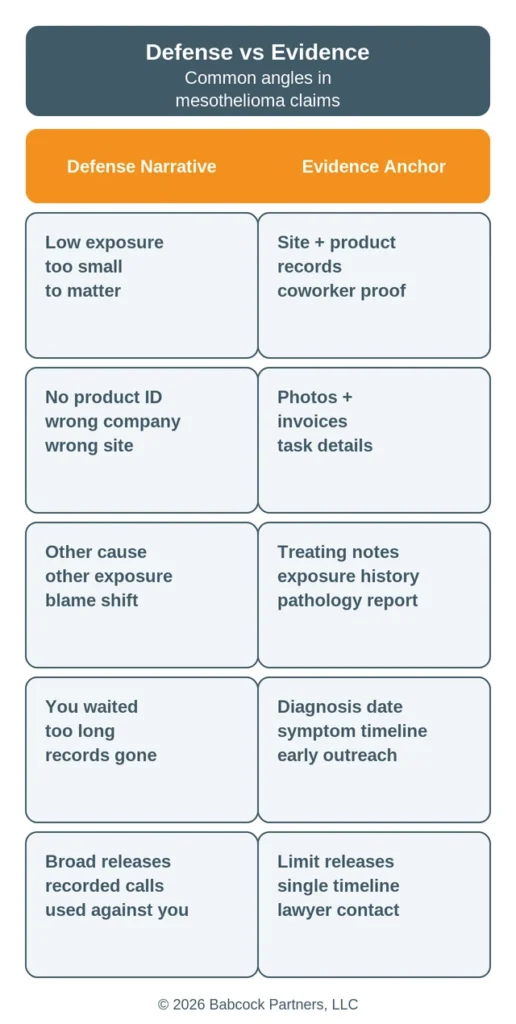
Defendants and insurers usually challenge mesothelioma claims by attacking the exposure story, the product identification, or the timing of the claim. The practical response is to identify the likely “proof gaps” early and gather evidence that answers them directly.
| Common Defense Angle | Evidence That Often Helps |
|---|---|
| “You cannot prove where exposure happened.” They argue the work history is too vague. | Site list + task descriptions + coworker confirmations + payroll or union records. |
| “You cannot tie exposure to this defendant.” They focus on missing product identification. | Brand photos, invoices, parts lists, maintenance logs, and witness statements naming products. |
| “It was something else.” They try to shift causation away from asbestos. | Treating-provider history, consistent exposure narrative, and complete pathology reports. |
| “You waited too long.” They point to lost records and delay. | Diagnosis-date timeline, prompt records requests, and documented reasons for gaps. |
| “Your own statements hurt you.” They use broad releases or recorded calls. | Controlled communications, limited releases, and a single verified timeline before statements. |

That is what we mean by leverage when we say we build the file to withstand defense scrutiny, not just to start a claim. When an insurer pushes for a quick recorded statement, leverage is having a verified timeline and medical packet ready first.
What we see in practice
In real mesothelioma cases, the hardest part is rarely a single missing record; it is the accumulation of small gaps that let the defense create doubt. We see families do better when they treat the timeline like an evidence project, not a memory test.
- Multiple worksites and products can create overlapping responsibility arguments.
- Old employers may merge, close, or change record systems, which can slow verification.
- Witnesses can be hard to find, and their recollection gets thinner each year.
- Defense teams often look for inconsistent histories across doctors, forms, and claims.
This is why we prioritize one clean exposure narrative across records. It reduces contradictions that defense teams look for.
What Should You Do in the First 30 Days After Diagnosis?
In the first 30 days, focus on organizing proof, not perfecting your story. Your goal is to capture facts while they are fresh and to prevent preventable documentation gaps.
- Create a one-page job and site list, even if dates are approximate.
- Request or locate pathology reports and your imaging history list.
- Write down coworker names, supervisors, and “who knows what” about your tasks.
- Save any old pay stubs, union cards, badges, or training documents.
- Keep a short symptom and function journal for caregivers and providers.
If your diagnosis ties to a broader chemical exposure history, it helps to keep those records separate and labeled. Our toxic exposure resource explains how documentation often works in exposure cases without turning your timeline into speculation.
When Should You Talk to a Lawyer Quickly?
You should talk to a lawyer quickly when you suspect evidence may change, a key witness may disappear, or you are being asked to sign documents you do not understand. In mesothelioma cases, “quickly” often means before the first major paperwork push, not after it.
- You are asked to sign a broad medical authorization or settlement release.
- A former employer has closed, merged, or changed ownership and records may be purged.
- You have a known jobsite with many contractors and overlapping product suppliers.
- A family member is handling care and needs help organizing records consistently.
- A loved one has passed or is declining quickly, raising survival and wrongful-death questions.
For families facing a death, Louisiana recognizes separate claims that can arise after a wrongful death, and Louisiana Civil Code article 2315.2 is one place those rules are defined in state law. If you need an overview of how a wrongful-death case works in general, we cover that on our wrongful death page.
Download the printable toolkit (PDF)
Louisiana Law Snapshot (Updated 2026)
Louisiana injury and exposure claims generally run on tight deadlines, so you should treat the legal clock as an evidence clock too. The rules below are simplified, and the facts of a latent disease case can change how deadlines get argued.
| Rule | Plain-English Meaning |
|---|---|
| Two-year delictual prescription | Louisiana Civil Code article 3493.1 sets a two-year prescriptive period for many personal injury claims, which can affect when a lawsuit must be filed. |
| Comparative fault and a 51% bar | Louisiana Civil Code article 2323 addresses comparative fault and includes a post–Jan. 1, 2026 51% bar, so fault allocation can change recovery in some cases. |
Mesothelioma cases can also involve family claims, especially if a loved one passes away during the process. Louisiana Civil Code article 2315.1 and Louisiana Civil Code article 2315.2 are key statutes lawyers evaluate when survival and wrongful-death issues are in play. The right question is not “How fast can we file,” but “What proof do we need before the window closes.”
Next Steps After a Mesothelioma Diagnosis
We are not built for volume. We are built for leverage. The Babcock Benefit is about moving early on the proof, keeping the record consistent, and preparing every case as if it may need a courtroom-ready file.
If you want help building that file, call (225) 500-5000 and use the free case review form. The urgency in a mesothelioma case is not hype; it is that employers purge records, witnesses become harder to find, and defense narratives harden over time.
If you are looking for where we start, our team can explain the process on the phone and point you to mesothelioma case help resources that match your situation.
These items are helpful to have with you when you call, but do not delay calling because you do not have them. If you have them handy, keep them nearby for the call.
- Your best estimate of job sites and years worked
- Any pathology report or biopsy summary you have
- A list of doctors and hospitals involved so far
- Names of coworkers or supervisors who can confirm tasks
- Any photos, invoices, or product labels you still have
Call Today If…
- You are being asked to sign a release or broad authorization
- You need help getting a pathology report or imaging list
- A key witness is elderly, ill, or moving out of state
- An employer or plant has closed and records may be purged
- A loved one has passed and your family needs deadline guidance
What Happens Next
- Evidence triage: we map the exposure timeline and preserve high-risk records first
- Deadline spotting: we identify time-sensitive legal and insurance issues tied to your facts
- Insurer contact strategy: we control communication and paperwork so your record stays consistent