


Editorial & Legal Accuracy Notice (Louisiana)
This blog contains general legal and safety information and is not legal advice. Laws and deadlines can change, and outcomes depend on specific facts.
Last reviewed / updated: March, 2026
Reviewed, updated, and authored by: Stephen Babcock, Louisiana injury lawyer
This guide explains Navy ship asbestos exposure risks, what evidence matters, and how Louisiana deadlines can shape next steps.
Many veterans and shipyard workers learn about asbestos-related disease years after service. The hard part is not only getting care, but also proving where and how the exposure happened. This post focuses on practical documentation steps that help families avoid proof gaps. We also explain Louisiana’s key deadline rules near the end.
When a Navy asbestos diagnosis raises questions, the record you build matters as much as the story you tell. We are not built for volume. We are built for leverage. Speed + evidence preservation + insurer-insider knowledge + trial-ready preparation = The Babcock Benefit. In a Navy ship asbestos exposure case, leverage often comes from clean medical proof and a believable exposure timeline.
If you want help mapping a diagnosis to a shipboard exposure history, start with our Baton Rouge mesothelioma lawyer page and then use the evidence steps below to organize your file. Because these cases often involve decades-old facts, a simple timeline and document request list can prevent “we can’t confirm it” defenses later.
If you are inside the first 72 hours, call (225) 500-5000 or use the free case review form before evidence changes.
Firm links: Client Reviews | Contact | Locations
Download the printable toolkit (PDF) if you want the two infographics and a one-page quick-start checklist in a clean, print-friendly format. This download link is for the toolkit only, and the main article continues below.
Can Navy Ships Expose Sailors to Asbestos?
Yes. OSHA’s asbestos page explains that asbestos can become airborne when it is disturbed, and it was used for years in materials tied to heat and insulation. The VA’s asbestos exposure guidance also recognizes that many veterans had asbestos contact through military work and ship-related settings.
- Write down the ship name, hull number (if known), and the years you served.
- Note your job rating and the tasks you performed during maintenance, overhaul, or repair.
- List the compartments you worked in, such as engine rooms, boiler rooms, or mechanical spaces.
- Record whether you handled insulation, gaskets, packing, or fireproofing materials.
Even when you never saw “dust,” exposure can still be alleged because fibers are not always visible. According to ATSDR’s asbestos health effects overview, asbestos fibers are small enough to be inhaled and can remain in the body for long periods.
Which Diseases Are Linked to Navy Asbestos Exposure?
Common asbestos-related diseases include mesothelioma, lung scarring (asbestosis), and pleural disease, as ATSDR’s asbestos health effects overview explains. The National Cancer Institute’s asbestos fact sheet also emphasizes that some asbestos diseases may appear decades after exposure, which makes documentation and record requests especially important.
| Condition | Proof Focus | Records to Request |
|---|---|---|
| Mesothelioma | Diagnosis confirmation + exposure history | Pathology report, oncology notes, and a copy of any biopsy material because Mayo Clinic’s mesothelioma overview notes the diagnosis often depends on careful evaluation and testing. |
| Asbestosis | Objective lung findings + work timeline | Pulmonary testing and imaging summaries because ATSDR’s asbestos health effects overview describes asbestosis as lung damage and scarring linked to asbestos exposure. |
| Pleural disease | Imaging findings + symptoms in context | Radiology reports and follow-up notes because EPA’s asbestos overview explains asbestos exposure is linked to several lung and pleural conditions. |
In real life, these records are often spread across multiple providers. That is why we recommend creating a single “medical index” that lists the provider name, date range, and what you requested from each office. This is also how you reduce delays when the defense claims a missing document means a missing fact.
Why Do the First 72 Hours After Diagnosis Matter?
The first 72 hours matter because this is when families can lock down medical proof and start a timeline while details are still fresh. It is also when paperwork requests can be started before records get archived or staff turnover slows responses.
- Request copies of pathology reports, imaging reports, and a visit summary from the diagnosing provider.
- Write a first draft of your ship list, shipyard list, and job duties, even if it is incomplete.
- Start a witness list with names, nicknames, phone numbers, and how the person knows the work.
- Gather service and work history documents, including a DD-214, union cards, or pay records.
- Create a simple symptom and appointment calendar so later records match your memory.
This is why we treat “evidence preservation” as a first-week task, not a later step. When a defense team argues you cannot place yourself around a product, a contemporaneous timeline can be the difference between momentum and a stall.
Timeline Builder: What to Write Down
A good timeline is a short, specific story that can be checked against documents. It should identify where you were, what you did, and what materials you handled in a way that a third party can follow.
| Timeline Item | What to Write (Plain English) |
|---|---|
| Ships and dates | Ship name, years on board, and the port or shipyard where major work happened. |
| Rating and duties | Your job title and the tasks you did, especially maintenance, repair, and overhaul work. |
| Work areas | Compartments or spaces, such as engine rooms, boiler rooms, or mechanical shops. |
| Materials and parts | Insulation, gaskets, packing, valves, pumps, turbines, or other heat-related equipment you worked on. |
| Witnesses | Names of coworkers or family members who can confirm the work and the setting. |
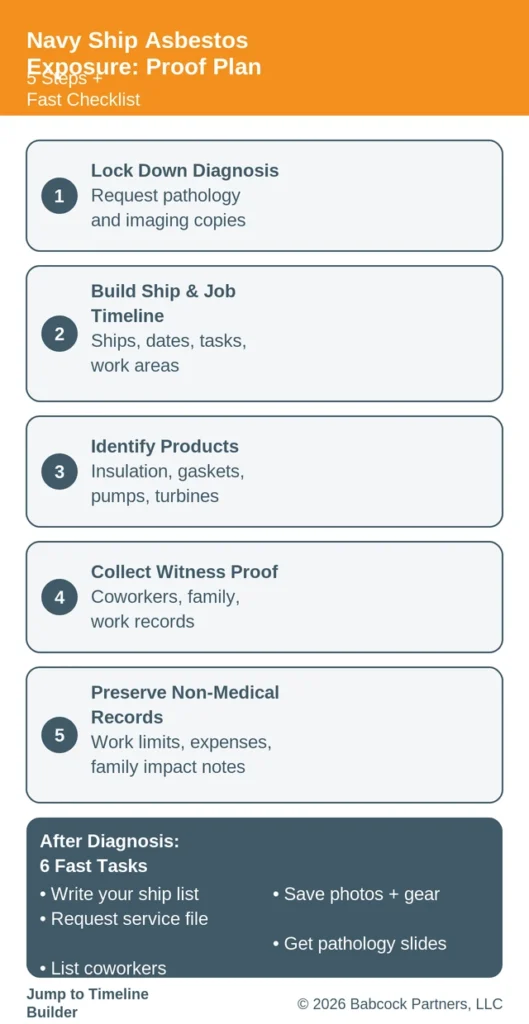
When you can clearly explain the timeline, it becomes easier to identify defendants and missing records without guessing. If you want a deeper look at how we build proof in these cases, review our mesothelioma practice page and then return to this timeline table as your working checklist.
That is what we mean by leverage when we say “trial-ready preparation.” A clean timeline limits the defense’s ability to reframe the facts as vague or unprovable.
Defense Audit: Match Each Claim to a Record
Most asbestos cases turn into a record-matching contest: a defense claim on one side, and a document on the other. If you build the record with those claims in mind, you reduce the chance of surprise later.
| Common Defense Theme | Evidence Anchor to Gather |
|---|---|
| “No asbestos on that ship or in that job.” | Service records, ship assignments, rating history, and task descriptions tied to work areas. |
| “Exposure was too low to matter.” | Product identification notes, witness statements, and details about frequency and proximity. |
| “Other causes explain the illness.” | Complete medical history, job history, and a consistent exposure narrative supported by records. |
| “Normal imaging means no disease.” | Pathology confirmation, specialist documentation, and a dated set of reports that show the full picture. |
| “You are fine now, so damages are minimal.” | Work limitations, expense logs, and family-impact notes kept in real time. |
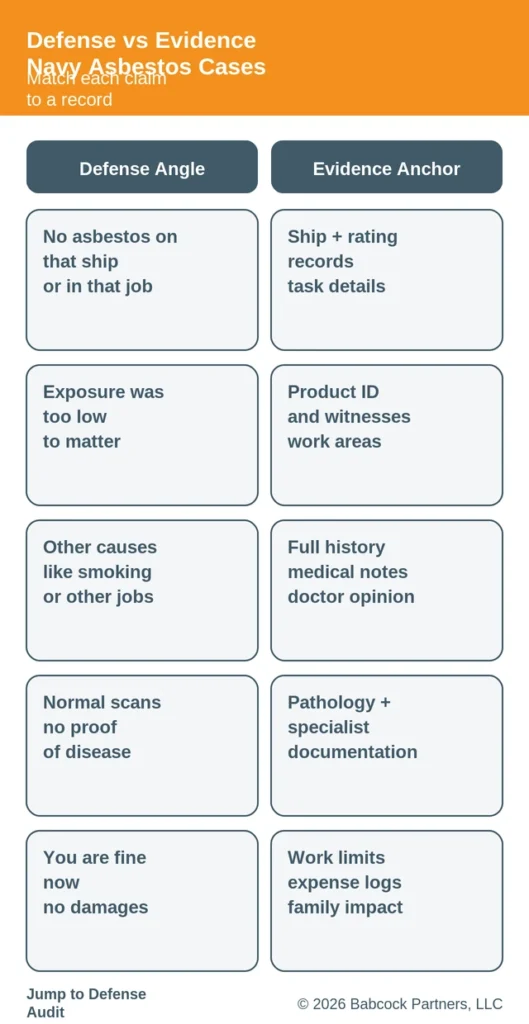
This is why we focus on “proof gaps” before a defendant points them out. When a file already answers the predictable angles, settlement discussions tend to be more grounded.
What we see in practice
We see families who are doing the right thing medically but are missing basic paperwork that proves where exposure occurred. We also see defenses built around “missing links,” such as an unclear ship list, no witness list, or no product identification story.
- Medical records exist, but they are split across providers and never organized into one index.
- Work histories are described in general terms, which invites the defense to call them “assumptions.”
- Family members can describe the work and the dust, but no one wrote down the details early.
- Expense and limitation tracking starts too late, which makes impact proof harder than it needs to be.
What Should You Do Next?
Start by getting care and collecting records, then decide on legal strategy with clear facts in hand. If you try to do it in reverse, you may lose time to preventable document gaps.
- Ask for your key medical documents in writing, and track what you requested and when.
- Build your ship-and-job timeline using the table above, then refine it as records arrive.
- Identify witnesses and save contact information so statements can be taken while details are clear.
- If you live in Baton Rouge or elsewhere in Louisiana, use our Baton Rouge page to find local resources and office locations.
Also, do not let unrelated topics blur the asbestos record. For example, if you are dealing with a separate chemical incident, keep that documentation separate and consider reading our Baton Rouge toxic exposure page so the issues do not get mixed together.
Download the printable toolkit (PDF) and share it with whoever is helping you gather records. It includes both infographics plus a one-page quick start checklist you can mark up by hand.
Louisiana Law Snapshot (Updated 2026)
Louisiana generally gives two years to file a delictual (tort) claim, and La. Civ. Code art. 3493.1 is the key starting point for understanding that deadline. Louisiana also uses comparative fault, and La. Civ. Code art. 2323 reflects a post–Jan. 1, 2026 rule that can bar recovery if a claimant is 51% or more at fault for causes of action arising on or after that date.
- Two-year prescription: Do not assume you can “wait and see” once you suspect an asbestos-related disease.
- Comparative fault: Fault arguments can reduce recovery, and for certain newer cases the 51% bar can apply.
- Practical takeaway: Talk to a lawyer quickly if you are unsure when the deadline clock started on your facts.
This Louisiana law snapshot is intentionally high-level because timing questions in latent-disease cases can be fact-specific. If you are trying to coordinate medical care, VA paperwork, and civil options at the same time, getting clarity early can prevent a deadline surprise.
Free Case Review: Build Leverage Before Records Vanish
We are not built for volume. We are built for leverage. That approach is what we call the Babcock Benefit: we move quickly to preserve evidence and prepare the file like it could be tried. If you want to discuss next steps, call (225) 500-5000 and use the free case review form, and consider reading more about how we approach these cases when you talk with our asbestos disease team.
Urgency in Navy asbestos cases is not about hype. It is about records, witnesses, and clarity while you still have access to the right information. It is also about protecting your options under Louisiana deadlines.
These items are helpful to have with you when you call, but do not delay calling because you do not have them. If you have them handy, keep them nearby for the call.
- Your DD-214 or service paperwork (if available)
- A list of ships, shipyards, and years served
- Diagnosis paperwork (pathology or imaging summaries)
- A list of prior civilian jobs and dates
- Names of potential witnesses
Call Today If…
- You were recently diagnosed and do not have copies of the pathology or imaging reports yet
- You are unsure which ships, work areas, or tasks involved asbestos materials
- A company, insurer, or investigator contacts you and asks for a statement or paperwork
- You are worried a Louisiana deadline may be running
What Happens Next
- Evidence triage: we identify the missing documents and the fastest way to request them
- Deadline spotting: we map key dates and confirm what timing rules may apply
- Insurer and defense strategy: we plan communications to avoid preventable proof traps