

A DUI arrest can become the headline after a serious crash, but the civil case cannot stop at the arrest report. A blood-alcohol result may help establish impairment. It does not, by itself, show which driver crossed the centerline, entered against a light, or failed to brake.
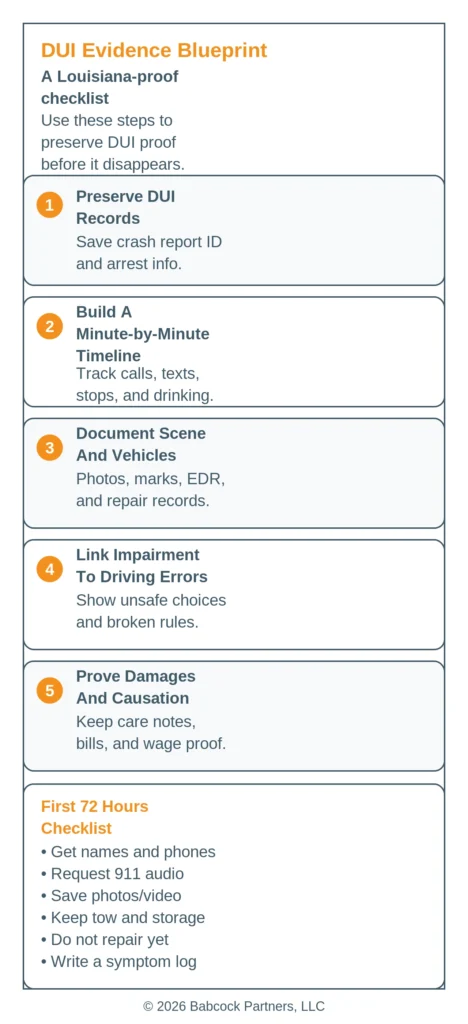
The strongest injury claim usually connects three records: the driver’s condition, the driving mistake, and the harm caused by the impact. That means building a timeline from what witnesses saw before the crash, what the vehicles did, what officers observed afterward, and when any breath or blood test occurred. Our guide to the first steps after a DUI crash covers the broader claims process. This article explains how the proof fits together.
Separate the test result from the crash time
Begin with the collision, the 911 call, officer arrival and any medical transport. Then add the times of field sobriety observations, breath testing or a blood draw. A test performed later is a separate event in the timeline; its significance cannot be assessed without that context.
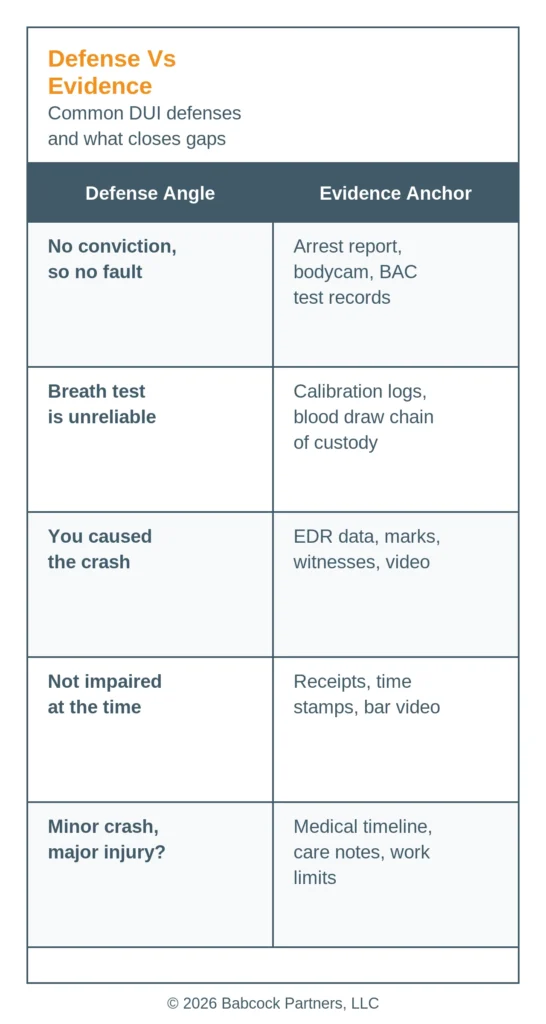
Keep the original testing records, not just a summary or a number quoted in an arrest report. Questions about collection, handling, laboratory work and equipment records may matter if reliability is disputed. A booking entry shows a procedural event. It does not substitute for the underlying observations or test documentation.
R.S. 14:98 defines Louisiana’s operating-while-impaired offense and includes a blood-alcohol concentration of 0.08 percent or more as one statutory condition. The statute also covers impairment by alcohol, drugs, or a combination of both. A civil injury claim still requires proof of fault and resulting harm under Civil Code article 2315. A result below 0.08 does not finish that civil analysis, just as a result at or above 0.08 does not reconstruct the collision.
Identify who holds the records
The investigating agency may hold body-camera footage, dash-camera footage, dispatch information and officer notes. A nearby business or home may have recorded the road. A tow yard may have the vehicle, while a separate company holds electronic data. A witness may have a video that was never given to police.
Write down the agency, report number, exact location, direction of travel and possible camera locations. Save witness contact details and the photographs, messages and recordings already in your possession. A preservation request should identify the evidence and the person or business that controls it. That matters because a police agency, tow yard, vehicle owner, restaurant, phone provider, and vehicle-data vendor may each hold a different part of the record.
Prompt action is important before repairs, salvage or routine overwriting remove evidence. Preserve material through lawful access and appropriate requests. Not every record is public, and some records may require consent, a subpoena, or another court process.
Match the driving error to independent evidence
A rear-end collision may call for examination of braking, vehicle data and video. A lane departure may be better explained by road markings, scrape patterns, debris and witness accounts. An intersection crash may turn on signal information, sight lines and the point of impact. The relevant evidence depends on the disputed movement.
NHTSA describes how alcohol impairs driving abilities, but that general information does not reconstruct a particular collision. Evidence from the actual scene is needed to test whether impairment contributed to the mistake alleged. Vehicle data should also be interpreted in context rather than treated as a complete account of the crash.
Keep uncertainty visible. If two records give different times, note the discrepancy and identify what could resolve it. Do not silently choose the time that best fits the claim. A useful chronology tells the reader both what is established and what remains unknown.
What a dispute about the evidence may involve
A challenge to the test’s reliability calls for testing and handling records. A dispute about whether the driver was impaired at the relevant time calls for the chronology and contemporaneous observations. An allegation that another driver contributed calls for the road and vehicle evidence. These are different disputes and may need different proof.
Injury causation is another issue. Preserve treatment dates, symptom history, work restrictions and records of functional changes. Those records help assess whether the claimed losses follow from the collision. For the wider investigation, see our car accident page; families dealing with a death can also consult the fatal crash resource.
A changed criminal charge does not answer the civil question
A reduced charge or lack of conviction does not necessarily prevent a civil injury claim. Officer observations, admissible testing evidence, video, witnesses and physical evidence may still support it. Conversely, an arrest does not establish every element of liability or the amount of damages.
The civil filing deadline deserves attention while the criminal case is pending. Civil Code article 3493.1 generally provides two years for delictual injury actions arising on or after July 1, 2024; earlier claims may be governed by the former shorter period. Other rules may affect the calculation.
For claims governed by the version of Civil Code article 2323 effective January 1, 2026, the injured person’s negligence of 51% or more bars recovery, while a lower percentage proportionally reduces damages. The applicable version depends on the claim’s dates. Evidence of impairment does not make the allocation of fault irrelevant.
If you need help preserving records for a Louisiana impaired-driving injury claim, contact Babcock Injury Lawyers. The report number, investigating agency and location of the vehicles are useful starting points.
Last reviewed: September 26, 2026. Sources checked: September 27, 2026.
This article provides general Louisiana legal information. Evidence access, admissibility, responsibility and deadlines depend on the particular claim.