

After a boat accident, account for everyone before worrying about damage, insurance, or photographs. A missing passenger, breathing difficulty after submersion, or a disabled vessel in an unsafe position calls for immediate help. Once people are safe, the next tasks are reporting the incident and keeping the boat, witness accounts, and navigation records available for investigation.
Get help without creating another emergency
Call emergency services and give your location, the number of people involved, and the nature of the problem. Render assistance only within safe limits. Fire, a moving propeller, current, unstable wreckage, and a sinking vessel can endanger rescuers as well as passengers.
A person who experienced non-fatal drowning needs medical evaluation even if they seem better after rescue. MedlinePlus explains why breathing complications and other injuries require prompt attention. Do not delay treatment to complete a report or collect evidence.
Head injuries also deserve attention. Concussion symptoms may appear later; new or worsening symptoms should be reported to a medical provider. Tell the provider about the impact, any loss of consciousness, and any time spent underwater. Our concussion-symptom discussion distinguishes ordinary symptoms from emergency warning signs.
Louisiana reporting changed in 2026
R.S. 34:851.10, as amended by Act 84 of 2026, requires practicable assistance and written identifying information, so far as the operator can act without serious danger to the vessel, crew, and passengers.
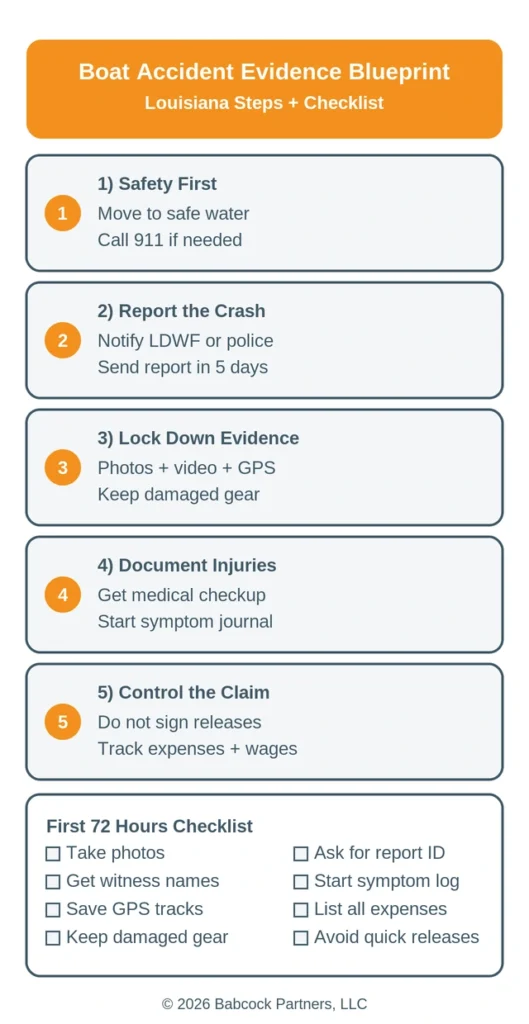
Under the amendment effective August 1, 2026, an incident involving a recreational vessel requires immediate notice when it results in death or injury, damage to vessels and other property totaling at least $2,000, or complete loss of a vessel. Notice goes to LDWF, the nearest law enforcement agency, or State Police. The operator must also send the department-approved incident report within five days. If the operator cannot file, people aboard must notify LDWF or determine that a report was submitted.
Keep the responding agency’s name, report number, and a copy of what you submit. Confirm current forms and submission instructions with LDWF. An insurer’s claim form is not a substitute for the required agency report.
Before the boat is repaired or moved again
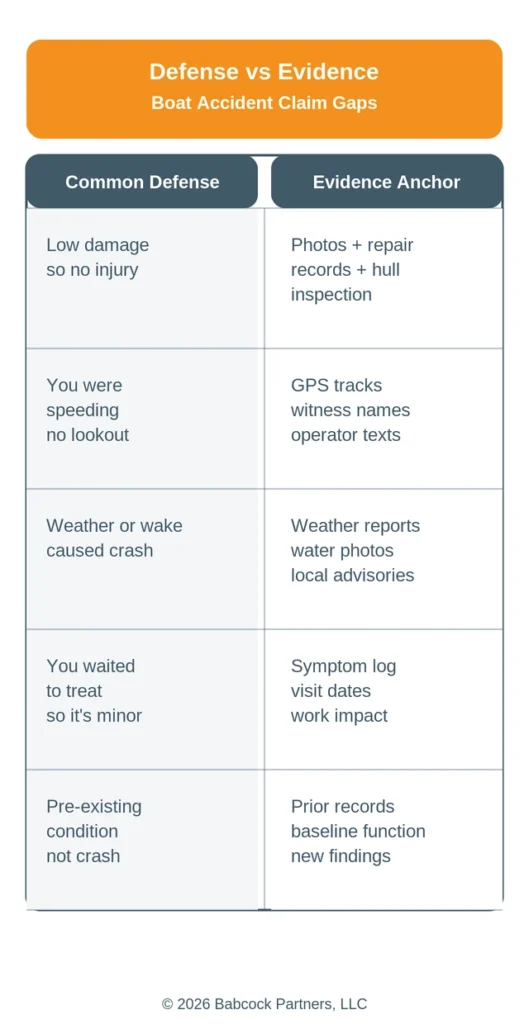
Rescue, safe recovery, and necessary hazard control come first. When conditions permit, document the vessel’s position and damage before further changes. Include registration numbers, the hull, steering and engine area, broken components, safety equipment, and the dock or shoreline involved.
Keep track of where the boat is towed or stored and who has access to it. Arrange for relevant parts and damage to be documented before repairs or disposal. If something must be changed for safety, record what was done, when, and by whom. Do not restart damaged machinery merely to test a theory about the accident.
Waterway conditions are part of the evidence. Record the location, direction of travel, lighting, visibility, wake, weather, and nearby traffic as you observed them. Ask passengers and independent witnesses for their own accounts. A witness who saw the boats before impact may answer a different question from someone who arrived during the rescue.
Save navigation data in its original form
Chartplotter tracks, GPS data, cameras, phones, and trip messages can help reconstruct movement and timing. Preserve original files and devices where practical, rather than relying only on a screenshot or edited clip. Avoid resetting equipment or overwriting the trip while trying to export it.
A track is useful only when someone understands what it records. The device, settings, clock, gaps, and relationship to other evidence may all matter. Do not turn an uncertain speed estimate into a precise claim just because it appears on a screen.
Keep a separate record of medical visits, symptoms, work restrictions, and expenses. Describe changes accurately and report new symptoms when they arise. If treatment is delayed or interrupted, record the reason. These notes should reflect what happened, not a reconstructed story designed around an insurance question.
Identify the operator, owner, and purpose of the trip
The person at the controls, vessel owner, rental company, charter operator, or maintenance provider may each have different responsibilities. Fault depends on the conduct or condition that contributed to the injury. Ownership alone does not answer every question.
If the trip was a paid fishing charter, keep the booking confirmation and identify the guide and vessel. Our Louisiana fishing-charter insurance guide explains which license, credential, and commercial marine policy records to investigate.
Louisiana’s general fault rule appears in Civil Code article 2315. A defective-product claim can require analysis under the Louisiana Products Liability Act. Keep rental agreements, maintenance records, repair invoices, and insurance documents so those possibilities can be evaluated against actual facts.
Boating incidents may also fall under federal maritime law. 28 U.S.C. § 1333 addresses admiralty jurisdiction, and Sisson v. Ruby illustrates why a recreational vessel can raise maritime questions. Location and the activity involved need to be assessed before choosing the governing rules.
Check the governing law before assuming a deadline
For many Louisiana delictual claims arising on or after July 1, 2024, Civil Code article 3493.1 provides a two-year period beginning when injury or damage is sustained. Earlier incidents and special claims require separate analysis. Do not assume that this state-law period governs every boating injury.
The version of Louisiana’s comparative-fault rule effective January 1, 2026 bars recovery at 51% or greater negligence and reduces damages below that threshold. Whether that rule governs a particular boating claim depends on the applicable law and incident date. Maritime issues cannot be resolved simply by treating the boat like a car.
If someone died, survival and wrongful-death questions require attention to the proper claimants and governing law. Suspected impairment may also affect the investigation, including Louisiana’s watercraft testing provisions.
Notify the relevant insurer promptly and keep communications factual. Before signing a settlement release, find out which parties and claims it covers and whether the injury and coverage picture is sufficiently clear. Ask about the basis and scope of requests for recorded statements or medical authorizations.
Our Baton Rouge boat accident practice can assess the incident, reporting, preservation, and deadline questions. For planning future trips, our boating safety guide addresses preparation, lookout, weather, and equipment.