

Shreveport police said a driver encountered ice on an I-20 westbound off-ramp, left the roadway, overturned, and struck a concrete bridge column early on January 30, 2026. The driver died at the scene.
What happened on January 30, 2026?
The Shreveport Police Department release describes a blue Chevrolet Blazer and places the crash at the Linwood and Pierre Avenue off-ramp at about 2:30 a.m. KSLA, citing the Caddo Parish Coroner’s Office, identified the driver as 33-year-old Tremaine Jones and reported that toxicology testing was ordered as standard procedure. Ordering that testing does not establish impairment.
What is confirmed, and what remains unresolved
Scroll horizontally to see all columns. Use the arrow keys when the table is focused.
| Confirmed in the public record | Not resolved by the public record |
|---|---|
| Single-vehicle rollover at the I-20 westbound off-ramp near Linwood and Pierre Avenue | The vehicle’s speed, steering, braking, and stability-control data |
| Police said part of the ramp remained covered in ice | When the ramp was inspected or treated and what roadway-condition records show |
| The Blazer left the road, overturned, and struck a bridge column | Whether vehicle condition or another factor contributed to the loss of control |
| The investigation was ongoing when SPD issued its release | The completed crash reconstruction and toxicology findings |
The distinction matters because a preliminary report can describe what officers found without resolving every cause. The public sources do not establish civil liability against any person or public body. That conclusion requires the completed investigation and the records behind it.
Records that may explain an ice-related rollover
Ice can disappear within hours. The National Weather Service explains that bridges and overpasses freeze before other surfaces, which makes the timing of photographs, treatment logs, weather observations, and roadway inspections important.
- SPD’s crash report, diagrams, photographs, supplements, and 911 or dispatch records
- Roadway inspection, closure, and treatment records for the off-ramp
- Weather observations for the hours before and after the crash
- The Blazer’s tow and storage history, inspection, maintenance records, and available event data
- Coroner records and the final toxicology result
- Any camera footage or witness account showing the ramp before the collision
A practical order for preserving records
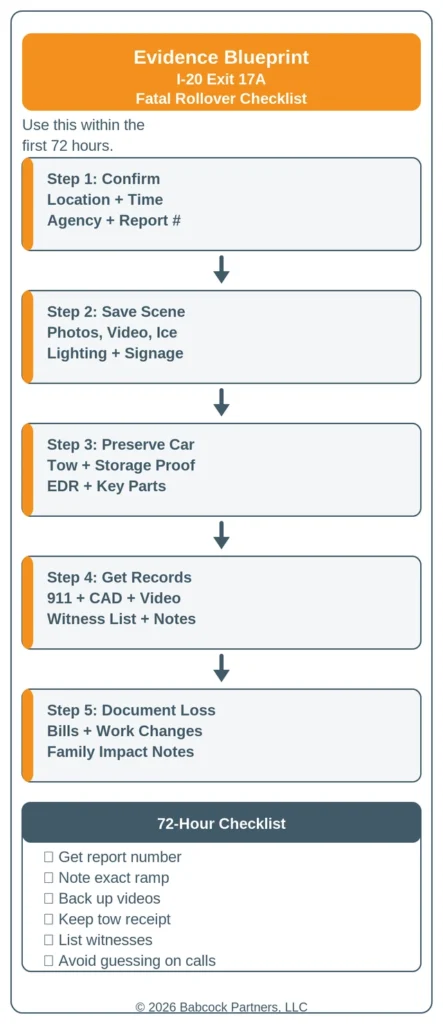
After a recent crash, one family member can keep a timeline and a record-request log. Start with material that may disappear, then add records as they become available. These steps are useful even if the first 72 hours have already passed.
- Confirm the investigating agency, report number, precise ramp location, and tow yard.
- Back up available scene photographs, dashcam clips, witness details, and messages. Ask promptly about preserving nearby camera footage; retention periods vary.
- Keep tow and storage paperwork. Discuss preservation before the vehicle or its parts are released, repaired, or disposed of.
- Track requests for dispatch records, crash-report supplements, roadway-treatment records, and any available camera recordings.
- Add medical, EMS, coroner, expense, and work-loss records to the same file as they become available. Access rules and release times differ.
Request records from the agency that investigated
The investigating agency controls the crash report. Our guide to obtaining Louisiana State Police and local crash reports explains why a city-police report will not necessarily appear in the state portal. The Louisiana crash-evidence guide discusses how photographs, video, witness statements, vehicle data, and official records fit together when fault is disputed.
The Louisiana State Police Traffic Records Unit explains its separate procedures, including in-person purchases of fatal-crash reports at a Troop office. Those instructions do not make LSP the records custodian for this city-police investigation; begin with SPD.
Keep the account consistent as more records arrive
Write down who provided each fact and when. If an insurer asks about an unanswered question, avoid guessing. Keep copies of letters and proposed releases, and review what a release would settle before signing it. You do not need a complete investigation file before asking for legal help.
Questions the records may answer
A single-vehicle crash still requires a careful investigation. Scene photographs and weather records may show where ice was present; treatment logs may explain what was done beforehand. Vehicle inspection and available event data may help reconstruct the sequence. Medical and coroner records document the injuries and death. None of those questions should be answered from a headline alone.
Louisiana wrongful-death and survival claims require proof of fault
Louisiana Civil Code article 2315.2 permits listed family members to bring a wrongful-death action when a person dies because of another’s fault. Article 2315.1 addresses the survival of the deceased person’s own claim. They are different causes of action, and neither arises merely because a fatal crash occurred.
In a single-vehicle collision, the investigation must first show whether someone or something legally attributable to another party contributed to the death. Ice mentioned in a police release is an important fact, but it is not by itself a finding that another party is liable. Our Shreveport wrongful-death lawyers explain the broader claim framework.
Civil Code article 3493.1 generally provides a two-year prescriptive period for delictual actions, beginning when injury or damage is sustained. Articles 2315.1 and 2315.2 contain their own current timing language. The current general language in articles 2315.1 and 2315.2 uses the longer of one year from death or two years from injury or damage; special provisions and the applicable version of the law still matter. Families should identify the potential parties and applicable deadlines from the actual records rather than relying on one general calendar rule.
Fault is another separate issue. Under the version of Civil Code article 2323 effective January 1, 2026, negligence of 51% or more bars recovery under the general comparative-fault rule; a lower share reduces damages proportionately. Paragraph C provides an exception involving an intentional tortfeasor. The public reports here do not assign a civil fault percentage.
Questions and records for a fatal rollover investigation
- Could road conditions help explain a single-vehicle crash?Records to examine include ice and temperature information, ramp photographs, road-treatment records from the Department of Transportation, and the crash diagram.
- What if no independent witness is available?Potential sources include 911 calls, dispatch records, body-camera footage, nearby cameras, and any witness contact information.
- Could injury severity be disputed despite limited visible vehicle damage?Relevant records may include emergency medical services and emergency-room records, the death certificate, any autopsy report, and the timeline of events.
- What evidence bears on seat-belt or impairment arguments?Records may include toxicology results, the report’s restraint observations, available airbag data, and responding personnel’s observations.
- Could a vehicle problem be relevant?Preserve the Blazer for an appropriate inspection and assess any available event-data recorder data, repair history, and recall information.
Discuss the records and your next steps
If your family needs help after a fatal crash, call Babcock Injury Lawyers at (225) 500-5000 or use the free case review form. A report number, tow paperwork, available photographs, and a short list of questions can help start the conversation; a complete file is not required.
Situations worth addressing promptly
Seek advice promptly if a vehicle may be released or destroyed, camera footage may be overwritten, or someone is asking you to sign a settlement release before you understand the facts.
What the conversation can cover
We can discuss which evidence to preserve, which records to request, possible deadlines, and communications with insurers. Our Babcock Benefit explains the firm’s approach. You can also read client reviews or find office and service-area information before you contact the firm.
Learn more about Stephen Babcock, a Louisiana attorney with Babcock Injury Lawyers.
This article provides general information based on the cited public reports. It does not establish the cause of this crash, an attorney-client relationship, or an outcome for a particular claim.
Sources
- Shreveport Police Department, January 30, 2026 fatal-crash release.
- KSLA, Man heading home from casino killed in rollover wreck on I-20 in Shreveport.
- National Weather Service, Ice Storms and black ice.
- Louisiana Civil Code article 2315.1.
- Louisiana Civil Code article 2315.2.
- Louisiana Civil Code article 3493.1.
Earlier source-check date: September 28, 2026.
Earlier review date: September 26, 2026.