


Editorial & Legal Accuracy Notice (Louisiana)
This blog contains general legal and safety information and is not legal advice. Laws and deadlines can change, and outcomes depend on specific facts.
Last reviewed / updated: March 3, 2026
Reviewed, updated, and authored by: Stephen Babcock, Louisiana injury lawyer
This rewrite summarizes publicly available information about a fatal rollover near Shreveport and explains practical evidence steps families can take while the investigation continues.
On January 30, 2026, public reporting described a fatal rollover on an I-20 off-ramp in Shreveport near Exit 17A during icy conditions. When a crash is fatal, families often have to juggle grief, police questions, and insurance calls at the same time. The problem is that evidence changes fast—vehicles get towed, videos overwrite, and the road surface can look different by daylight. This post lays out a calm, Louisiana-specific checklist for what to document next while you wait for the official findings.
We summarize what is publicly confirmed and avoid speculating about unknown causes. If you are a family member, your job right now is to preserve documents and let investigators do their work. A short timeline and a record-request tracker can keep you from repeating stressful calls.
Our approach is to treat the first few days like an evidence project, not a paperwork chore. We are not built for volume. We are built for leverage. Speed + evidence preservation + insurer-insider knowledge + trial-ready preparation = The Babcock Benefit. In a Shreveport fatal rollover, that leverage often comes from preserving the vehicle, scene conditions, and record requests early.
If you are inside the first 72 hours, call (225) 500-5000 or use the free case review form before evidence changes.
Firm links: Client Reviews | Contact | Locations
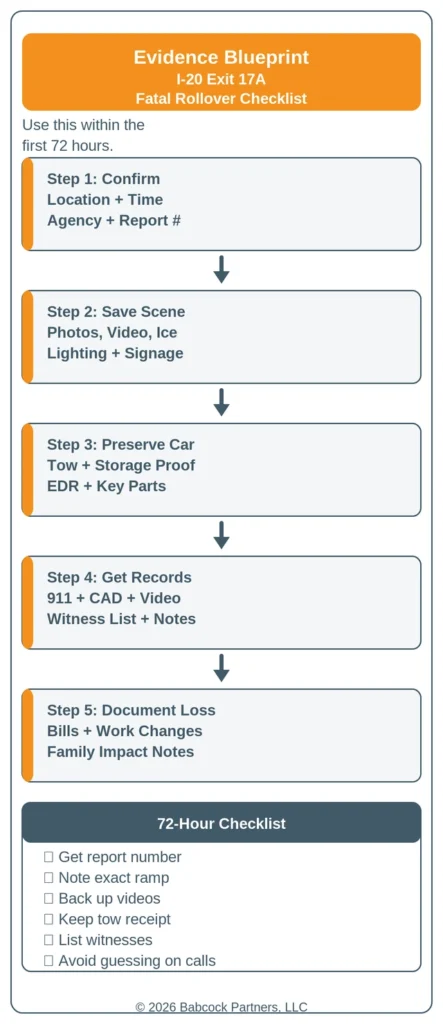
Prefer a checklist you can print? Download the printable toolkit (PDF) and keep it with your notes. The toolkit includes both infographics plus a record-request tracker.
What Happened in the Jan. 30, 2026, Fatal Rollover on I-20 in Shreveport?
A Shreveport Police Department press release states that officers responded around 2:30 a.m. on January 30, 2026, to the I-20 westbound off-ramp at Linwood and Pierre Avenue, where a Chevrolet Blazer was found overturned, and the driver was pronounced dead at the scene. KSLA’s coverage reports the crash was near Exit 17A by Lakeshore Drive and Linwood Avenue and identified the driver as 33-year-old Tremaine Jones.
| Quick Facts (Publicly Reported) | Details |
|---|---|
| Approx. time | About 2:30 a.m. on January 30, 2026 |
| Location | I-20 westbound off-ramp near Linwood and Pierre Avenue (Exit 17A area) |
| Vehicle | Chevrolet Blazer (reported) |
| Conditions mentioned | The SPD release references ice at the time of the crash |
| Status | Investigation ongoing |
Because a fatal crash can involve multiple record-keepers, treat the first week as a documentation project. If your family is facing a sudden loss, our fatal car accident practice page explains the evidence-preservation mindset we use while investigators finish their work.
Early updates can change when investigators review vehicle data, roadway conditions, and coroner records. Write down what you can confirm, and avoid filling gaps with assumptions you later have to unwind.
What Is Confirmed vs What Is Still Unclear Right Now?
Public reporting confirms the general location and that the crash was a single-vehicle rollover with a fatal outcome. The unanswered questions usually involve why the vehicle left the roadway and what factors, if any, outside the driver played a role.
| Confirmed in Public Sources | Not Yet Publicly Detailed |
|---|---|
| Single-vehicle rollover and fatality | Exact sequence of events (steering, braking, impact angles) |
| Exit-ramp area near Linwood / Lakeshore | Whether roadway treatment occurred before or after the crash |
| Icy conditions were mentioned | Vehicle data findings (speed snapshots, braking, stability control) |
| Investigation is ongoing | Toxicology and other coroner-related findings |
The SPD release states the driver was traveling home from a local casino and encountered ice before leaving the roadway and striking a bridge column. KSLA reports that toxicology testing was ordered, which is one reason early conclusions can be premature.
Why Evidence Can Disappear Fast After an Ice-Related Rollover
In winter crashes, the scene can change quickly when temperatures rise, traffic resumes, and crews treat the roadway. If the case later turns on ice, lighting, signage, or ramp conditions, early documentation often matters more than later memories.
- Scene photos and video showing ice, debris patterns, and any visible scrape or tire marks
- Roadway-condition proof, including treatment times, temperatures, and any closures
- Video sources that overwrite fast, like business cameras and dashcams
- Vehicle preservation, including tow and storage records and any downloaded data
- Witness contact info and short written statements made while details are fresh
The National Weather Service’s ice and frost guidance explains that bridges and overpasses can freeze before other road surfaces, which is one reason exit ramps can surprise drivers on cold nights. A Louisiana DOTD bridge warning similarly highlights that bridges freeze first, so the window to document an off-ramp surface can be short. This is why we push to secure photos, tow paperwork, and a simple call log before the story hardens.
Timeline Builder: The First 72 Hours for Families and Witnesses
The fastest way to protect a fatal rollover claim is to build a simple timeline and then request records in the right order. You do not need every answer on day one, but you do need to preserve what will disappear first.
- Day 0-1: Confirm the agency, report number, exact ramp location, and where the vehicle was towed.
- Day 1-2: Back up photos, dashcam clips, and any videos from witnesses or nearby businesses.
- Day 2-3: Request 911 audio, dispatch logs, and any bodycam footage while retention windows are still open.
- Day 3-7: Gather coroner, EMS, and hospital records and build a single folder for bills and receipts.
- Week 2+: Keep adding dates and documents so the timeline stays consistent as new facts come in.
If you were driving in that area, NHTSA’s winter driving tips emphasize slowing down and leaving more distance on icy roads, which can also help explain why ramps deserve extra caution in cold snaps. For witnesses, write down what you observed and save any dashcam video before your phone overwrites it.
How Crash Reports and Records Usually Work in Louisiana
Getting the right report is not always as simple as downloading a PDF, especially when a crash involves a fatality. Start by confirming which agency investigated, then request supporting records like 911 logs, photos, and any bodycam footage.
- Investigating agency: Police report, supplements, diagrams, and photos
- Fire/EMS: Response notes and transport information
- Coroner: Death certificate and any additional files released to family
- Tow/storage: Tow ticket, storage location, release forms, and timeline
- Roadway owner: Maintenance and treatment records when conditions are at issue
The Louisiana State Police crash report portal notes that only crashes worked by Louisiana State Police will appear there, so city-police investigations may require a different request route. The LSP Traffic Records Unit explains that fatal crash reports are not available through the online system and generally must be obtained in person from a Troop office.
That is what we mean by leverage when insurers start calling: when you control record requests, you do not have to rely on someone else’s summary of what happened. If an adjuster asks for a recorded statement, it is reasonable to slow the process down and avoid guessing about facts you have not confirmed.
What we see in practice
In fatal rollover investigations, the early narrative often forms before families have the report, and small gaps can grow into big arguments later. We see the strongest files when someone preserves the vehicle and key records early, even while the agency investigation is still pending.
- Video gets overwritten in days, especially from private cameras and dashcams
- Tow yards release vehicles quickly unless someone documents storage and holds
- Weather and ice conditions change, making later scene photos less useful
- Early calls with insurers can lock in mistaken details if someone guesses
- Families lose time when records are requested from the wrong agency
If you are trying to help from a distance, pick one person to keep the timeline, store documents, and write down who said what. This is why we treat the first phone call as evidence triage, not paperwork, because the record is easier to build before documents scatter.
Defense Audit: Common Questions and the Records That Answer Them
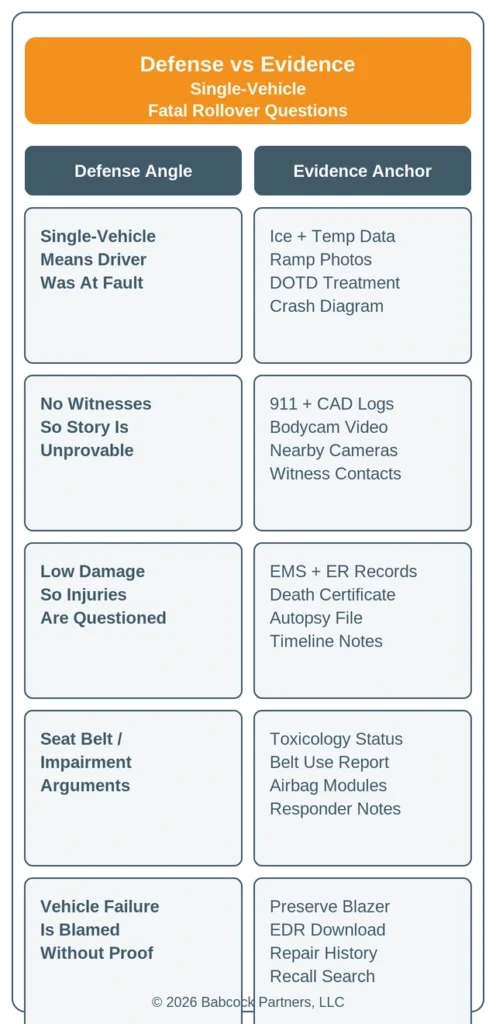
Insurers and defense teams tend to ask the same set of questions in a single-vehicle fatal rollover, because those questions shape fault and value. You can protect your family by gathering records that answer those questions without guessing.
| Common Question | Records That Usually Help |
|---|---|
| Was ice present and where? | Photos/video, temperature data, DOTD treatment logs, closure notices |
| What did the vehicle do before impact? | Crash diagram, witness notes, EDR data, tow and storage timeline |
| Were there contributing roadway issues? | Lighting/signage photos, barrier condition notes, prior complaints if any |
| What do official records show? | Police supplements, 911/CAD logs, EMS notes, coroner documents |
| Are there alternative explanations? | Vehicle inspection/repair history, recall research, preservation of key parts |
That is what we mean by leverage: the better your documentation, the less room there is for “maybe” explanations that shift blame. Our job is to build the record so negotiations start with facts, not assumptions.
If you want the same steps in one place, Download the printable toolkit (PDF) before you start making record requests. A single checklist helps you avoid duplicate calls and missed documents.
Louisiana Law Snapshot (Updated 2026)
The Louisiana Legislature’s text of La. Civ. Code art. 3493.1 sets a two-year prescriptive period for most delictual (tort) claims, so waiting can shrink both evidence and legal options. Under La. Civ. Code art. 2323, fault is compared among parties, and for incidents on or after January 1, 2026 a claimant who is 51% or more at fault cannot recover damages under Louisiana’s comparative-fault rules.
| Rule | Plain-English Takeaway |
|---|---|
| Two-year prescription | Most tort claims have a two-year filing deadline, and evidence tends to degrade long before that. |
| Comparative fault | Fault can reduce recovery, and for certain claims after Jan. 1, 2026, being 51%+ at fault can bar recovery. |
The Louisiana Legislature’s text of La. Civ. Code art. 2315.1 addresses the survival action, which can cover certain damages that existed before death. The Legislature’s text of La. Civ. Code art. 2315.2 addresses the wrongful-death action, which can cover certain losses suffered by qualifying family members.
Free Case Review: Practical Next Steps After a Fatal Rollover
We are not built for volume. We are built for leverage. At Babcock Injury Lawyers, leverage means preserving evidence early and dealing with insurers from a position of documentation, not pressure. Call (225) 500-5000 and use the free case review form so we can help you map the timeline, spot deadline issues, and plan next steps; you can also review our fatal-crash case page for background.
Evidence moves fast after an ice-related rollover because the roadway changes and vehicles get released. Insurance calls can also come before you have the report, and early statements can become a permanent part of the file. That is why we focus on the Babcock Benefit in plain English: fast evidence preservation and trial-ready organization that improves your leverage.
These items are helpful to have with you when you call, but do not delay calling because you do not have them. If you have them handy, keep them nearby for the call.
- The report or incident number and the investigating agency
- Tow yard name, storage address, and any release paperwork
- Names and phone numbers of witnesses or responders you spoke with
- Any photos, videos, or dashcam clips you have saved
- A short list of questions you want answered by the agency
Call Today If…
These situations often have the fastest evidence loss and the highest risk of proof gaps. A quick call can help you preserve what is still available.
- Someone is pressuring you to sign a release or take a quick settlement
- You believe ice, lighting, signage, or a barrier contributed to the rollover
- The vehicle may be moved, repaired, or declared a total loss
- You think there is video from a nearby business, traffic camera, or dashcam
What Happens Next
- Evidence triage: we identify the fastest-expiring items and help preserve them first.
- Deadline spotting: we map the timeline and flag any shorter deadlines that may apply to certain defendants.
- Insurer contact strategy: we plan communications so the record, not pressure, drives the process.