

A Louisiana vehicle-damage claim can include reasonable rental or other transportation costs while a damaged vehicle cannot be used. The source of payment matters. Your own insurer owes only the rental coverage provided by your policy, while an at-fault driver’s insurer may owe reasonable loss-of-use expenses as part of the property-damage claim.
Louisiana law also creates specific consequences when insurer inaction leaves a claimant without a personal vehicle. Those rules use different triggers for first-party and third-party claims, so the claim file should identify who controls the delay, what coverage applies, and why each day of alternative transportation was reasonable.
Three possible paths to payment
- Your rental-reimbursement coverage: If you purchased this optional coverage, the policy controls the daily limit, total limit, eligible vehicle class, and covered period.
- A claim against the at-fault party: Under the general fault principle in Louisiana Civil Code article 2315, reasonable loss-of-use expenses may be part of the damages caused by the collision.
- The insurer-inaction provisions: Louisiana Revised Statute 22:1892(B)(4) addresses certain first-party and third-party delays and may add penalties when the statutory conditions are met.
These paths are related but not interchangeable. A claimant who did not buy rental reimbursement may still pursue reasonable transportation expenses from a legally responsible third party. Conversely, a first-party request depends on the actual policy terms.
How the Louisiana delay rules differ
Scroll horizontally to see all columns. Use the arrow keys when the table is focused.
| Issue | Third-party property claim | First-party policy claim |
|---|---|---|
| Who owns the damaged vehicle? | The claim must involve a personal vehicle owned by the third-party claimant. | The claimant must be an insured entitled to a rental vehicle under the policy. |
| Delay trigger | The claimant is deprived of the vehicle for more than five business days as a direct consequence of insurer inaction in settling the loss. | The insurer does not provide rental coverage within three business days after the insured’s written request. |
| Underlying expense | Reasonable expenses for alternative transportation during the period the claimant is without the vehicle, to the extent the insurer is legally responsible. | Reasonable rental or loss-of-use expenses incurred while rental coverage was not approved. |
| Penalty condition | The insurer fails to pay within thirty days after adequate written proof and demand, and the failure is arbitrary, capricious, or without probable cause. | The failure to provide coverage is arbitrary, capricious, or without probable cause. |
| Important limitation | The claimant must connect the deprivation to insurer inaction, not merely to ordinary repair time or an unrelated shop delay. | The provision does not apply while the insurer is conducting a coverage investigation under a reservation of rights. |
The five-day and three-day periods are not automatic rental entitlements for every crash. They are statutory triggers with factual and proof requirements. The third-party rule, for example, requires a direct connection between insurer inaction and the extended deprivation. The first-party rule requires rental coverage in the policy and a written request.
What counts as a reasonable transportation expense
Reasonableness depends on the circumstances. A standard rental that serves the same basic transportation need is usually easier to justify than an upgraded or specialty vehicle. A larger vehicle may still be reasonable when the claimant needs it for passengers, mobility equipment, tools, or another documented purpose.
A claimant does not need to rent a car in every case. Rideshare charges, public-transit costs, or other substitute-transportation expenses may be relevant if they are tied to the period of lost use and supported by records. Keep the receipts and a short explanation of why the transportation was needed.
For first-party claims, read the declarations page and endorsement. Daily caps, maximum benefits, waiting periods, and eligible classes can limit what the policy pays even when the expense itself was reasonable.
Build a timeline that separates ordinary repair time from avoidable delay
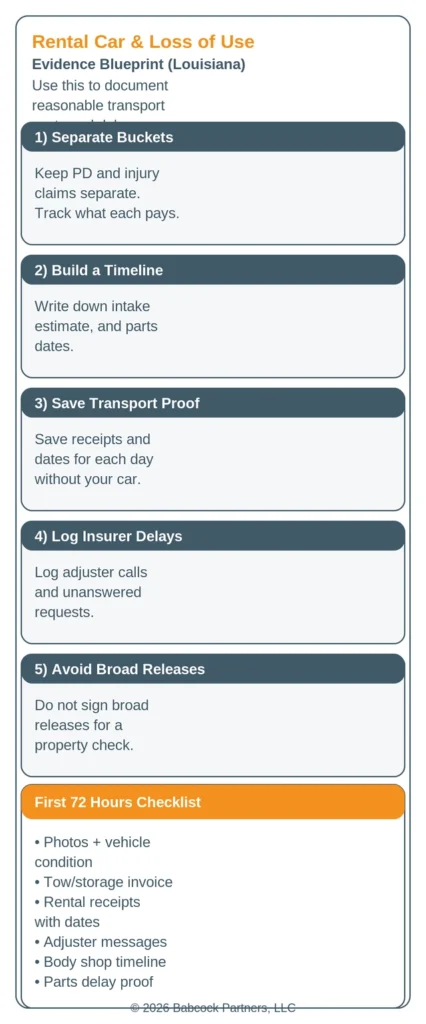
The most useful record is a dated sequence from the day the vehicle became unavailable through the day it was repaired, replaced, or returned. Include:
- the crash, tow, and body-shop intake dates;
- the date the claim was reported and an adjuster was assigned;
- inspection, estimate, and approval dates;
- supplement requests and insurer responses;
- parts orders, backorder notices, and delivery dates;
- repair completion or total-loss decision dates; and
- each rental extension or other transportation expense.
That timeline helps identify who controlled each gap. Parts shortages, additional hidden damage, the shop’s workload, and insurer inaction are different causes. A loss-of-use demand is stronger when it does not attribute every delay to the insurer without supporting evidence.
Documents that answer common insurer objections
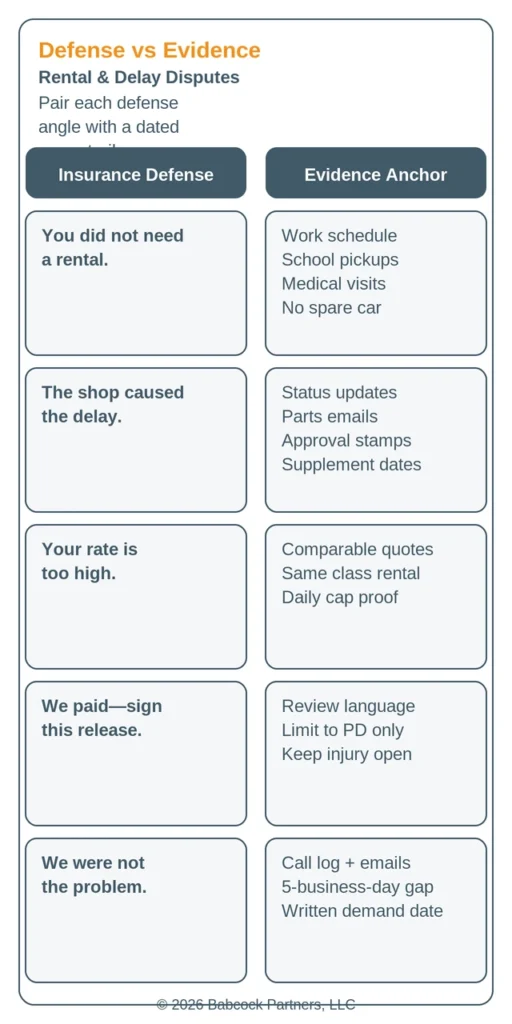
- “The rental was not necessary.” Keep work schedules, school or medical commitments, and a brief record showing that no other household vehicle was available.
- “The daily rate was too high.” Save comparable quotes and explain any need for a particular vehicle size or accessibility feature.
- “The body shop caused the delay.” Obtain shop status notes, supplement dates, parts records, and the adjuster’s approval timestamps.
- “We never received a request.” Send the request in writing and keep the email, portal confirmation, or certified-mail record.
- “The vehicle was already drivable.” Preserve photographs, tow records, repair estimates, and any shop statement explaining why operation was unsafe.
A written demand should identify the claimant, claim number, vehicle, dates of deprivation, transportation expenses, and supporting documents. For the third-party penalty provision, the statute expressly refers to adequate written proof and demand. Keep the demand focused and factual.
Repair claims and total-loss claims do not end the same way
In a repair claim, the disputed period often runs until the vehicle can reasonably be returned, subject to questions about ordinary repair time and avoidable delay. In a total-loss claim, the relevant period may turn on when the insurer communicates the valuation, makes a legally sufficient payment or offer, and gives the owner a reasonable opportunity to obtain replacement transportation. The facts and policy terms matter.
Do not assume a property check resolves only the visible issue. Read any release before signing it. Our article on accepting a property-damage check while an injury claim remains open explains why the wording matters.
If repairs restore the vehicle but reduce its market value, that is a separate issue.
When a rental dispute deserves closer review
Get the file reviewed if an insurer will not identify the covered period, a repair approval has stalled, the total-loss decision keeps changing, storage charges are accumulating, or a proposed release is broader than the payment being offered. A delay can also become more difficult to document after the vehicle moves between a tow yard, shop, and salvage facility.
A Baton Rouge property-damage lawyer can compare the policy language, insurer timeline, repair records, and written demand to the current Louisiana rules.
Firm links: The Babcock Benefit | Client reviews | Locations | Stephen Babcock | Request a case review
Sources checked: September 29, 2026. Last reviewed: September 28, 2026.