


Editorial & Legal Accuracy Notice (Louisiana)
This blog contains general legal and safety information and is not legal advice. Laws and deadlines can change, and outcomes depend on specific facts.
Last reviewed / updated: March, 2026
Reviewed, updated, and authored by: Stephen Babcock, Louisiana injury lawyer
This guide explains how rental reimbursement and rental “loss of use” issues work after a Louisiana crash. It focuses on documentation and claim strategy when your vehicle is in the shop.
Rental bills add up fast when your car is stuck at a body shop and the claim feels stalled. If you are dealing with the repair, valuation, or rental side, our Baton Rouge property damage page explains the bigger property claim categories that often overlap with rental disputes. This post stays narrow and shows how to prove the days, the delay, and the reason you needed alternative transportation.
Our approach is simple: build a dated timeline first, then match every expense to a reason. We are not built for volume. We are built for leverage. Speed + evidence preservation + insurer-insider knowledge + trial-ready preparation = The Babcock Benefit. In a Louisiana rental car loss of use dispute, that leverage comes from clean dates, clean receipts, and clean communication records.
Firm links: Client Reviews | Contact | Locations
If you are inside the first 72 hours, call (225) 500-5000 or use the free case review form before evidence changes.
Want a print-ready version for your claim file? Download the printable toolkit (PDF). It includes a timeline worksheet plus both infographics.
Can You Recover Rental Car Costs in Louisiana While Your Car Is in the Shop?
Often, yes, but the path depends on who owes what and why your car was unavailable. The cleanest claims show that the cost was reasonable and tied to specific days of deprivation.
- Option 1: Your own policy may include rental reimbursement if you paid for it.
- Option 2: A third-party property damage claim may include loss of use when another driver is at fault.
- Option 3: In some situations, Louisiana’s alternative transportation rules apply when insurer inaction causes a long delay.
The general starting point for fault-based recovery is La. Civ. Code art. 2315, which describes the obligation to repair damage caused by fault. In everyday terms, that is the legal backdrop for property damage, related expenses, and loss of use when a vehicle is not available.
Still, “loss of use” arguments get messy because rental disputes are really proof disputes. That is why we push clients to think in two tracks: coverage you bought for yourself versus what the other side owes when liability is clear.
What Does Louisiana’s Alternative Transportation Statute Require?
The alternative transportation language in Louisiana Revised Statute 22:1892 can apply when an insurer’s inaction keeps you deprived of your vehicle beyond certain triggers. When it applies, your record should show the deprivation period and that the transportation expense was reasonable.
- Third-party trigger: You are deprived of your vehicle for more than five business days because of the insurer’s inaction.
- First-party trigger: You made a written request for rental coverage you purchased, and the insurer did not provide it within three business days.
- Practical proof: You have written proof and a written demand that ties the rental to the delay and dates.
In plain language, the statute rewards organized, dated documentation. That is what we mean by leverage because timelines and written demands reduce room for “we never got that” arguments. This is why we treat screenshots, emails, and claim log notes as evidence, not as throwaway details.
For a consumer-friendly overview, Louisiana Department of Insurance’s auto insurance guide explains that when a delay is caused by the other driver’s insurer, the insurer should pay rental costs for a reasonable repair time. The same guide also notes that rental coverage in your own policy only applies if you paid for it, which is why the declarations page matters.
Does Your Own Policy Cover a Rental Car After a Wreck?
Sometimes, but only if your policy includes rental reimbursement coverage and you follow the claim steps your carrier requires. Even then, rental reimbursement usually has daily and total limits, so dates and receipts still matter.
| Question | What to Check | What to Save |
|---|---|---|
| Did you buy rental reimbursement? | Your declarations page and coverage summary. | Policy page screenshots and any written request for a rental. |
| Is there a daily or total cap? | Dollar caps and the maximum number of days. | Rental invoices that show daily rate and class. |
| Is the claim “repair” or “total loss”? | How the insurer is valuing the vehicle and when they made that call. | Valuation report, photos, and the date you got the decision. |
If you are unsure where the rental obligation is coming from, start with the declarations page and then build the timeline. If the claim turns into a broader dispute about repairs, valuation, or delay, our vehicle property damage dispute guidance gives the bigger picture without mixing in injury issues.
What to Ask the Adjuster in Writing
Put key questions in writing so there is a timestamped record. Ask what date they consider the start of deprivation, what they need to approve the estimate, and who is responsible for supplements and parts delays.
- “What is the date you opened the claim and assigned an adjuster?”
- “What date did you receive the estimate and approve it?”
- “If you need more information, what exactly is missing and when did you request it?”
How Do You Prove the Delay Was Not Your Fault?
You prove delay by building a simple, dated chain from “car unavailable” to “car available,” with receipts tied to each day. A good file also separates normal repair time from avoidable claim-handling gaps.
- Start with dates: intake, inspection, estimate, approval, supplement, parts order, and completion.
- Pin down gaps: note where the file sat and who had the next move.
- Attach documents: emails, texts, shop status updates, and parts backorder notices.
- Match expenses to days: keep rental invoices and alternative transport logs.
- Send a short demand: ask the insurer to confirm the covered period in writing.
Timeline Builder: The Dates That Usually Matter
A timeline is the fastest way to reduce arguments. It shows what happened, who controlled the next step, and why the rental continued. This is why we build the timeline early, while emails, texts, and shop notes are still easy to pull.
| Timeline Item | What to Record |
|---|---|
| Deprivation start | Date the vehicle was not safely drivable or was dropped off for repairs. |
| Claim reporting | Claim number, adjuster name, and the first date you notified the insurer. |
| Inspection and estimate | Date inspection was scheduled, performed, and the estimate was issued. |
| Approval and supplements | Approval timestamps and any supplement requests with dates. |
| Parts delay proof | Backorder notices, order dates, and expected delivery updates. |
| Deprivation end | Date repairs were complete or the vehicle was declared a total loss. |
What to Save in the First 72 Hours
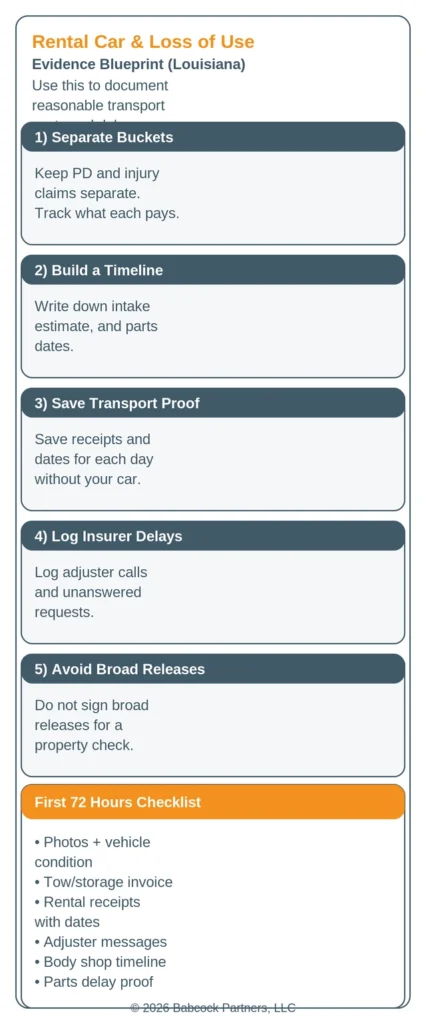
The first 72 hours are where documents are easiest to gather and hardest to recreate later. That is what we mean by leverage because a clean early record prevents later “we cannot verify” defenses.
- Photos of all damage and the interior, plus the mileage.
- Tow and storage receipts and the lot address.
- Rental receipts, rideshare logs, or public transit records tied to dates.
- Body shop intake date, estimate date, and every written status update.
- Any messages showing approvals, delays, or unanswered requests.
Defense Audit: Common Rental and Delay Arguments
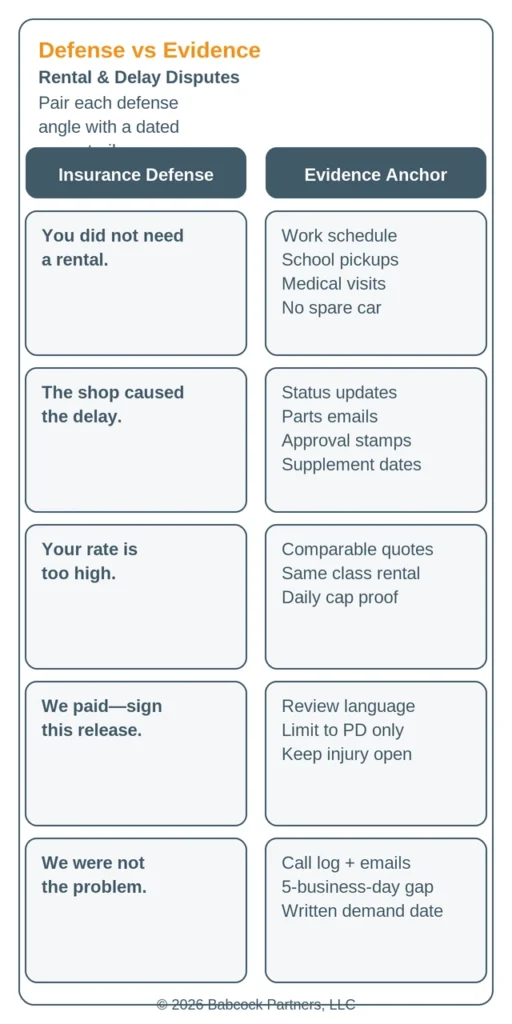
Rental disputes are usually won or lost on documentation, not on speeches. If you can anticipate the defense angle, you can collect the exact record that closes the gap.
| Common Defense Angle | Evidence That Helps |
|---|---|
| “You did not need a rental.” | Work schedule, school pickups, medical appointments, and proof you had no spare vehicle. |
| “The shop caused the delay.” | Status updates, supplement dates, parts emails, and adjuster approval timestamps. |
| “Your rate is too high.” | Comparable quotes, same-class rental proof, and a short note on why the class was needed. |
| “We paid, so sign this.” | The proposed release language, a request for a property-only release, and a copy kept for your file. |
| “We were not the problem.” | Call log, emails, unanswered requests, and the dates that show inactivity gaps. |
Keep your file calm and factual. If you make a written demand, attach the timeline and ask the insurer to confirm the covered deprivation period in writing. Short, dated letters often produce better results than long arguments.
What we see in practice
We see rental car loss of use disputes turn into leverage points because the rental bill creates pressure to take a quick deal. We also see that the strongest files are the ones with dated proof showing who controlled each next step.
- Body shop timelines get blurry when supplements and parts orders are not documented.
- Adjuster silence is hard to prove unless emails and texts are saved and organized.
- Rental companies produce clean invoices, but claim files often lack the “why” for each day.
When the paperwork is organized, the discussion becomes practical: what is the reasonable repair window and what days were caused by avoidable inactivity. That is what we mean by leverage because organized proof makes it harder to minimize the deprivation period.
When Should You Talk to a Lawyer Quickly About Loss of Use?
You should talk to a lawyer quickly when the rental dispute is being used to force a rushed decision, or when the file shows long inactivity gaps that need to be documented. Early help is also useful when you suspect the insurer is treating a property-only issue as a reason to close the whole claim.
- You are being asked to sign a release and you are not sure what it covers.
- Towing and storage charges are piling up and the vehicle may be moved or sold.
- The insurer is not confirming dates, approvals, or the repair plan in writing.
- You are told the delay is “not our problem,” but you have unanswered requests.
- You have questions about how to keep the property claim separate from any injury claim.
If the rental dispute is part of a broader property fight, our property damage practice page explains related issues like total loss disputes, diminished value, and repair estimate conflicts. This is why we focus on evidence preservation early, because once the timeline goes stale, the leverage drops.
Want a copy you can print and keep with your receipts? Download the printable toolkit (PDF). It compiles the timeline worksheet and both visuals into a clean handout.
Louisiana Law Snapshot (Updated 2026)
Most Louisiana crash claims are subject to a two-year delictual prescription period, and missing it can end the claim. The controlling time rule is in La. Civ. Code art. 3493.1, and the safest practice is to calendar it early while you are still collecting records.
- Do not wait on a rental dispute: the claim deadline can run while repairs are ongoing.
- Preserve proof early: receipts and messages are easier to verify when they are fresh.
Louisiana also uses comparative fault, which can reduce recovery when multiple parties share blame. The comparative fault framework is in La. Civ. Code art. 2323, and after January 1, 2026, a 51% bar can apply in the situations covered by that rule.
| Issue | Why It Matters for Loss of Use |
|---|---|
| Prescription | Do not let “we are still working on rental” distract from the filing deadline. |
| Comparative fault | If fault is disputed, document the crash facts and keep the rental file clean and reasonable. |
Ready to Protect Your Loss-of-Use Claim?
We are not built for volume. We are built for leverage.
For rental car loss of use problems, leverage means moving fast, preserving proof, and preparing the claim file as if it could be litigated. Call (225) 500-5000 and use the free case review form so we can spot deadlines and stabilize the timeline.
These items are helpful to have with you when you call, but do not delay calling because you do not have them. If you have them handy, keep them nearby for the call.
- Claim number, adjuster name, and the best email to reach them
- Body shop intake date and the current status
- Your rental invoice or a list of dates you needed transportation
- Any written messages showing delay, approvals, or silence
- Photos of damage and the last estimate or supplement
Call Today If…
- You are being asked to sign a release you do not understand
- The insurer will not confirm the covered rental period in writing
- Storage fees or towing issues are creating urgent pressure
- You are told “the delay is the shop’s fault,” but you have written gaps
- You need to keep property issues separate from any injury issues
What Happens Next
- We triage the evidence: timeline, rental proof, and claim communications.
- We spot deadlines and liability issues early so the claim does not drift.
- We set an insurer contact strategy that keeps the file clean and trial-ready.
If you want a deeper overview of the property side, review our Baton Rouge property damage practice page and keep this post focused on rental and loss of use documentation.