

A driver-facing camera may notice that someone has looked down at a phone and sound an alert before the vehicle drifts from its lane. Whether that warning prevents a crash depends on what the system detects, how quickly it responds, and whether the driver acts. Driver monitoring systems, or DMS, offer that extra chance to recover attention. They do not make distracted driving safe.
In 2024, crashes involving a driver identified as distracted killed 3,208 people and injured an estimated 315,167, according to the National Highway Traffic Safety Administration. NHTSA also cautions that police reports do not capture distraction consistently across jurisdictions, so the recorded numbers should not be treated as a complete count.
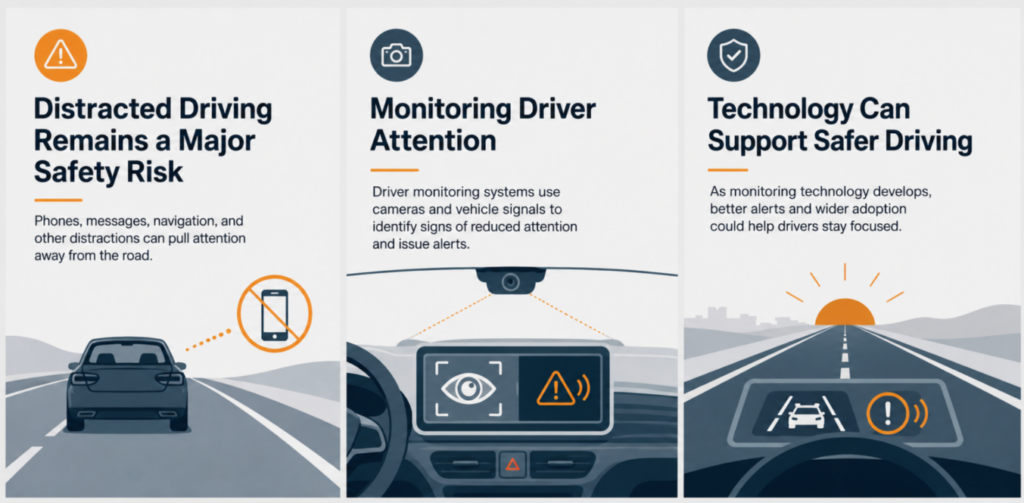
Figure 1. Driver monitoring technology can identify some signs of reduced attention and warn the driver, but it remains a backup to focused driving.
What the distraction numbers measure
Phone use deserves attention because texting can combine visual, manual, and cognitive distraction. But NHTSA’s definition is broader. Eating, talking with passengers, reaching for an object, adjusting navigation or climate controls, and becoming absorbed in something unrelated to driving can all pull attention away from the road.
A separate NHTSA roadside observation study found that 4.5 percent of passenger-vehicle drivers were visibly manipulating a handheld device during a typical daylight moment in 2024. That was a statistically significant increase from 3.0 percent in 2023 and represented an estimated 537,946 drivers. Another 1.9 percent were observed holding phones to their ears. Those are separately observed behaviors and should not simply be added together.
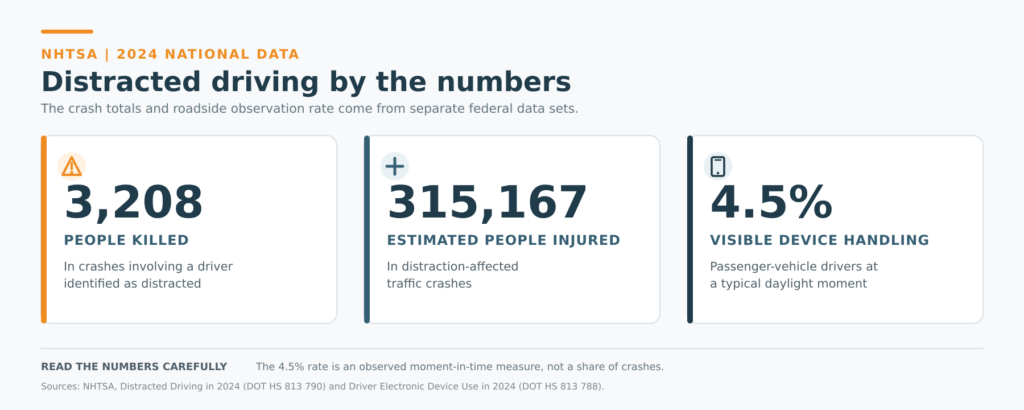
Figure 2. The fatality and injury totals come from crash data. The 4.5 percent figure comes from a separate roadside observation study and is not a share of crashes.
In crashes where cellphone use was specifically identified, 437 people were killed and an estimated 32,327 were injured in 2024. Even that subset has reporting limits. Distraction may not be admitted, seen by a witness, documented in a police report, or uncovered through electronic evidence.
A camera watches the driver, not just the road
Driver monitoring is different from technology that watches the road. Automatic emergency braking, lane-keeping assistance, and adaptive cruise control respond to traffic or vehicle movement. DMS is designed to watch the driver.
Many newer systems use a driver-facing camera to evaluate gaze direction, head position, eye closure, and other signs of reduced attention or drowsiness. Depending on the design, a system may also consider steering inputs, lane position, hand position, or the surrounding driving context.
If the system detects a problem, it may issue a visual, audible, or haptic warning. More advanced designs can work with collision-avoidance features by escalating alerts, increasing the sensitivity of lane or forward-collision support, restricting automation, or bringing an unresponsive driver to a controlled stop. The capability varies substantially by vehicle. A warning light in one model may represent something very different in another.
That distinction matters most with partial automation. Level 2 driving assistance can control speed and steering at the same time, but the human driver must remain fully engaged and ready to act. Monitoring should make misuse harder. It should not invite a driver to surrender attention.
What the 28-study review found
A 2026 scoping review published in Transportation Research Part F identified 28 qualifying primary studies of real-time DMS interventions. Thousands of search results were screened to reach that smaller group; a search result count is not a count of effectiveness studies. Warnings were evaluated most often, appearing in 23 of those studies.
Overall, the interventions often improved driving performance, gaze behavior, or engagement with distracting tasks. The results were not uniformly positive. Five studies found increased distraction engagement, with possible explanations including inaccurate detection, confusing warnings, and too much trust in automated assistance.
The evidence base also has important gaps. Many studies used simulators, definitions varied, and most did not report detection accuracy. Research has concentrated on visual and manual distraction, which means a camera may miss cognitive distraction or a driver who is looking forward without processing a developing hazard.
The warning itself is part of the safety problem: it must be accurate, timely, understandable, and difficult to ignore. Frequent or unnecessary alerts can create a cry-wolf effect and teach drivers to tune the system out.
European requirements and U.S. safeguards
Under European Union vehicle-safety rules, advanced driver-distraction warning requirements applied to new unlimited-series vehicle types beginning July 7, 2024, and to new unlimited-series vehicles beginning July 7, 2026. The technical requirements are performance-based and do not necessarily require the camera-based systems discussed here.
In its March 2026 report linked below, the NTSB identified the need for standardized U.S. driver-monitoring performance requirements. NHTSA’s April 2026 notice describes proposed research on how drivers interact with DMS-equipped Level 2 systems, while the National Transportation Safety Board has called for performance standards and the Insurance Institute for Highway Safety evaluates driver monitoring, escalating attention reminders, and fail-safe procedures in its partial automation safeguard ratings. For consumers, the practical point is simple: do not assume that the same marketing label means the same monitoring performance in every vehicle.
Australian cost projections are not U.S. crash results
A separate 2026 study led by the Monash University Accident Research Centre examined camera-based DMS linked to advanced driver-assistance systems under the Euro NCAP 2026 Driver Engagement Protocol. Using serious-injury crash data from Victoria, Australia, the researchers estimated that the combination could prevent or mitigate nearly 40,000 serious-injury crashes over 30 years.
The modeled full-fleet scenario produced a benefit-cost ratio of 2.82. In a gradual 30-year rollout, the modeled ratio increased to 21.8, with about AUD 13 billion in avoided trauma costs compared with about AUD 0.6 billion in implementation costs.
Those figures are projections based on Australian crash data and assumptions about system effectiveness, cost, and fleet turnover. They are not measured U.S. crash reductions or a guaranteed financial return. Their value is in showing how those assumptions affect the potential savings from fewer serious injuries.
The paper also discloses that one coauthor works for DMS manufacturer Seeing Machines and supplied unit-cost estimates. It states that the economic analysis was performed independently. That industry connection does not invalidate the work, but it belongs in a fair description of the model.
Does the vehicle retain usable evidence?
From a legal standpoint, driver monitoring is a safety aid, not a transfer of responsibility away from the person behind the wheel. In a Louisiana personal injury claim, a driver who ignores a warning, uses a phone, or relies too heavily on partial automation may still have failed to operate the vehicle safely.
The technology may also create another investigative lead. Depending on the vehicle and system, stored alerts or driver-state information could help reconstruct what happened. But data availability, format, and retention vary. Vehicle data should be compared with phone activity, video, physical evidence and witness accounts. The guide to proving phone distraction explains why a device timestamp alone may be misleading. In a commercial-truck crash, ECM and other electronic records may come from separate systems with different retention rules. A DMS alert should not be assumed to appear in every download.
Read the warning instructions before relying on the system
The owner’s manual should explain what the vehicle monitors and what its warnings mean. Do not treat silence as proof of attention or an alert as permission to resume a distracting task. Level 2 assistance still requires an engaged driver even while speed and steering are assisted.
If the system repeatedly misreads your attention, review the manual and have it inspected instead of simply disabling it. After a collision involving suspected phone use, the firm’s Baton Rouge texting-and-driving accident lawyers address the preservation and investigation of distraction evidence.

About the Author
Stephen Babcock is a Louisiana personal injury attorney, founder of Babcock Injury Lawyers, and author of A Life-Changing Accident. Since 2003, he has represented people and families in serious motor vehicle, commercial truck, and wrongful death cases. Louisiana Bar No. 26792.
Selected Sources
- National Highway Traffic Safety Administration, Distracted Driving in 2024, DOT HS 813 790 (April 2026).
- National Highway Traffic Safety Administration, Driver Electronic Device Use in 2024, DOT HS 813 788 (April 2026).
- Ayas, Powell, and Donmez, Distraction Mitigation Through Driver Monitoring Systems, Transportation Research Part F 121 (2026), 103701.
- Regulation (EU) 2019/2144 and Commission Delegated Regulation (EU) 2023/2590, advanced driver-distraction warning requirements.