

People often ask about the odds of dying in a car crash because they want one number that tells them whether driving is safe. There is no honest way to turn a national statistic into a personal prediction. The useful question is what the available data measures, which risks are within your control, and what a family should preserve when a serious crash occurs.
What the latest fatal-crash numbers actually show
The National Highway Traffic Safety Administration reported that 39,254 people died in United States traffic crashes in 2024. The national fatality rate was 1.19 deaths per 100 million vehicle miles traveled. Those figures describe the country as a whole. They do not mean that every driver, road, vehicle, or trip carries the same risk.
NHTSA’s 2024 annual data is useful because it separates a raw death count from a mileage-based rate. The count tells us the scale of the problem. The rate helps compare years in which Americans drove different numbers of miles.
Louisiana also publishes state-specific crash information through the LSU Center for Analytics and Research in Transportation Safety. Its 2024 Louisiana Traffic Records Summary Report gives a much better picture of conditions here than a national lifetime-odds figure. Even state data, however, describes groups of crashes. It cannot predict the outcome of a particular trip.
Why lifetime odds can be misleading
A lifetime-odds estimate combines decades of exposure across millions of people. It mixes high-mileage drivers with people who rarely drive, rural roads with city streets, restrained occupants with unrestrained occupants, and sober driving with impaired driving. It can put roadway deaths in perspective, but it is not a forecast for you or your family.
The same caution applies when comparing states. A per-person rate may reflect how much residents drive, the kinds of roads they use, emergency response time, population density, seat-belt use, and other factors. A per-mile rate answers a different question. Before repeating any crash statistic, check its year, geographic area, and denominator.
The risks that matter most on an individual trip
Some of the strongest risk factors are not mysterious. Speed changes both the likelihood of a collision and the energy involved when vehicles hit. NHTSA reported 11,288 deaths in speeding-related crashes in 2024, representing 29 percent of all traffic fatalities that year. Its speeding guidance also explains that a driver can be traveling too fast for rain, darkness, construction, or another road condition even when the posted limit is not exceeded.
Seat belts remain one of the most effective protections available. According to NHTSA’s seat-belt data, 48 percent of passenger-vehicle occupants killed in 2024 were unrestrained, based on cases with known restraint use. Properly worn lap and shoulder belts reduce the risk of fatal injury for front-seat passenger-car occupants by about 45 percent.
Other important factors include alcohol or drug impairment, distraction, driver fatigue, vehicle condition, roadway design, and the type of impact. Head-on crashes, side impacts near an occupant, rollovers, and collisions involving pedestrians or motorcycles can be especially severe. No list makes driving risk-free, but a sober and attentive driver who slows for conditions and makes every occupant buckle up can materially reduce risk.
What these statistics do not prove after a crash
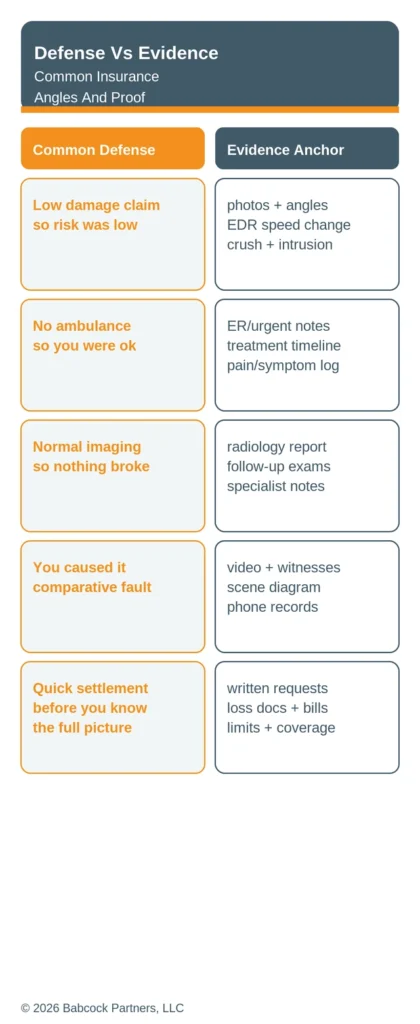
Crash data can explain why a safety issue matters. It does not prove who caused a specific collision. Liability still depends on the evidence from that crash, including vehicle positions, witness accounts, physical marks, video, electronic data, phone records when legally obtainable, and the conduct of each driver.
This distinction matters when an insurer tries to substitute a general assumption for the facts. A photograph that shows modest exterior damage does not establish the speed change experienced by an occupant. A statewide speeding percentage does not prove that a particular driver was speeding. The evidence must connect the claimed conduct to the collision.
Our guide to proving fault when the other driver disputes a Louisiana accident explains the records that tend to matter most. The Baton Rouge car accident practice page provides a broader explanation of the claim process.
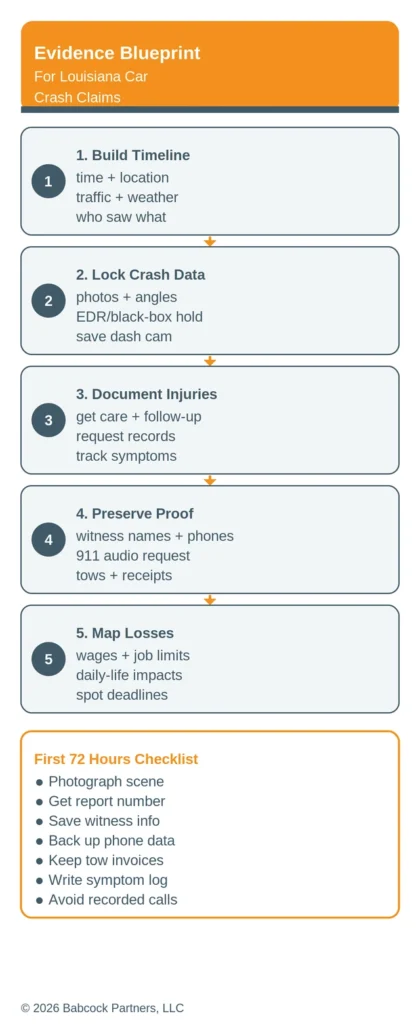
What to preserve after a fatal or life-changing collision
A family dealing with a catastrophic crash has more important things to do than build a litigation file. Still, a few early steps can prevent valuable evidence from disappearing. Someone the family trusts can often handle these tasks while the injured person receives care.
- Save the crash report number and the name of the investigating agency.
- Keep original photographs and videos instead of sending or editing the only copies.
- Write down witness names and contact information.
- Identify the tow yard before a vehicle is repaired, sold, or destroyed.
- Preserve dash-camera recordings and ask nearby businesses about surveillance footage.
- Keep insurer letters, claim numbers, medical records, and expense receipts together.
Commercial-vehicle crashes may require faster preservation work because driver logs, onboard systems, dispatch records, maintenance records, and camera footage may be controlled by different companies. A written preservation request should be tailored to the vehicles and businesses involved rather than copied from a generic checklist.
Louisiana fault and filing rules
For accidents occurring on or after January 1, 2026, Louisiana Civil Code article 2323 generally bars recovery when the injured person is 51 percent or more at fault. When the person’s fault is below 51 percent, recoverable damages are reduced by that percentage. Earlier accidents can be governed by the prior version of the law, so the crash date matters.
Louisiana Civil Code article 3493.1 generally provides a two-year prescriptive period for delictual actions arising from injuries or damage sustained on or after July 1, 2024. Different rules or shorter practical deadlines can apply to older accidents, government defendants, uninsured-motorist notice issues, and other circumstances. Our accident-date and filing-date guide explains why the transition dates should be checked before anyone relies on a general deadline.
A statistic is context, not a case evaluation
I would not tell a family that a national lifetime number decides whether a road is safe or whether a claim is strong. The better approach is to use current data for perspective, then examine the facts that actually affected the collision: speed, visibility, restraint use, impairment, vehicle condition, road design, and the available evidence.
If a Louisiana crash caused a death or a life-changing injury, call Babcock Injury Lawyers at (225) 500-5000. A consultation can focus on the evidence that may disappear, the law that applies to the accident date, and the immediate decisions the family should not have to make alone.
This article provides general information, not legal advice. Outcomes and deadlines depend on the facts of each matter.