

There is no reliable average settlement for a T-bone car accident. A side-impact crash can involve anything from short-lived soreness and minor vehicle damage to surgery, permanent disability, or death. Combining those cases into one number does not tell an injured person what a particular Louisiana claim is worth.
A useful evaluation starts with evidence: who had the right of way, how the impact occurred, what injuries the collision caused, how those injuries changed daily life, and which insurance policies may respond.
Why online settlement averages are misleading
Settlement figures found online usually omit the facts needed to compare one case with another. They may mix different states, different policy limits, disputed and undisputed fault, minor injuries and catastrophic losses. Many settlements are confidential, so any public sample is incomplete.
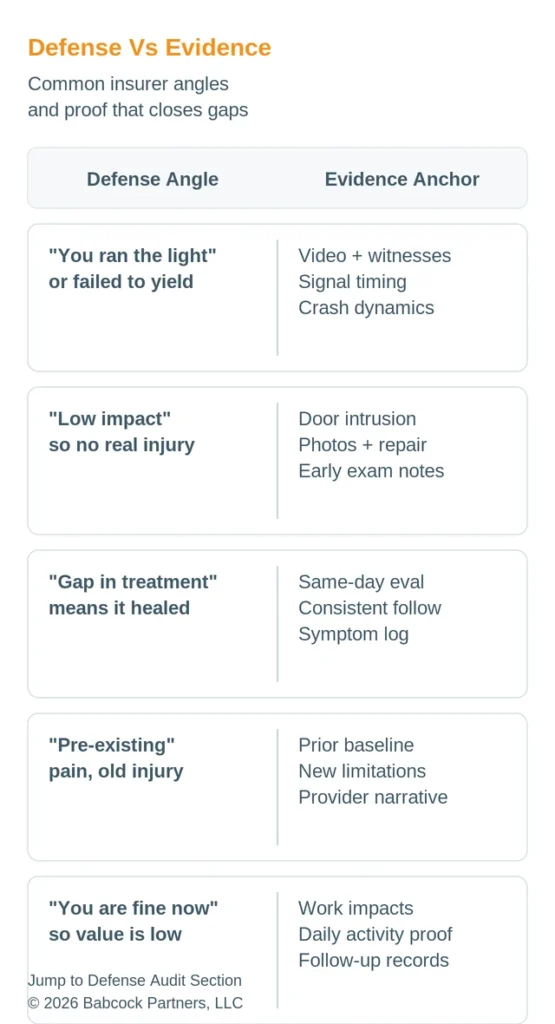
A large medical bill does not automatically produce a large settlement. The insurer may dispute whether all treatment was caused by the crash, whether the care was reasonable, or whether the injured person shares fault. At the same time, a modest repair estimate does not prove that an occupant could not have been injured. The whole record matters.
The first question is who had the right of way
T-bone collisions often happen when one vehicle enters an intersection while another vehicle is crossing. Liability may depend on the traffic signal, a stop sign, a left turn, a failure to yield, or whether either driver was speeding or distracted.
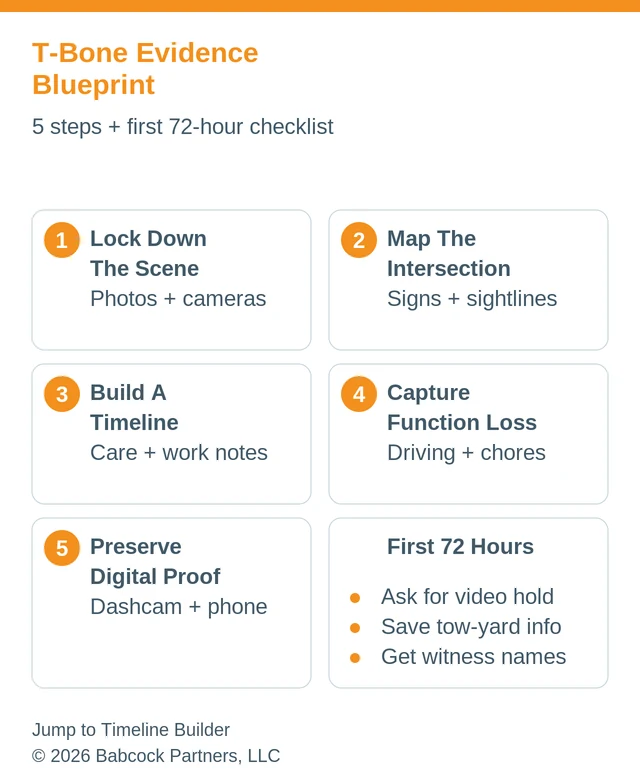
Evidence that can clarify the right-of-way dispute includes:
- Traffic-camera, business-camera, dashcam, or doorbell video
- Names and current contact information for independent witnesses
- Photographs of signals, signs, lane arrows, sight lines, debris, and skid marks
- Damage patterns and the point of impact on each vehicle
- Vehicle data when it is available and relevant
- The crash report and any citations, considered with the rest of the evidence
Video can be overwritten and vehicles can be repaired or salvaged. Preserving those sources early is often more important than debating a settlement number. This site’s guide to proving fault after a Louisiana car accident explains how these pieces fit together.
Injury proof drives much of the value
A settlement evaluation should connect the collision to the injuries and then connect the injuries to measurable losses. Medical records can show symptoms, examination findings, diagnoses, treatment, restrictions, and prognosis. They are most useful when they also explain what changed after the crash.
Relevant losses may include emergency care, follow-up treatment, therapy, medication, future medical needs, lost income, reduced earning ability, pain, and loss of ordinary activities. Serious side impacts can also produce long-term care or accessibility needs.
Consistency matters, but consistency does not mean using identical words at every appointment. It means giving providers an accurate history, attending reasonable follow-up, and explaining concrete limits. A note that a person could drive for only fifteen minutes or could no longer lift a child is more informative than a general statement that everything hurt.
Property damage can help explain the crash
Door intrusion, a bent center pillar, airbag deployment, wheel displacement, and the direction of deformation may help explain how force entered the passenger compartment. Repair records and photographs can preserve details that disappear after the vehicle is fixed or sold.
Property damage and bodily injury are related but distinct parts of a claim. A total-loss value does not measure pain or medical loss, and a low repair estimate does not decide medical causation. Each issue needs its own proof.
Insurance coverage can limit the practical recovery
Even a well-supported claim may face limited liability coverage. Other possible sources can include uninsured or underinsured motorist coverage, medical payments coverage, an employer’s policy when a driver was working, or another responsible party’s coverage. Whether a policy applies depends on its terms and the facts.
Before evaluating an offer, it is important to understand the available limits, coverage disputes, medical-payment obligations, reimbursement claims, liens, case expenses, and attorney’s fees. A gross settlement is not the same as the amount the injured person receives.
How comparative fault affects a Louisiana claim
Louisiana Civil Code article 2323 governs comparative fault. For an injury occurring on or after January 1, 2026, the current statute generally bars recovery when the claimant is assigned 51 percent or more of the fault. If the claimant is 50 percent or less at fault, damages are reduced by the assigned percentage. Earlier incidents can be governed by the prior version of the law, which allowed recovery reduced by the claimant’s percentage even when that percentage was higher.
The accident date therefore matters. A person should not apply the current percentage rule to an older crash without checking the transition law. The site’s Louisiana injury-law effective dates guide explains several recent changes.
Do not confuse negotiation time with the filing deadline
Negotiations do not automatically stop prescription. Louisiana Civil Code article 3493.1 generally provides a two-year prescriptive period for delictual actions arising on or after July 1, 2024. Many earlier accidents were subject to a one-year period. Claims involving a government entity, workers’ compensation, a minor, a death, or another special circumstance may involve additional rules.
Evidence can disappear well before the legal deadline. Waiting for treatment to end may be sensible in some negotiations, but it should not delay preservation of video, witness information, or vehicle evidence.
When is a case ready for settlement?
An early offer may arrive before the medical course is clear. Settling too soon can leave the injured person responsible for later treatment because a release usually ends the claim. On the other hand, unnecessary delay can create financial pressure and deadline risk.
A careful decision considers:
- Whether fault evidence has been collected and reviewed
- Whether the medical condition and future needs are reasonably understood
- Whether wage and household losses are documented
- Whether all relevant policies and limits have been investigated
- What liens or reimbursement claims may reduce the net recovery
- The risks, time, and cost of litigation compared with the offer
The Baton Rouge intersection-collision practice page discusses the investigation of right-of-way and side-impact cases in more detail.
A case-specific evaluation is more useful than an average
No chart can responsibly predict a T-bone settlement from the crash label alone. The most useful evaluation identifies the disputed facts, the strongest and weakest evidence, the documented losses, the available coverage, and the amount the injured person would actually receive after deductions.
If a T-bone collision caused a serious injury in Louisiana, call Babcock Injury Lawyers at (225) 500-5000. A consultation can address evidence preservation, applicable deadlines, insurance coverage, and whether an offer reflects the documented losses.
This article provides general legal information, not legal advice. Outcomes depend on the facts, the law in effect on the accident date, and the available evidence and insurance.