

A traumatic brain injury claim often depends on evidence that cannot be captured in one scan or one office visit. The injury may affect memory, concentration, balance, sleep, mood, vision, or the ability to tolerate noise and screens. Some symptoms appear immediately, while others become noticeable only after the injured person tries to return to ordinary work and family responsibilities.
The legal task is to connect the event to the injury and the injury to real changes in function. That requires accurate medical history, a reliable timeline, and records from people who observed the difference.
What is a traumatic brain injury?
The National Institute of Neurological Disorders and Stroke describes traumatic brain injury as an injury caused by an outside force that disrupts normal brain function. A concussion is a form of mild TBI, although “mild” describes the initial clinical classification and does not guarantee that symptoms will be brief or insignificant.
A direct blow to the head is not required. A collision can cause rapid acceleration, deceleration, or rotation of the head and brain. The mechanism, immediate observations, and symptom course should be documented without trying to diagnose the injury outside a medical setting.
When do symptoms require emergency care?
Medical safety comes before claim documentation. The CDC’s current concussion guidance advises immediate emergency care for danger signs such as a worsening headache, repeated vomiting, seizures, unusual behavior, increasing confusion, slurred speech, weakness or numbness, unequal pupils, or an inability to wake.
Symptoms can change over hours or days. A person who was evaluated and discharged should follow the provider’s instructions and return for care if a danger sign appears or the condition worsens. Legal concerns should never be used as a reason to delay or direct medical treatment.
Why can a concussion exist when imaging is normal?
CT and MRI serve important purposes, particularly when clinicians are looking for bleeding, fracture, swelling, or another structural injury. They do not diagnose every concussion. The CDC’s adult mild-TBI checklist uses clinical assessment and decision rules to determine when imaging is appropriate rather than recommending a scan for every patient.
A normal scan should not be described as proof that nothing happened. It is also not proof of every later symptom. Diagnosis and treatment belong to qualified clinicians, who may consider the mechanism, neurological examination, symptom pattern, medical history, and, when appropriate, cognitive, balance, vestibular, vision, speech, or neuropsychological testing.
Build the medical timeline from the first reliable records
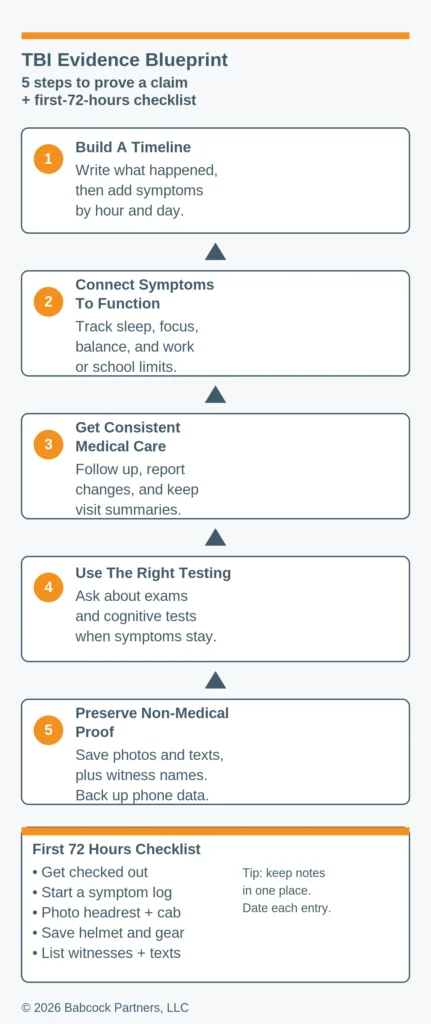
A useful timeline distinguishes what was observed from what was remembered later:
- the time and mechanism of the event;
- loss of consciousness, confusion, amnesia, vomiting, or unusual behavior reported at the scene;
- the first medical examination and discharge instructions;
- the onset and progression of headache, dizziness, sleep, vision, mood, or concentration symptoms;
- follow-up visits, referrals, testing, therapy, and medication changes; and
- attempts to return to work, school, driving, exercise, or household responsibilities.
Use the words that accurately describe the experience. Repeating a memorized list at every appointment can make the record less useful. If a symptom improved, worsened, or appeared later, the date and surrounding circumstances matter.
What non-medical evidence can support causation?
Medical records explain diagnosis and treatment, but other evidence can show the force of the event and the immediate change:
- scene, vehicle, helmet, restraint, airbag, and interior-contact photographs;
- dashcam, business, traffic, body-camera, or phone video;
- 911 recordings and emergency-response records;
- witness accounts of confusion, repetition, imbalance, or loss of consciousness;
- vehicle repair, event-data, and tow records when a collision is involved; and
- contemporaneous texts, emails, calendars, and missed-appointment or missed-work messages.
The guide to loss of taste after a car accident discusses why a neurological symptom should be medically evaluated rather than assumed to have one cause. The article on long-term TBI effects addresses the records used when symptoms continue.
How do symptoms become proof of functional loss?
A diagnosis does not, by itself, establish the full effect of an injury. Function should be described with specific, verifiable examples. A work note documenting reduced hours, an accommodation for screen breaks, a family member’s observation of repeated questions, or therapy records showing balance limitations can be more informative than a general statement that life changed.
Relevant records may include:
- attendance, payroll, and leave records;
- written work or school accommodations;
- therapy goals and progress notes;
- driving restrictions or failed attempts to resume driving;
- help required with medication, finances, appointments, childcare, or household tasks; and
- a concise symptom log tied to dates and activities.
Logs should be factual and sustainable. Record a meaningful change, trigger, or limitation instead of writing the same conclusion every day.
How are common defense arguments tested?
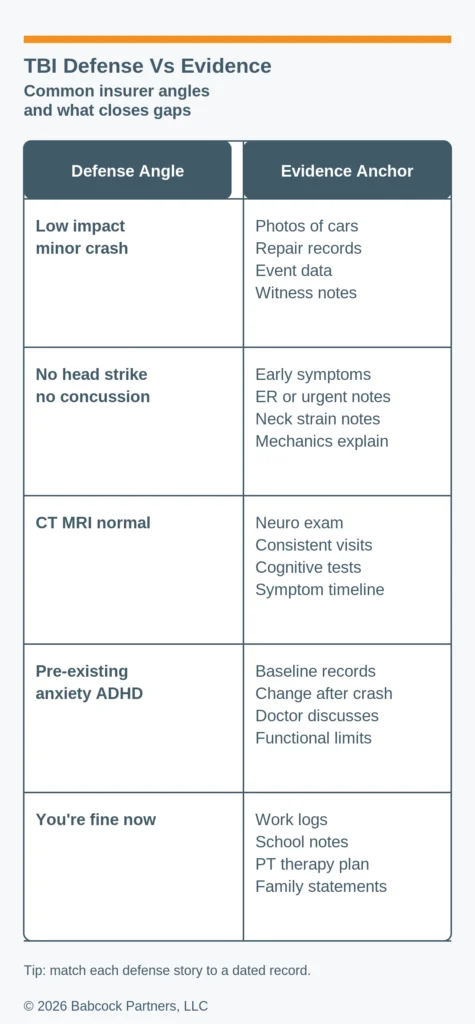
A disputed TBI claim often involves several recurring arguments:
- No head strike: compare the recorded mechanism, witness accounts, restraint evidence, and medical history rather than assuming a strike is required.
- Normal imaging: identify what the scan was ordered to evaluate and what the clinicians actually concluded.
- Delayed symptoms: compare the timing with early messages, family observations, discharge guidance, and follow-up records.
- Preexisting condition: use earlier records to establish baseline function and identify what changed after the event.
- Inconsistent reporting: determine whether the difference is a genuine contradiction, a symptom that evolved, or a brief initial record that did not ask about the later issue.
- Symptoms caused by stress, sleep, or another condition: leave differential diagnosis to qualified providers and collect the records they considered.
The answer is not to overstate the claim. A careful record should preserve improvement as well as difficulty and distinguish medical opinions from personal observations.
Louisiana fault and filing rules depend on the incident date
Civil Code article 2323 governs comparative fault. Its current 51 percent bar took effect January 1, 2026. A claim based on an earlier incident may be governed by the prior version, so the event date must be checked before describing the effect of fault.
Civil Code article 3493.1 provides a two-year prescriptive period for delictual actions and took effect July 1, 2024. Earlier injuries can involve the former one-year rule, and special claims or defendants may have different requirements. Treatment, an insurance claim, or settlement discussion does not necessarily stop prescription.
Where can an injured person learn more?
The firm’s published Baton Rouge brain injury practice page discusses symptoms, neurological testing, experts, and life-impact proof. A case-specific review should begin with the event date, complete medical history, original records, and the person’s actual pre-injury and post-injury function.