

A class action changes who may litigate a shared dispute together. It does not create a new legal claim. One or more named plaintiffs ask to represent a larger group because central questions can be answered with common proof. The underlying dispute might concern a standard contract, a uniform fee, a product, a notice, or another practice that affected many people in substantially the same way.
A large number of similar complaints is not enough. Before the case can proceed for a class, a court must certify the proposed group, define who belongs in it, and decide which claims or issues can fairly be handled together.
What a class action actually does
In an ordinary lawsuit, each plaintiff generally proves an individual claim. In a class action, named representatives ask the court to decide common questions for a defined group. The class device can make sense when separate suits would repeat the same central proof and produce a risk of inconsistent results.
Examples of potentially shared questions include whether every customer received the same contract, whether a company charged the same disputed fee, or whether one standardized notice omitted the same information. Questions such as the amount of an individual’s medical loss, reliance, or causation may require more personal proof.
This distinction matters because a case can involve many people without qualifying as a class action. Some product and toxic-exposure claims proceed as individual suits, consolidated proceedings, or federal multidistrict litigation because each person’s exposure, diagnosis, causation, and damages require separate proof. Our articles on Louisiana talc claims and the difference between asbestos exposure and mesothelioma illustrate why a large number of related claims does not by itself answer the class-certification question.
What Louisiana courts examine before certification
Louisiana Code of Civil Procedure article 591 starts with four prerequisites:
- Numerosity: the class is so large that joining every member is impracticable.
- Commonality: the group shares questions of law or fact.
- Typicality: the representatives’ claims or defenses are typical of the class.
- Adequacy: the representatives can fairly and adequately protect the class.
Those prerequisites are only the first part of the analysis. Article 591 also requires the proposed action to fit a maintainable class category. In many damages cases, the court examines whether common questions predominate over issues affecting only individual members and whether a class action is superior to other available ways of resolving the dispute. The court also considers whether the class can be defined using objective criteria.
The certification decision does not decide whether the defendant ultimately violated the law or owes damages. It decides whether the identified claims or issues can proceed on behalf of the proposed class.
How the certification process works
Louisiana Code of Civil Procedure article 592 governs certification procedure, notice, judgments, and related orders. The article generally requires the class proponent to file a certification motion within 90 days after service of the initial class pleading on all adverse parties, unless the deadline is extended by stipulation or for good cause.
That 90-day procedural requirement is not an opt-out deadline for an absent class member. A person who receives a class notice should follow the dates and instructions in that notice and the court order governing the case.
The certification process may include discovery about the proposed class, briefing, evidence, and a hearing. If the court certifies a class, the order should identify the class, the claims or issues receiving class treatment, and the representatives and counsel responsible for the case. The court can later alter or amend certification if the record changes.
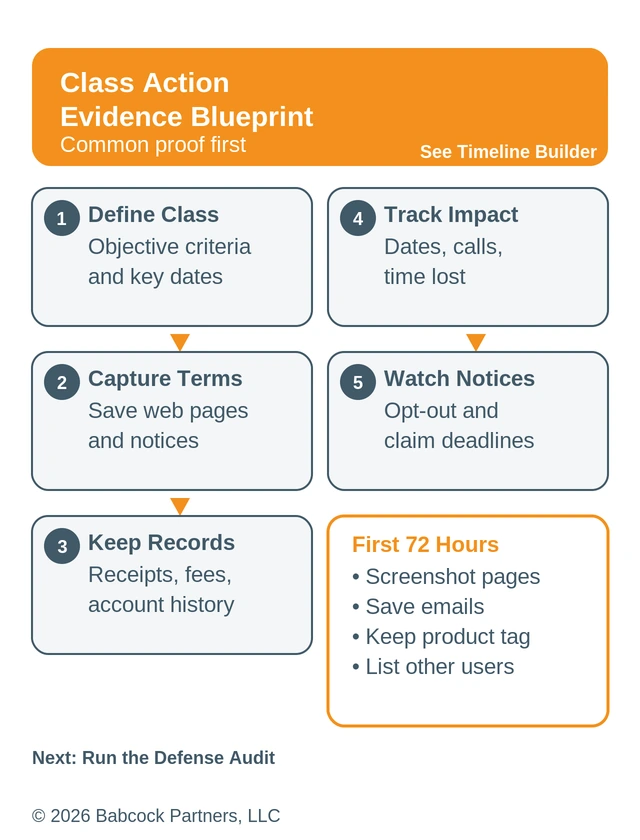
Read a class notice as a set of choices and deadlines
A legitimate class notice should identify the case, the court, the class definition, the claims or issues, and the available choices. Depending on the type and stage of the case, it may explain how to exclude yourself, object to a proposed settlement, submit a claim, update contact information, or do nothing.
Do not assume that every class notice creates the same rights. Under Federal Rule of Civil Procedure 23, for example, a damages class certified under Rule 23(b)(3) receives notice that includes the right to request exclusion. Other kinds of federal classes do not necessarily carry the same automatic opt-out right. Louisiana procedure and the court’s certification order likewise matter.
When a notice arrives, save the complete document and envelope or email. Record the date received. Then identify:
- the exact class definition and covered time period;
- whether you must submit a claim form to receive relief;
- the deadline and method for requesting exclusion;
- the deadline and procedure for an objection;
- the claims a judgment or settlement would release; and
- where the court filings and official case website can be reviewed.
Use the contact information stated in the court-approved notice or official docket. Be cautious with unsolicited messages requesting a payment, password, or sensitive financial information.
Staying in the class versus requesting exclusion
When exclusion is available, the right decision depends on more than the expected payment. Staying in the class may allow a person with a relatively uniform claim to share the cost and result of the litigation. In exchange, the person may be bound by the judgment or settlement and the release described in the case documents.
Requesting exclusion may preserve the ability to pursue an individual claim, but it also means the person is responsible for protecting that claim and its deadlines. Exclusion can deserve closer attention when the harm is much larger or materially different from the typical class member, when individualized damages dominate the dispute, or when the proposed release reaches claims the person may want to pursue separately.
Doing nothing is still a choice with consequences. It may leave a person bound by a result without receiving money if the settlement also requires a claim form. The notice and proposed settlement should be read together rather than relying on an advertisement or summary.
Records that help evaluate class membership
The first question is usually whether objective records show that the person falls within the class definition. Useful records vary with the dispute but may include:
- the complete class notice and every attachment;
- contracts, terms of service, amendments, proof of the version accepted, and any arbitration or class-waiver opt-out notice and proof;
- invoices, statements, receipts, account exports, and disputed charge codes;
- emails, text messages, letters, support tickets, and complaint numbers;
- product tags, model, serial, purchase, and ownership information;
- screenshots showing the page, date, web address, and surrounding context; and
- a short chronology connecting the shared practice to the person’s loss, including costs and time lost; and
- names of other affected people you already know.
Keep original files. If a website or account can be exported, save the export rather than relying only on isolated screenshots. Do not alter account records or try to access another person’s private information.

Why a Louisiana class action may proceed in federal court
A case filed in Louisiana state court can sometimes be removed to federal court. Federal jurisdiction may arise under the class-action provisions of 28 U.S.C. section 1332(d), and 28 U.S.C. section 1453 contains special removal provisions for covered class actions.
Federal court changes the governing certification rule and procedure, but removal does not itself establish that a class should be certified or that the claims have merit. Certification in federal court is evaluated under Rule 23.
A pending class case does not make every deadline disappear
The underlying claim may arise from a contract, tort, consumer statute, federal law, or another source. Those claims can have different limitation periods, notice requirements, administrative prerequisites, and rules concerning the effect of a pending class action. A notice deadline and the deadline for an individual lawsuit are not necessarily the same date.
Someone considering exclusion should obtain claim-specific advice before assuming there will be time to sue afterward. The same caution applies when a proposed class has not yet been certified or when the person’s facts may place the claim outside the class definition.
Our Louisiana legal FAQs explain why some group disputes fit class treatment while others are better handled as individual, consolidated, or coordinated claims.
A refund or credit offered in exchange for a release, or lost access to account history or old terms, is another reason to ask for advice promptly.
The Babcock Benefit describes the firm’s approach to preserving evidence and preparing a case for trial. A review of a class notice starts with the common records, court deadlines and the scope of any release.
Read client reviews, contact us or see our office locations. Attorney profile: Stephen Babcock.
When to ask for an individual review
Consider getting advice before an exclusion, objection, or claim deadline when the loss is substantial, the proposed release is broad, the facts differ from the class description, or an individual claim may require separate proof. Call (225) 500-5000 or use the free case-review form below. Bring the notice and available records, but do not delay asking for help because the file is incomplete. Do not send confidential information until the firm confirms how it should be provided.