

A sideswipe happens when the sides of two vehicles make contact while traveling beside one another or while one vehicle moves past the other. The damage may look like a long scrape, but fault can be difficult to determine because both drivers may say they stayed in their own lane.
The cause usually becomes clearer when the roadway, point of first contact, vehicle movement, and available video are considered together.
Unsafe lane changes are a common cause
Many sideswipes begin when a driver changes lanes without enough clearance. The driver may misjudge distance, fail to check the adjacent lane, or begin moving before another vehicle has passed.
La. R.S. 32:79 requires a vehicle to remain as nearly as practicable within a single lane and not leave that lane until the driver has first determined that the movement can be made safely. La. R.S. 32:104 also addresses safe lateral movement and signals.
A traffic violation may be relevant, but it does not decide a civil claim by itself. The circumstances still matter, including each driver’s position, speed, attention, and opportunity to avoid the collision.
Blind spots matter around cars and trucks
A driver may look in the mirror and still miss a vehicle beside the rear quarter panel. The blind area can be larger around commercial trucks. A tractor may clear a vehicle while the trailer remains close enough to make contact, and a trailer can track differently from the cab during a turn.
Blind spots explain how a crash may happen, but they do not excuse moving without adequate clearance. Evidence showing the vehicles’ relative positions can be more useful than an argument about whether one driver “should have seen” the other.
Merging traffic and disappearing lanes create conflict
Highway entrances, lane drops, work zones, and congested interchanges require drivers to judge speed and available space quickly. A driver may force a merge, accelerate to block another vehicle, or continue in a lane that is ending.
Photographs of signs, arrows, lane markings, barriers, and the length of the merge area help explain what each driver faced. If construction changed the normal pattern, record the temporary markings and devices before they move.
Distraction, fatigue, and overcorrection can cause drift
A driver looking at a phone, navigation screen, passenger, or roadside event may gradually cross a lane line. A tired or impaired driver may have the same problem. Sometimes the sideswipe occurs when the driver notices the drift and overcorrects.
Do not assume distraction solely because the other vehicle crossed a line. Video, witnesses, admissions, phone records obtained through lawful process, or a repeated pattern of movement may be needed to support that conclusion.
Aggressive passing can reduce the margin for error
A driver who accelerates through a narrow gap or passes close to another vehicle leaves little room for ordinary movement. Contact may also occur when one driver changes lanes as another begins passing.
The length and direction of paint transfer, the location of first damage, and video timing may help distinguish a gradual drift from a sharp merge or close pass. A qualified reconstruction professional may be needed in a serious or disputed collision.
Who is at fault in a sideswipe?
The driver who left a lane without reasonable safety may bear fault, but that is not automatic in every case. Two vehicles may move toward the same lane at once. One driver may cross the line while another speeds up or fails to react. Road design or a third vehicle may also contribute.
Louisiana’s current comparative-fault rule requires the factfinder to allocate responsibility among people who contributed to the loss. For causes of action governed by the version effective January 1, 2026, Civil Code article 2323 bars recovery when the injured person’s share of negligence is 51 percent or more and reduces recovery proportionally when it is less than 51 percent. Earlier crashes may be governed by the prior version, so the crash date matters.
Physical evidence can resolve a word-against-word dispute
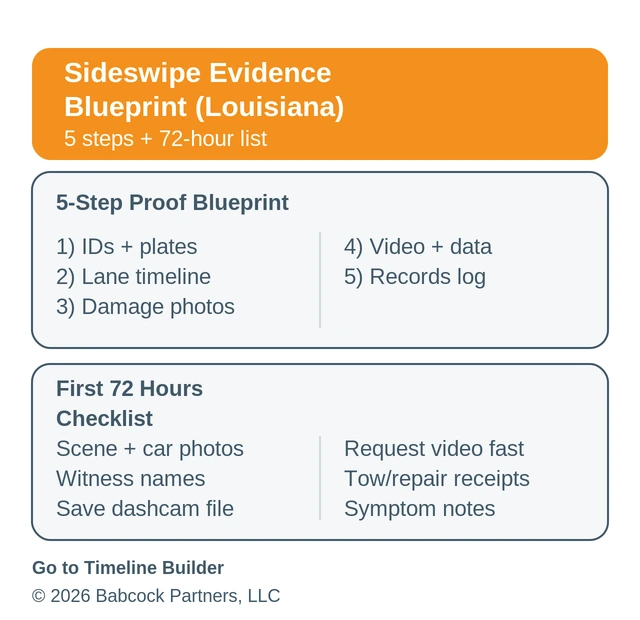
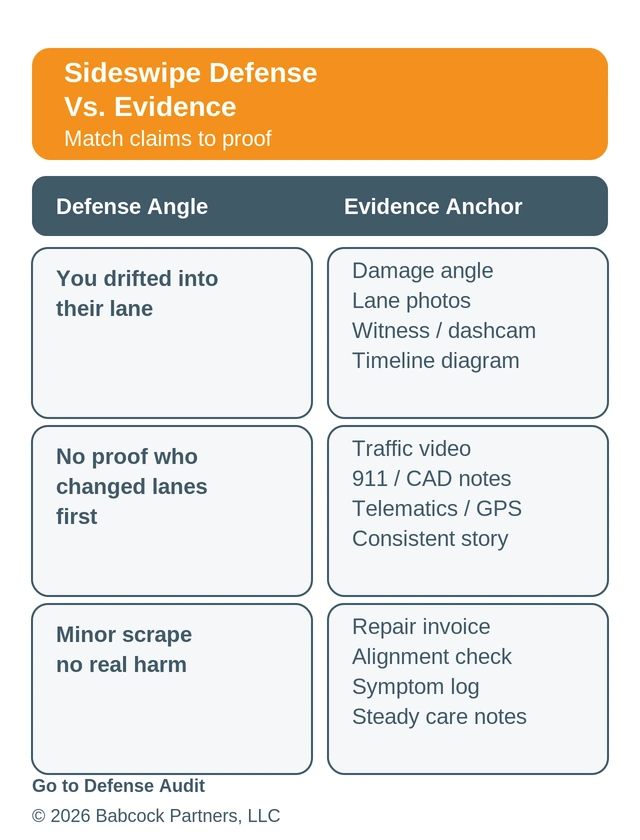
Photograph both vehicles before repair when possible. Include wide views of all sides, close views of contact damage, paint transfer, wheel or tire marks, mirrors, and any secondary impact. Damage height and direction may help show how the vehicles moved.
At the scene, photograph lane markings, road signs, merge areas, traffic signals, shoulder width, debris, and final vehicle positions. Do not stand in active traffic or take photographs from an unsafe location.
Write a simple diagram showing the lanes, direction of travel, and each vehicle’s position before contact. Label it as a recollection made on that date, not as a precise scale drawing.
Look for video before it is overwritten
Dash cameras, commercial-vehicle cameras, nearby businesses, homes, transit systems, and traffic-management systems may have recorded the collision. Identify the source and exact time promptly. Retention periods vary, and some systems overwrite recordings quickly.
A person asking for video should preserve the original file and related metadata rather than screen-recording a playback when the original is available. A lawyer may send a preservation request when the footage belongs to a company or other third party, but a request does not guarantee that the material exists or must be produced voluntarily.
Witnesses and reports still matter
Obtain witness names and contact information. Ask where the person was and what they actually saw. A witness who saw one vehicle begin crossing a line may be more useful than someone who arrived after contact.
Call law enforcement when required or when the location, injuries, disabled vehicles, or dispute makes a response appropriate. Exchange driver, vehicle, and insurance information. The report may document statements and scene facts, but an officer who did not see the collision may not be able to resolve every fault question.
Do not use vehicle damage to diagnose an injury
A long scrape can involve little vehicle deformation, while the occupants may still experience movement or a secondary impact. Photographs and repair estimates help describe the collision, but they do not diagnose or disprove an injury.
Seek medical care based on symptoms and professional advice. Tell the clinician how the collision occurred, when symptoms began, and whether there was another impact. Preserve treatment records, work restrictions, wage information, and out-of-pocket costs.
Keep the insurance account factual
Report the collision promptly and provide accurate information. Avoid guessing about speed, distance, phone use, or fault. If you do not know, say so. Review any written or recorded statement for accuracy when the process permits.
Save claim numbers, adjuster communications, photographs sent, estimates, supplements, payment explanations, and the vehicle’s repair or total-loss documents. A consistent chronology is more credible than an account expanded after a dispute begins.
When legal review may help
Legal review may be useful when both drivers deny leaving their lane, a commercial or government vehicle is involved, important video belongs to a third party, the crash caused serious injury, or the insurer assigns fault without addressing the physical evidence.
The firm’s sideswipe collision practice page explains the claim process. Related guides address evidence of distracted driving and additional records in a commercial-truck claim.