What are Common Causes of Sideswipe Accidents?


Editorial & Legal Accuracy Notice (Louisiana)

This blog contains general legal and safety information and is not legal advice. Laws and deadlines can change, and outcomes depend on specific facts.

Last reviewed / updated: March 2, 2026

Reviewed, updated, and authored by: Stephen Babcock, Louisiana injury lawyer

This guide explains the common causes of sideswipe accidents and how to preserve proof. It also outlines practical next steps that help reduce “word vs. word” disputes.

A sideswipe crash looks simple, but fault can turn on inches of lane position. Insurers often treat these claims as shared blame unless you can show who moved first. The goal is to turn a confusing scrape into a clear timeline with documents.

Our approach starts with the lane map, the damage angle, and the fastest evidence requests. We are not built for volume. We are built for leverage. Speed + evidence preservation + insurer-insider knowledge + trial-ready preparation = The Babcock Benefit. In a sideswipe accident, leverage often comes from proving which vehicle moved first before the story changes.

If you are inside the first 72 hours, call (225) 500-5000 or use the free case review form before evidence changes.

Firm links: Client Reviews | Contact | Locations

Want a print-friendly version of the checklists and visuals in this post? Download the printable toolkit (PDF) and keep it with your crash notes.

If you are dealing with a sideswipe in Baton Rouge, start with our Baton Rouge sideswipe collision practice page for the big-picture claim process. Then use this article to build the lane timeline and evidence list that supports your version of events.

What Causes Sideswipe Accidents in Louisiana?

Most sideswipe accidents happen when one driver changes lanes or merges without enough space, often because of blind spots, distraction, or speed mismatch. The most reliable way to prove the cause is to capture lane position, contact point, and timing with photos, video, and a quick lane diagram made while memories are fresh.

  • Unsafe lane changes and merges
  • Blind spots, especially around larger vehicles
  • Distracted or drowsy driving
  • Aggressive passing and speed differences
  • Confusion at lane drops, exits, and construction zones
  • Commercial truck trailer sweep during turns or lane shifts

Sideswipes create disputes because both drivers can stay in control and keep moving. That makes the crash feel “minor,” even when the damage and injuries are real. A calm, documented timeline usually matters more than a heated roadside argument.

Which Driver Is Usually at Fault in a Sideswipe?

In many sideswipe cases, the driver who moved into the other lane without checking mirrors and leaving space carries most of the fault. Because Louisiana applies comparative fault under the Louisiana Legislature’s text of La. Civ. Code art. 2323, insurers may argue shared blame, so your file should show who moved first and what you could reasonably do to avoid impact.

Common Scenario Evidence That Helps Assign Fault
One car merges into a lane already occupied Dashcam or traffic video, witness statement, lane diagram, contact point, and scrape angle
Two cars “change lanes at the same time” Timeline notes, turn-signal context, roadway markings, consistent statements, nearby camera footage
Sideswipe near an exit or lane drop Scene photos showing signage and lane arrows, GPS route context, video showing last-second movement
Commercial vehicle drifts or swings wide Fleet identifiers, company info, wide-angle photos, video requests, repair measurements

The Louisiana Legislature’s text of La. Civ. Code art. 2315 is the baseline rule for fault-based injury claims. The Louisiana Legislature’s text of La. Civ. Code art. 2316 addresses negligence, which is careless conduct that causes harm.

A police report can help, but it does not always answer “who moved first,” especially if no one saw the moment of contact. If you want a broader overview of injury claim steps in Louisiana, our Baton Rouge car accident practice page explains the process and common proof issues.

Common Causes of Sideswipe Collisions

The common causes of sideswipe accidents usually connect to one theme: a driver changes lateral position without seeing or accounting for a vehicle already there. To prove the cause, match the “why it happened” story to physical proof like damage direction, roadway markings, and video timing.

Cause Proof Anchor to Collect
Unsafe lane change Lane diagram, damage angle, dashcam or witness confirmation
Blind spot Mirror-position context, relative vehicle positions, wide scene photos
Distraction or fatigue Video timing, consistent statements, surrounding traffic context
Speed mismatch Skid and scrape length, traffic flow notes, repair measurements
Truck swing or trailer sweep Wide-angle photos, company identifiers, preservation requests for onboard data

Unsafe Lane Changes and Merges

This is the most common cause of sideswipe accidents because the movement is quick and often unannounced. A driver may think the lane is clear, then drift over while looking ahead instead of checking mirrors and shoulder. The best proof often comes from the first few seconds of video or a credible witness who saw the merge start.

If you can, draw a simple lane map with arrows showing where each vehicle started and where contact began. Keep it factual and time-based, not emotional. That map helps you explain the same story to medical providers, adjusters, and attorneys without drift.

Blind Spots and Mirror Gaps

Blind spots matter more when one vehicle is taller, wider, or sits higher off the ground. Drivers also misjudge space when another car rides slightly behind the rear quarter panel. Wide-angle scene photos help because they show lane width, shoulder space, and how close traffic was.

Do not rely on “they should have seen me” as your only proof. Instead, use damage height and direction, which can show whether the other vehicle moved into you or you moved into it. This is why we start with physical patterns before we argue about intent.

Distracted or Drowsy Driving

Distraction turns a normal lane change into a sideswipe because the driver stops tracking lateral position. You often see this when a driver looks down, drifts, then over-corrects. If distraction is a factor, document surrounding context like traffic density and whether the driver kept drifting across the line.

For a deeper look at how distraction affects liability and proof, see our Baton Rouge distracted driving page. Keep your claim file focused on what can be shown, not what you assume.

Speed Mismatch and Aggressive Passing

Sideswipes happen when one driver tries to slip past in a tight gap or accelerates while another vehicle is merging. Speed differences also change the length and direction of the scrape. Repair records can matter here because they sometimes document alignment issues or secondary impacts.

If the other driver says “I never left my lane,” compare that claim to the contact point and the run of paint transfer. A long, consistent scrape often supports steady side contact rather than a single bump. That is what we mean by leverage when the physical evidence tells a clearer story than the statements.

Commercial Trucks and Trailer Sweep

Trucks can sideswipe a smaller vehicle during wide turns, lane shifts, or when a trailer tracks differently than the cab. These cases can involve extra evidence sources, including onboard cameras, dispatch records, or fleet telematics. If a commercial vehicle is involved, get the carrier name and DOT markings early.

Even when the crash looks “minor,” the claim handling can be more complex with a fleet. If you need a starting point for those situations, our Baton Rouge truck accidents page explains common evidence categories and why preservation letters matter.

Timeline Builder: Reconstructing a Sideswipe Step by Step

A sideswipe timeline is a short, structured account of lane position and movement that stays consistent across your claim. Build it once, early, and use it to guide your photo labels, video requests, and repair documentation.

  1. Mark the roadway: write the road name, direction of travel, nearest cross-street, and which lane you were in.
  2. Place the vehicles: note where each vehicle was relative to you (ahead, beside, rear quarter).
  3. Record the trigger: identify the first observable change, like a merge, drift, or lane drop.
  4. Pinpoint contact: describe where contact started and where it ended, using landmarks if possible.
  5. Capture after-movement: note whether either vehicle corrected, braked, accelerated, or pulled over.
  6. Attach proof: label photos and video clips by “before contact,” “contact,” and “after contact.”

This is why we push for early video preservation: the most neutral proof often disappears first. When you build a clean timeline and request footage quickly, you reduce the insurer’s room to frame the crash as “unclear.”

If you want help structuring those preservation requests and organizing the claim file, read how we handle these cases on our sideswipe accident case approach. Good leverage starts with a timeline you can defend with documents.

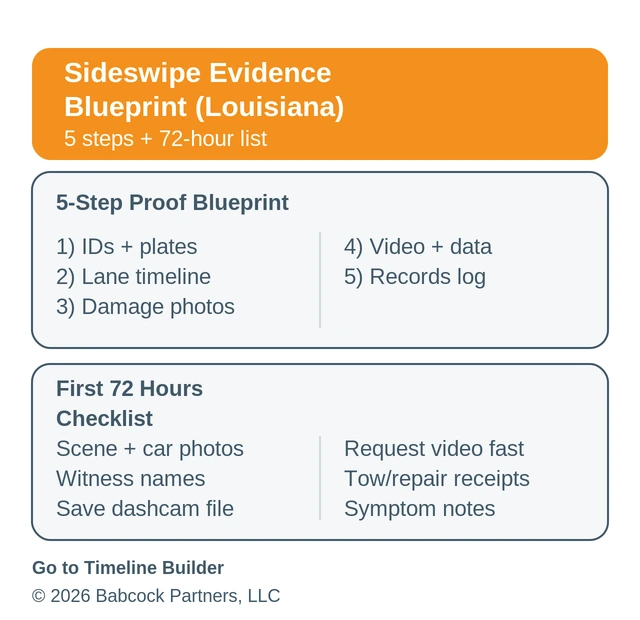
Quick reference: the 5-step sideswipe proof blueprint + the first-72-hours evidence checklist.

First 72 Hours After a Sideswipe: What to Preserve

The first 72 hours matter because video overwrites, vehicles get repaired, and memories shift. Your goal is to capture the lane story and the physical patterns before the file becomes “just statements.”

  • Take wide and close photos of both vehicles, including the undamaged sides.
  • Photograph the roadway: lane lines, arrows, merge signs, exits, and shoulder space.
  • Save dashcam files and back them up in two places.
  • Write down witness names, phone numbers, and where they were positioned.
  • Keep tow and repair paperwork, including supplements and parts lists.
  • Make short dated notes about symptoms, sleep, and work or activity limits.

This is why we tell people to make a simple lane map the same day, even if they feel “fine.” It preserves your memory while it is sharp and helps you describe the crash consistently later.

Call a Lawyer Quickly If These Issues Apply

Some sideswipe claims turn into deadline problems fast because key proof sits with third parties. If any of these are true, talk to a lawyer quickly so evidence requests go out before routine deletion or repair.

  • A commercial truck, rideshare, or work vehicle was involved
  • You suspect a hit-and-run or the other driver’s identity is uncertain
  • There may be nearby business or government camera footage
  • The crash happened in a construction zone or lane-drop area
  • Injuries worsened after the initial adrenaline wore off

Defense Audit: How Insurers Argue Sideswipe Cases

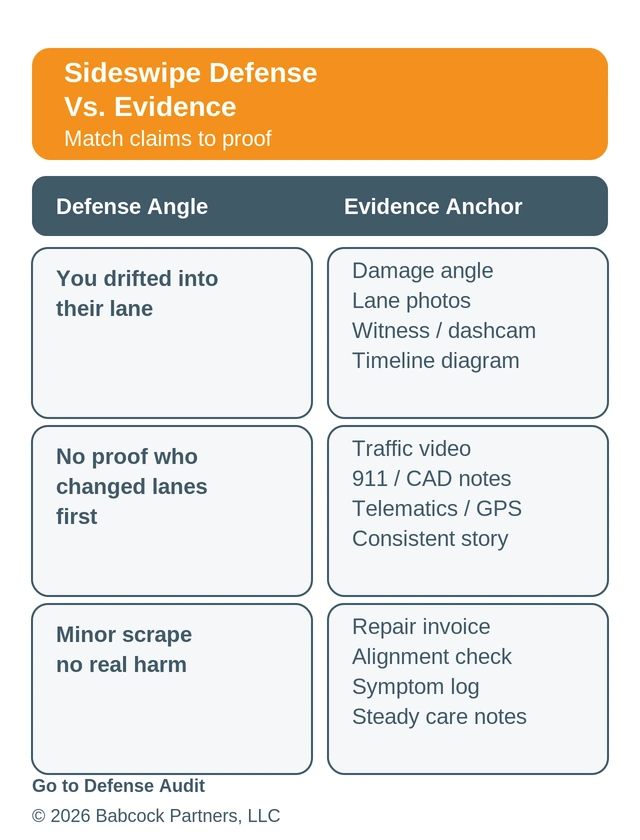
Insurance companies defend sideswipe cases by questioning who moved first, whether contact was “minor,” and whether you could have avoided it. You can reduce these arguments by pairing each defense angle with a specific document or data source.

Common Defense Narrative Evidence That Counters It
“You drifted into their lane.” Damage angle, paint transfer direction, wide scene photos, dashcam or witness confirmation
“No proof who changed lanes first.” Traffic video requests, 911/CAD timing, consistent timeline notes, telematics if available
“It was a minor scrape, so you weren’t hurt.” Repair documentation, symptom notes, consistent care records, work/activity limitation log
“You should have avoided it.” Roadway photos, traffic density notes, lane-drop signage, time and distance constraints

That is what we mean by leverage in an insurer fight: you answer the adjuster’s favorite stories with records, not opinions. When the evidence is organized early, the negotiation stays grounded in verifiable facts instead of blame language.

Common sideswipe defense narratives—and the documentation that closes the gaps.

What we see in practice

We see sideswipe cases become harder when people wait too long to lock down video, witness details, and repair documentation. We also see insurers push shared-fault arguments early because lane-change facts can feel ambiguous without a timeline.

  • Repairs happen quickly, and “before” photos disappear unless you capture them first.
  • Witnesses move on, and contact info gets lost unless you collect it at the scene.
  • Video gets overwritten on a routine cycle unless someone requests preservation.
  • Recorded statements can create contradictions when people guess instead of using a lane map.

When we build the proof around lane position, damage angle, and timing, the claim becomes easier to evaluate. We do not need drama to create urgency, because the evidence clock creates it on its own.

How a Lawyer Adds Value Without Slowing Your Recovery

A lawyer adds value in a sideswipe case by building a proof file while you focus on health and daily life. The goal is not to create conflict, but to prevent proof gaps that insurers later use to reduce value or deny fault.

  • Send targeted preservation requests for video, fleet data, and third-party records
  • Organize the lane timeline and label photos so they match the story
  • Spot comparative-fault arguments early and gather the documents that answer them
  • Track medical and work documentation so the record stays consistent

In a true “word vs. word” dispute, structure matters. If the other driver blames you, your file should still tell the same lane story across your photos, repair records, and treatment notes. This is why we build the timeline first and let it drive the rest of the claim.

If you want the checklists in one place, Download the printable toolkit (PDF) before you give any detailed recorded statement. It is designed to help you keep dates, documents, and evidence sources organized.

Louisiana Law Snapshot (Updated 2026)

The Louisiana Legislature’s text of La. Civ. Code art. 3493.1 sets a two-year delictual prescription for many injury claims, so you should calendar deadlines early. For crashes after January 1, 2026, the Louisiana Legislature’s text of La. Civ. Code art. 2323 includes a 51% bar, meaning you cannot recover if you are assigned 51% or more of the fault.

Rule What It Means in a Sideswipe Claim
Two-year prescription Talk to a lawyer quickly if injuries develop later or fault is disputed, because waiting can create deadline risk.
Comparative fault Expect “you should have avoided it” arguments; your timeline and photos should show why avoidance was not reasonable.
Evidence preservation Video and repair records often matter more than opinions, so request and save them early.

If you are unsure which deadlines apply to your situation, get advice tailored to your facts. Urgency is about evidence loss and legal timing, not about rushing into a decision.

Free Case Review: Protect the Evidence Before It Changes

If you were hit in a sideswipe accident, the fastest way to reduce blame disputes is to lock down video, photos, and repair records before they disappear. We are not built for volume. We are built for leverage.

In plain terms, the Babcock Benefit means we move early on evidence preservation and prepare the claim like it may need to stand up in court. Call (225) 500-5000 and use the free case review form to get guidance that fits your facts. If you are looking for case-process details, start here: talk with a Baton Rouge sideswipe accident attorney.

These items are helpful to have with you when you call, but do not delay calling because you do not have them. If you have them handy, keep them nearby for the call.

  • Photos of both vehicles and the roadway
  • Witness names and phone numbers
  • Police report number or exchange information
  • Tow and repair estimates (including supplements)
  • Your short lane diagram and a symptom/work-limits note

Call Today If Any of These Are True

  • Video may exist from a business, apartment complex, or traffic camera
  • A commercial or work vehicle was involved
  • The other driver is disputing the lane position or denying contact
  • Your vehicle may be repaired or totaled soon
  • You feel new symptoms, even if the crash felt minor

What Happens Next

  • We triage evidence sources and help you prioritize what to request first.
  • We spot deadlines and build a timeline that stays consistent across the claim.
  • We plan insurer communications to reduce recorded-statement traps and proof gaps.
×