

Good crash documentation is not a contest to collect the most paper. It is a way to preserve the few facts that may later become disputed: where the vehicles were, what damage was visible, who saw the collision, when symptoms began, what treatment was recommended, and what the crash cost.
Start with accuracy. Save original files, use dates, and write down what you actually know. If a fact is uncertain, say so rather than filling the gap with a guess.
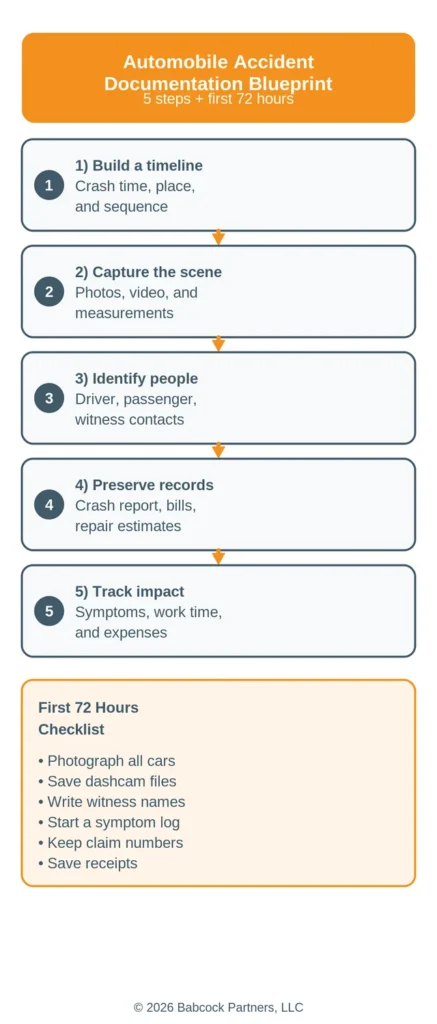
Build one working crash file
Create a folder for the claim, either on paper, electronically, or both. Inside it, separate the material into five groups:
- Crash: photographs, video, witness information, the report number, and the names of responding agencies.
- Medical: discharge instructions, appointment summaries, prescriptions, referrals, restrictions, and bills.
- Vehicle: towing and storage records, repair estimates, total-loss documents, rental charges, and photographs taken before repair or disposal.
- Work and expenses: missed-time records, wage information, mileage, replacement services, and out-of-pocket receipts.
- Insurance: policy information, claim numbers, adjuster contact details, letters, emails, offers, and notes from calls.
Use dates in filenames, such as 2026-09-27-front-passenger-damage.jpg. Keep original photographs and video untouched. If you crop or annotate a copy, keep the original file as well.
Our Baton Rouge car accident guide explains how liability, insurance coverage, medical proof, and damages fit together. The file you build should help answer those questions, not simply become a pile of unsorted documents.
Preserve the scene and vehicle evidence
If it is safe to take photographs, capture more than close-ups of a damaged bumper. Wide views can show the lanes, intersection, signs, traffic controls, sight lines, debris, skid marks, construction, weather, and final vehicle positions. Photograph every side of each vehicle and the interior areas where an occupant may have made contact.
Save the other driver’s name, contact and insurance information, license plate, and vehicle description. For a commercial vehicle, record the company name, unit number, license plate, and any visible USDOT number. Ask witnesses for direct contact information and make a short note identifying what each person says they observed.
Get the responding agency’s report or incident number. Our guide on obtaining a Louisiana crash report explains where state and local reports are commonly requested. A report is useful, but it does not replace the original photographs, recordings, and witness information.
NHTSA’s Special Crash Investigations materials illustrate why those sources matter. Investigators use scene evidence, vehicle damage, interviews, police reports, and medical records together when reconstructing a collision. No single item answers every question.
Create an accurate medical timeline
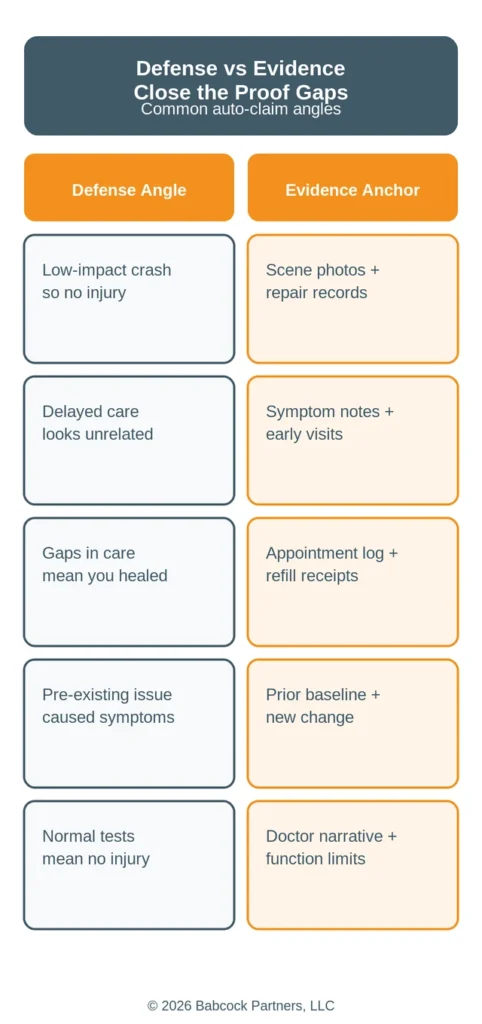
Medical records should reflect what you told the clinician, what the clinician found, and what was recommended. At an appointment, explain how the crash occurred, what symptoms you noticed, when they began, what makes them better or worse, and how they affect ordinary activity. Identify earlier problems involving the same body area rather than assuming they will remain unknown.
Keep a short dated symptom record between visits. Useful entries describe function: whether you could drive, sleep, lift, sit through work, care for a child, or complete prescribed exercises. Avoid exaggeration and avoid copying the same sentence every day.
The CDC notes that some concussion symptoms may appear or be noticed hours or days after an injury. Its current mild TBI and concussion guidance identifies emergency danger signs such as a worsening headache that does not go away, repeated vomiting, seizures, slurred speech, weakness or numbness, increasing confusion, or an inability to wake the person. Seek emergency care for those signs. For a broader discussion of symptoms that appear later, see our article on delayed pain after a Louisiana crash.
Do not use a claim diary to diagnose yourself. Medical conclusions should come from the treating professionals and appropriate testing.
Track expenses and missed work as they occur
Save bills even when health insurance paid part of them. Keep explanation-of-benefits documents separately from provider bills so the two are not confused. Record prescriptions, medical equipment, mileage to appointments, towing, storage, rental charges, and other crash-related costs.
If the injury affects work, keep the employer’s absence or restriction records, pay information, and communications about leave. A simple calendar showing the dates missed is more useful when supported by employer and medical records. Self-employed people may need invoices, tax records, appointment calendars, and evidence of work that could not be completed.
For a vehicle declared a total loss, keep the valuation report and the comparable vehicles used in the calculation. Check the mileage, trim, options, condition adjustments, and local comparables instead of looking only at the final number. Our article on reviewing a total-loss offer explains that process in more detail.
Keep insurance communications organized
Write down the insurer, claim number, adjuster’s name, date, and subject of every important contact. Save emails and letters. After a significant phone call, make a dated note of what was requested, what you provided, and what the adjuster said would happen next.
Be truthful, but do not guess about speed, distance, symptoms, or fault. Before giving the other driver’s insurer a recorded statement or signing a broad medical authorization, understand what is being requested and how it may be used. If your own insurer requests cooperation under the policy, do not ignore the request. Review the policy obligation and seek advice if the scope is unclear.
A settlement release can end the claim. Read it before signing, confirm which claims and parties it covers, and do not assume that an unresolved medical or property issue will remain open.
Identify evidence that can disappear
Some evidence is under your control. Other evidence belongs to a business, government agency, vehicle owner, or technology provider and may be overwritten or discarded under a routine retention policy. Depending on the crash, that can include:
- dash-camera or nearby surveillance video;
- vehicle event-data-recorder information;
- commercial driver logs, dispatch records, inspection reports, and electronic communications;
- rideshare or delivery-platform trip records;
- traffic-signal or roadway-maintenance records; and
- the damaged vehicle or a failed component.
Do not attempt to access another person’s private account or device. When material evidence is held by someone else, a properly directed preservation request may be necessary. The request should identify the event and evidence with enough precision to be useful.
Louisiana deadlines and fault rules
Louisiana Civil Code article 3493.1 provides a two-year prescriptive period for delictual actions and took effect July 1, 2024. The correct deadline can depend on the accident date, type of claim, defendant, and other facts. An older claim should not be evaluated by simply applying the current article.
Louisiana also allocates fault among the people who contributed to an injury. Under the version of Civil Code article 2323 effective January 1, 2026, a claimant assigned 51 percent or more of the negligence cannot recover damages. Below 51 percent, damages are reduced by the claimant’s percentage of negligence. Which version applies is claim-specific.
Documentation cannot change what happened, but it can make a later fault dispute less dependent on memory. Scene photographs, vehicle damage, independent witnesses, digital records, and a consistent timeline may each answer a different part of that dispute.
This article provides general legal and safety information, not medical or legal advice. Laws and deadlines can change, and outcomes depend on specific facts.
Last reviewed: September 26, 2026. Sources checked: September 27, 2026.
When the documentation problem needs legal help
Consider getting advice promptly when a commercial vehicle is involved, video or vehicle data may disappear, the insurer disputes fault, the injuries are serious, or someone has requested a recorded statement, broad authorization, or release. Call (225) 500-5000 or use the case-review form below. Bring whatever records you have, but do not delay the conversation merely because the file is incomplete.